
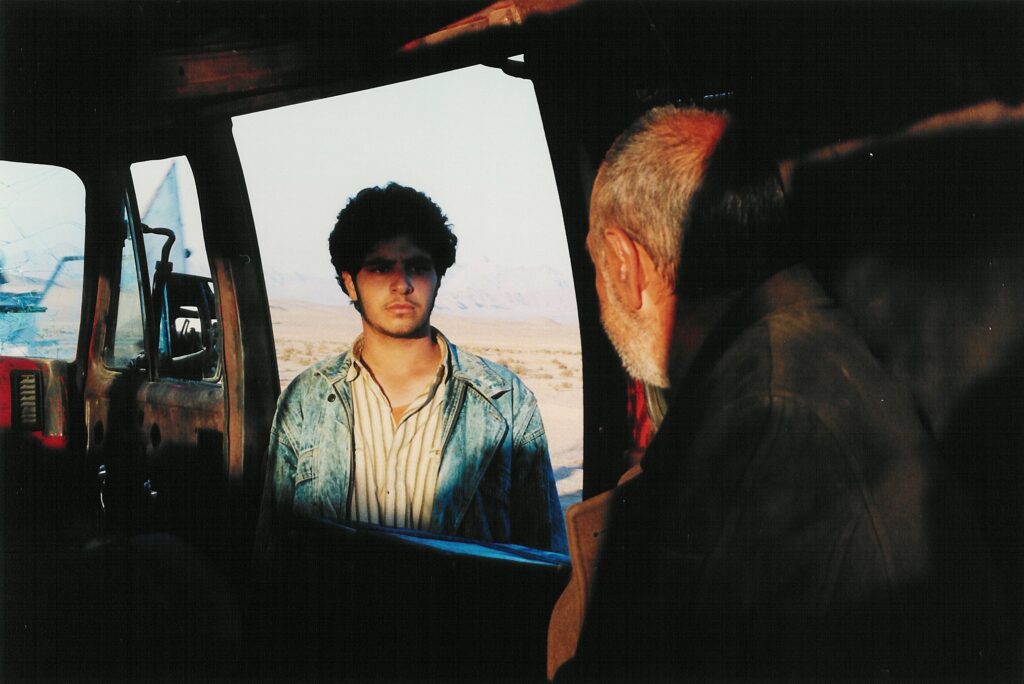
Asghar Farhadi, Iran’s most renowned living director, was actively interested in filmmaking from his teens, but at the University of Tehran, the admissions office instructed him to study theater instead, the subject in which he earned a bachelor’s and then a master’s degree. This apparent detour ultimately proved invaluable: as Farhadi reflected, studying the classic dramatists—Ibsen, Strindberg, and Chekhov—“opened up a whole new world for me” and profoundly shaped his understanding of storytelling. The future filmmaker also immersed himself in the theories of the Russian director Konstantin Stanislavsky and the plays of Harold Pinter. Regarding the latter, Farhadi observed, his “characters talk a lot, but it seems they talk to hide something. Everything is underneath”—which also very well describes a Farhadi film.
Today Farhadi’s first two feature films, Dancing in the Dust (2003) and Beautiful City (2004), are finally available in the United States (both on Blu-ray and via streaming)—an opportune moment to reflect on the auteur’s extraordinary body of work. His searing, searching, social dramas are all the more remarkable for having been produced under one of the most draconian (and punitive) censorship regimes in the world; the writer-director has navigated a tightrope that may finally be fraying under his feet.
In his mid-twenties, the future moviemaker got his start in television, writing and directing for several very popular series in Iran and then earning a sizable reputation for writing, producing, and directing sixty-plus episodes of A Tale of the City (2000-2001). An ambitious exercise in social realism, the series followed a group of (fictional) documentary filmmakers observing characters grappling with delicate issues, including immigration, poverty, drug abuse, and AIDS—topics which at times led the show to run afoul of the censors. As would be the case with his future film work, Farhadi’s goal with each episode was for the audience to be “left contemplating the show . . . after it ends,” which is “the main responsibility of any work of art.”
Farhadi entered cinema first as a writer, collaborating on the screenplay of Low Altitude (2002), a sophisticated hijacking drama directed by Ebrahim Hatamikia, then known for a series of well-received films that explored the domestic consequences of the Iran-Iraq war. (Hatamikia, increasingly associated with the ruling regime, subsequently became one of Farhadi’s more vocal critics.) Farhadi would go on to write a handful of screenplays for others, including Tambourine (2008), directed by his spouse, Parisa Bakhtavar, best known for her own work in Iranian television, and Trial on the Street (2009), collaborating with Masoud Kimiai, a prominent member of the “Iranian New Wave” that emerged in 1970.
With the success of his work on the small screen, Farhadi was able to secure financing for Dancing in the Dust and Beautiful City. Each features a strong turn by the highly regarded Faramarz Ghariban, and focuses on the travails of characters at the margins of society: Azeri migrants, impoverished youth, low-rent drug dealers, desperate women. After these early efforts, Farhadi would shift the focus of his attention more toward the middle class, always with a keen sensitivity to the class distinctions and tensions within Iranian society.
Dancing in the Dust boasts an intriguing setup: a young man resists pressure from his family to divorce his new wife due to suggestions that her mother is a sex worker. It has a strong finish, too, featuring wrenching choices made by two characters as they confront the challenges of financing a medical emergency. Nevertheless, it comes across as a first film, with an overlong and repetitive middle section (an anti-buddy road trip to nowhere that flirts with implausibility and lingers on the grating attributes of the less interesting traveler). Ticket sales were modest, but the best parts of the film were suggestive of an emerging talent, and it was well received by critics and at domestic and regional film festivals.
Beautiful City, in contrast, is little short of a revelation. This sophomore effort, coming swiftly on the heels of his debut, suddenly showcases what can only be described as fully formed Farhadi. The story develops slowly, with layers of complexity unearthed serially, presenting numerous characters with moral dilemmas for which the best choices are not obvious. A rumination on sacrifice and the possibility of forgiveness, the movie, involving a youthful convict coming of age and facing a looming death sentence, also hinges on steps taken by two female characters. And although one of them, played by Taraneh Alidoosti (who would collaborate with Farhadi in three subsequent films) makes a heartbreaking final choice, signified only by a gesture she makes with a cigarette, the story is open-ended. As Farhadi explained, the movie “couldn’t have a firm and definite conclusion”—often a wise approach for a thoughtful film, but also, one suspects, a choice that the director often reached for as a tactic to circumnavigate censorship.
Beautiful City won several accolades, including the grand prize at the Warsaw International Film Festival, and Farhadi would take another giant step forward with his next effort, Fireworks Wednesday (2006)—a flat-out masterpiece that achieves Cassavetes-like levels of intensity. A young woman (Alidoosti) is dispatched by an agency as a day-maid to a tension-filled household (the husband is suspected of having an affair; the evidence is ambiguous; neighbors and in-laws are implicated). The story sounds simple, but it is not. Once again revelations are serially uncovered, forcing the audience, repeatedly, to reassess all that has come before. This is the first hallmark of a Farhadi film, and defines the three bravura features that would follow, all dramas anchored by their complex female characters. The second is an active interrogation of that most slippery concept: Where does the truth lie? In Fireworks, as elsewhere, most of the characters engage in acts of deception. But would we, in their shoes, have behaved differently? Farhadi suggests not. “I believe that every character in my films has reasons for their wrongdoings,” he said in an interview with the New York Times, “and that if we gave them time they’d be able to explain those reasons to the rest of us.”
That sentiment shows the influence of the great Polish director Krzysztof Kieslowski, who insisted once that “knowing isn’t my profession. Not knowing is.” It is not surprising that in 2012 Farhadi listed Kieslowski’s Red as one of the ten greatest films of all time, along with Ingmar Bergman’s Persona and Akira Kurosawa’s Rashomon (less expected entries: Martin Scorsese’s Taxi Driver and Woody Allen’s Take the Money and Run). Years later Farhadi would describe himself as a filmmaker who “places a question mark” with his movies, for which he doesn’t have “definite answers.”
Fireworks Wednesday was a breakthrough, and a big box office hit in Iran. It also raised the question, “how does he do it?”—that is, make movies that press so hard against received social conventions. After all, film scripts in Iran must be submitted for approval to the Ministry of Culture and Islamic Guidance, and, even when completed, can (and often are) shelved by the censors. The answer is, increasingly, not easily. His next feature, About Elly (2009), a brilliant rumination on collective guilt and unspoken tensions within a group of friends on vacation at the Caspian Sea, earned Farhadi the Silver Bear for Best Director at the Berlin International Film Festival, but was held back for months in Iran before permission for local screenings was allowed.
Alidoosti plays the titular Elly, an outsider to the group, there, perhaps, to see if she is romantically compatible with one of the members of the party (ritualistically restrained by the role-playing imposed by local norms governing gender relations). Sepidah (Golshifteh Farahani, who was barred from returning to Iran in 2012), perhaps subconsciously influenced by troubles in her own marriage, is eager to play matchmaker, and in so doing also shields other members of the group from certain details of the backstory. Elly, it turns out, harbors her own secrets as well. Things become even more complicated when one character vanishes, L’Avventura style. Perhaps she has drowned, but perhaps not. Farhadi’s camera movement and impeccable orchestration of scenes is such that, as Amy Taubin lauded, “the web of evasions and lies becomes as compelling as in any great suspense movie.” More impressive still is the extent to which the actors utterly disappear into their roles, with performances so seemingly effortless and naturalistic that the audience becomes fully invested in another Farhadi trademark: that, as the director observes, “those who enter the story and then leave are not the same people they were at the beginning.”
Farhadi’s struggles with the Ministry of Culture would only increase, especially as the domestic political situation in Iran became increasingly charged. His next film, A Separation (2011), was initially banned after Farhadi told an interviewer that he hoped that several prominent filmmakers, including Jafar Panahi, would be allowed to resume their work in Iranian cinema. Panahi had been imprisoned for several months and was forbidden from traveling abroad after being photographed at the Montreal Film Festival wearing a green scarf, presumably a sign of support for Iran’s opposition Green Movement in the wake of the hotly contested and controversial presidential election in June 2009. The director was also barred from filmmaking for twenty years—though he has subsequently managed to direct five features surreptitiously, each smuggled out of the country. (Panahi was also arrested in July 2022 and held for six months after making inquiries about the detention of fellow filmmakers Mohammad Rasoulof and Mostafa Aleahmad.) The Ministry indicated that A Separation’s license could be restored if Farhadi renounced his comments. Under pressure to “say what I could to make sure the film went ahead,” he reportedly issued an apology, and the ban was lifted.
As the title suggests, A Separation is about the end of a marriage, and, more provocatively, a woman’s desire to emigrate from Iran, because, as she explains in court, “As a mother, I’d prefer my daughter not grow up in these circumstances.” But it is about much more than that, dwelling on the numerous divisions that riddle Iranian society: between the secular and the religious, between the middle class and the working class, and between individuals and often inscrutable institutions of authority—and all in the recognizable Farhadi house style, with head-turning revelations and an extraordinary even-handedness toward its characters. Both this film and Fireworks Wednesday show the influence of Abbas Kiarostami’s exceptional pre-revolutionary marital drama The Report (1977), but in A Separation, it can be hard to know who the film is rooting for. Indeed, Iranian audiences were divided over whom the movie sided with—Simin (Leila Hatami), Nader (Payman Maadi), or even Razieh, the domestic worker (Sareh Bayat). Western audiences this side of J. D. Vance will most naturally gravitate toward Simin, who is something of a feminist heroine, and perhaps for that reason Farhadi almost stacks the deck against her, leaving it impossible not to sympathize with Nader as he struggles to care for his father in advanced cognitive decline.
Of course, authoritarians will be obtuse, and a ceremony to honor the film—the first Iranian movie to win an Academy Award, and, adding to national pride, besting an Israeli film also nominated—was cancelled by the authorities. Appearing on state-run television, one critic closely associated with the government explained: “The image of our society that A Separation depicts is the dirty picture westerners are wishing for.”
The combination of global adulation and an increasingly hostile censorship environment likely contributed to Farhadi’s decision to shoot his next film, The Past (2013), in Europe. Once again, the nominal plot is simplicity itself: a man travels from Iran to France to formalize his divorce from his wife, who wishes to remarry. But heed the title, which refers to pivotal moments in the lives of each of the film’s characters. Also note the visual motif of transparencies, and how the film, with an all-too-uncommon deft, deploys children with sophistication and subtlety rather than sentimentality and mawkishness. Anchored by a performance by Bérénice Bejo that won her the Best Actress Award at Cannes, The Past is a rich, novelistic drama that is, simply put, one of the great films of this century. Punctuated by twists and turns and complex, fraught interpersonal relations, the themes of confession and apology emerge as the intricate tapestry of the narrative unfolds, featuring breathtaking, blindsiding disclosures that shift the burdens of responsibility from one participant to another. Nevertheless, Farhadi at the time insisted on the primacy of the story, rejecting attempts to adhere to a particular message. A theme-driven film attempts to “disseminate an absolute theory,” and in such an enterprise, “you shape all the people in the story and everything they do in a way to conform to your worldview, because you want to compel the audience to accept your opinion. This is in fundamental contradiction to the cinema I believe in.”
Farhadi returned to Iran to shoot The Salesman (2016), the film that most bears the imprint of his theatrical roots. The lives of a couple (Alidoosti and Shahab Hosseini) staging a local production of Arthur Miller’s Death of a Salesman are upended by a sudden act of violence and its emotional aftermath. In discussing the film, the writer-director is reliably on-brand: “When the audience comes out of The Salesman, they have the same question that I have: which character was doing the right thing?” What distinguishes this finely crafted film, which boasts an exceptional last act, is Farhadi’s deep appreciation of Miller, whom he compares to the esteemed dissident Iranian writer Gholam-Hossein Saedi (they “share very similar thoughts and beliefs”), and the affinities he sees between themes of Miller’s definitive postwar American drama and aspects of a rapidly modernizing Iranian society. Among its numerous global accolades, The Salesman netted Farhadi’s second Academy Award for Best International Feature—but he (and Alidoosti) boycotted the 2017 ceremony “out of respect for the people of my country” and others affected by then-president Trump’s executive order restricting entry into the United States by citizens of various Muslim-majority countries. (Standing with the people was not the same thing as standing with the regime—five years later, Alidoosti would be arrested for an Instagram post critical of the Iranian government.)
Everybody Knows (2018), shot in Spain and starring Penélope Cruz and Javier Bardem, is two-thirds of a great movie. Structured similarly to About Elly, a large cast of characters (essential Farhadi collaborator and regular editor Hayedeh Safiyari had her hands full here), each with their secrets and lies, are welcomed on screen in a celebratory mode until the unexpected intercedes. Everybody Knows also pushes smartly, if more overtly, on the theme of class contempt. Ultimately, however, and in contrast to his more enigmatic dramas, in the end everybody does know, as the movie hurtles toward a conclusion in which everything is explained. As Farhadi acknowledged, there is less “concealing, hiding, and ambiguity” in this drama; paradoxically, liberated from censorship, it may be that the director was free to be too literal.
Farhadi would return home for his next feature, A Hero (2021). It is a very fine film, beautifully shot and seamlessly executed, with sharp dialogue, crisp pacing, and strong, humanistic performances. A Hero also has things to say, artfully reflecting the pathologies of social media and the clumsy rigidity of official institutions, qualities for which the movie was recognized with the Grand Prix at Cannes. Nevertheless, although sure-handed and certainly worth seeing, A Hero does not soar to the heights of the director’s best work, with its plot twists, for the first time since Dancing in the Dust, depending on key choices of questionable plausibility and featuring fewer layers of eye-opening revelations.
Events surrounding the pre-production and subsequent reception of A Hero suggested that Farhadi’s aspiration to work within the system had finally reached its limit. In 2019 Farhadi was among those in the filmmaking community who, in a show of solidarity, accompanied director Mohammad Rasoulof to court as he appealed his conviction for creating “propaganda against the system” with his film A Man of Integrity. This was not Rasoulof’s first brush with the law; his Manuscripts Don’t Burn (2013), shot three years after he was arrested for “acting against national security,” was so incendiary it withheld all credits to protect its cast and crew. In May 2024 Rasoulof faced even more severe harassment, sentenced to an eight-year prison term (and an attendant flogging); fortunately, he was spirited out of the country and resurfaced at Cannes for a triumphant screening of his most recent movie, The Seed of the Sacred Fig.
In this environment, Farhadi, once a source of national pride for his high-profile global achievements, was increasingly castigated for his lack of political commitment. When rumors spread that A Hero failed to take up the mantle of protest against the regime, many Iranians flooded the internet with negative reviews for the yet-to-be-released feature, to the extent that the Internet Movie Database (IMDb) temporarily disabled its ratings function for the film. With his history of relative silence and occasional equivocations (protestations followed by reticent retractions) now seen less as a survival tactic and more an implicit endorsement of the government, Farhadi was ultimately forced to choose sides. In an interview with Le Monde in 2024, Farhadi announced that although he hoped to be able to continue to live in his homeland, he would no longer make films there. Over forty years of censorship, he reflected, Iranian artists have found “modes of expression to circumvent” the heavy hand of oppression, but, finally, as the authorities have become ever more intolerant, he found he could “no longer continue to work in the same conditions.” Sometimes, inescapably, the political is political.
The sharpest expression of those views can be found in a lengthy Instagram post from three years earlier in November 2021, in which he denounced officials who “deceitfully” associated him “with a state whose extremist media has spared no effort to destroy, marginalize and stigmatize me,” and a government about which his views regarding “the suffering it has caused over the years” could not be more clear. In sum, he concluded, “I detest you!”
Independent and nonprofit, Boston Review relies on reader funding. To support work like this, please donate here.