
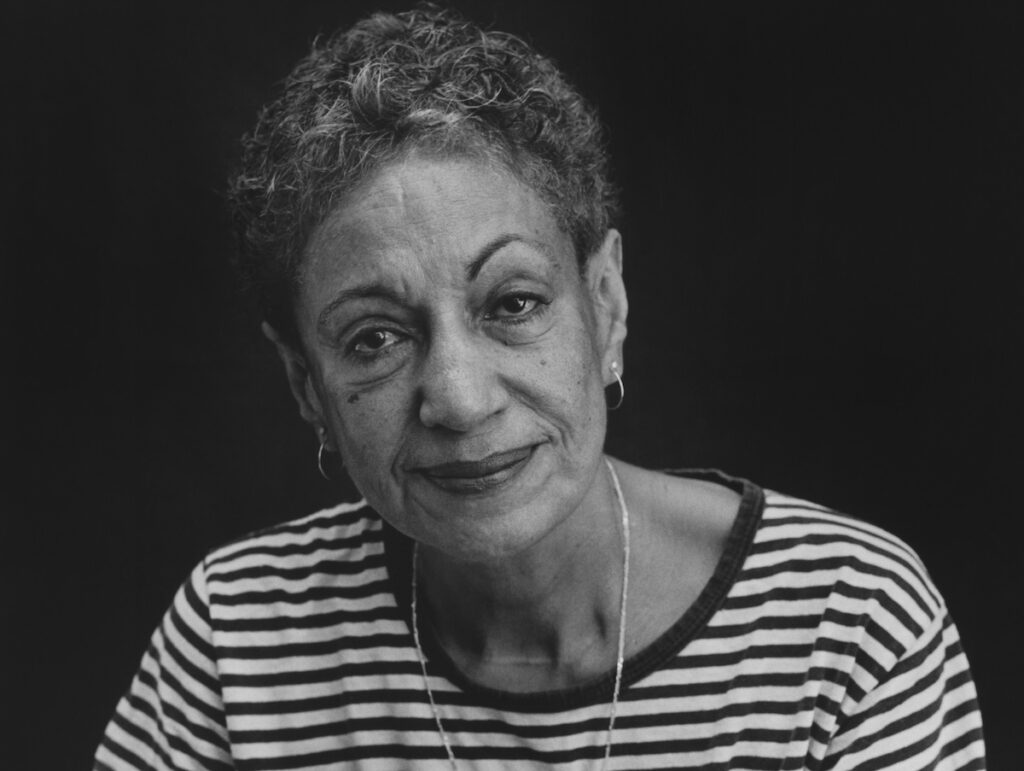
June Jordan’s work embraced a half century in which she dwelt as poet, intellectual, and activist—also as teacher, observer, and recorder. In a sense unusual among 20th-century poets of the United States, she believed in and lived the urgency of the word—along with action—to resist abuses of power and violations of dignity in and beyond her society.
To read Jordan today is to read her in a time when reflections of human solidarity, trust, compassion, and respect are in danger of disappearing from our public landscape; when what glares out from public discourse is division—not the great racial and class divides that have afflicted us since colonization, but oppositions marked as “cultural”: modernity vs. regression,fundamentalist faith vs. secular reason. Without denying our cruel separations, Jordan went for human commonality, the opportunities for beholding and being seen by one another. One of her early poems,“Who Look at Me,” was originally written for a book of images of black Americans by white and black visual artists:
see me brown girl throat
that throbs from servitudesee me hearing fragile leap
and lead a black boy
reckless to succeed
to wrap my pride
around tomorrow and to go
there
without fearingsee me darkly covered ribs
around my heart across my skull
thin skin protects the part
that dulls from longing
Jordan took the world as her field and theme and passion. She studied it, argued with it, went forth to meet it in every way she knew. Along with poems,she wrote children’s fiction, speeches, political journalism, musical plays, an opera libretto, and a memoir. But poetry stood at the core of her sensibility. Her teaching began in the 1960s with the founding of a poetry program for black and Puerto Rican youth in Brooklyn called The Voice of the Children; in her late years she created “Poetry for the People,” a course in the writing and teaching of poetry for students at the University of California, Berkeley. She saw poetry as integrated with everything else she did—journalism, theater work, activism, friendship. Poetry, for her, was no pavilion in a garden, nor was it simply testimony to her inner life.
She believed, and nourished the belief, that genuine, up-from-the-bottom revolution must include art, laughter, sensual pleasure, and the widest possible human referentiality. She wrote from her experience in a woman’s body and a dark skin, though never solely “as” or “for.” Sharply critical of nationalism,separatism, chauvinism of all kinds, as tendencies toward narrowness and isolation, she was too aware of democracy’s failures to let herself embrace false integrations. Her poetic sensibility was kindred to Blake’s scrutiny of innocence and experience; to Whitman’s vision of sexual and social breadth; to Gwendolyn Brooks’s and Romare Bearden’s portrayals of ordinary black people’s lives; to James Baldwin’s expression of the bitter contradictions within the republic.
Keeping vibrations of hope on the pulse through dispiriting times was part of the task she set herself. She wanted her readers, listeners, and students to feel their own latent power—of the word, of the deed, of their own beauty and intrinsic value; she wanted each of us to understand how isolation can leave us defenseless and paralyzed. She knew, and wrote about, the power of violence, of hate, but her real theme, which infused her style, was the need, the impulse, for relation. Her writing was above all dialogic:
reaching for you
whoever you are
and are you ready? . . .I am a stranger
learning to worship the strangers
around mewhoever you are
whoever I may become.[“Things That I Do in the Dark”]
She was a most personal of political poets.Her poems could be cajoling and vituperative, making love and warsimultaneously, her sensual lyrics cohabiting with performance pieces. Yet there’s a June Jordan persona throughout, “directed by desire,” moving between longings for a physical person and for a wider human solidarity, vocalizing a range from seductive to hortatory, accusing illegitimate authority along with the recalcitrance of unavailable lovers.
She once defined poems as “voiceprints of language,” and she devised her own with passion, finesse, and a compressed, individual style. They arc back and forth between manifestos and love lyrics, jazz poetry and sonnets, reportage (“when the witness takes a stand”) and murmured lust, “spoken word” and meditative solos, with mood shifts and image juxtapositions to match:
Snow knuckles melted to pearls
of black water
Face like a landslide of stars
in the darkIcicles plunging to waken the grave
Tree berries purple and bitten
by birdsCurves of horizon squeeze on the sky
Telephone wires glide
down the moonOutlines of space later
pieces of land
with names like Beirut
where the game is to tear
up the whole Hemisphereinto pieces of children
and patches of sandAsleep on a pillow the two
of us whisper we know
about apples and hot bread
and honeyHunting for safety and eager for peace
we follow the leaders who chew up
the land
with names like Beirut
where the game is to tear
up the whole Hemisphere
into pieces of children
and patches of sandI’m standing in place
I’m holding your hand
and pieces of children
on patches of sand[“March Song”]
Here she breaks what is actually a metrically regular dactylic line so that the beat is undermined and countered by the line breaks: a subtle disorienting of form and expectation.
Her flexible, swift mind was tuned to what John Edgar Wideman has called “the continuum of language”: intimate lyricism, frontal rhetoric, elegance, fury, meditative solos, dazzling vernacular riffs. These are poems full of specificity—people and places, facts, grocery lists, imaginary scenarios of social change, anecdotes, talk—that June Jordan voice, compelling, blandishing, outraged and outrageous, tender, relentless, urgent with the trust that her words matter, that someone is listening and ready for them.
She knew many poetries, ancient and modern; her sonnets, for example, are both silken and surprising:
Supposing we could just go on as two
voracious in the days apart as well as
when
we side by side (the many ways we do
that) well! I could consider then
perfection possible, or else worthwhile
to think about.Which is to say
I guess the costs of long term tend to
pile
up, block and complicate, erase away
the accidental, temporary,near
thing/pulsebeat promises one makes
because the chance, the easy new, is
there
in front of you. But still, perfection takes
some sacrifice of falling stars for rare.
And there arestars, but none of you, to
spare.[“Sunflower Sonnet Number Two”]
But in her preface to the collection Passion, she matched herself consciously with the tradition of “New World poetry”: non-European, deriving in North America from Whitman, and including Pablo Neruda, Agostinho Neto, Gabriela Mistral, Langston Hughes, Margaret Walker, and Edward Brathwaite:
In the poetry of the New World, you meet with a reverence for the material world that begins with a reverence for human life,an intellectual trust in sensuality as a means of knowledge and of unity, an easily deciphered system of reference, aspiration to a believable, collective voice and, consequently, emphatic preference for broadly accessible language and/or “spoken” use of language,a structure of forward energies that interconnects apparently discrete or even conflictual elements, saturation by quotidian data,and a deliberate balancing of perception with vision: a balancing of sensory report with moral exhortation.
Reading through Jordan’s work, we find her restless in movement, writing always for the voice: sometimes for the intimate interior room, sometimes more for declamation. Some of her long declamatory poems, specific to certain moments or written for public occasions, don’t survive on the page absent the vibrancy of her live breath and bodily presence. Others do, and will, as “I Must Become a Menace to My Enemies”:
And if I
ever let love go
because the hatred and the whisperings
become a phantom dictate I o-
bey in lieu of impulse and realities
(the blossoming flamingos of my
wild mimosa trees)
then let love freeze me
out
Some of her brief message-poems for friends can seem tenuous and transitory. Others are firmly chiseled epigrams:
There is no chance that we will fall apart
There is no chance
There are no parts.[“Poem Number Two on Bell’s Theorem”]
In the last years of her life, often in great pain from metastasized cancer, surgery, and chemotherapy, her wit and fury enabled her to go on writing poems of love and polemics,sometimes in delicately caressing language, sometimes grimly or hilariously resistant to diminishment, as in “Racial Profile #2”or the exuberantly scathing rap “Owed to Eminem.”
And she continued, too, as in “Poem of Commitment,” to bring together the “conflictual elements” of outraged witness and lyrical beauty:
Because cowards attack
by committee
and others kill with bullets
while some numb by numbers
bleeding the body and the language
of a child . . . Who would behold the colorings of a cloud
and legislate its shadows
legislate its shine?
Or confront a cataract of rain
and seek to interdict its speed
and suffocate its sound?
Or disappear the trees behind a nomenclature
no one knows by heart?
Or count the syllables that invoke
the mother of my tongue?
Or say the game goes the way of the wind And the wind blows the way
of the ones who make
and break
the rules? . . .because
because
because as far as I can tell
less than a thousand children playing
in the garden of a thousand flowers
means the broken neck
of birdsI commit my body and my language . . .
And throughout her ardent, abbreviated life, she did.