“I don’t like neutrality,” Marcel Ophuls wrote in his autobiography, Memoirs of a Father’s Son. “You can vote Green, Red, Pink, or Black. But never White. It’s in the life of nations, like in the life of people, sooner or later. You always have to take sides for someone or something.”
For five decades, Ophuls, who died in May, made documentaries exploring the twentieth century’s great crimes and the trail of guilt they left behind. He is mostly known for The Sorrow and the Pity (1969), a daring study of France under German occupation in World War II, which in this country has taken on the status of a worthy classic like Citizen Kane: admired but not much watched. His other films are in danger of being forgotten in the United States, but the occasion of his death is a good reason to change that. They still live, both because the moral questions he poses are timeless and because his skill as a filmmaker allows him to conduct these investigations with great verve. And since they address the sources of political evil, and the compromises individuals allow themselves to make when their government does wrong, watching them today can’t help but generate a shudder of recognition.
Every scene of The Sorrow and the Pity is a kind of thumb in the eye to the collective myth of valiant and widespread resistance that France accepted after the war.
Ophuls was the son of the great German Jewish director Max Ophuls, who made classic films in Germany, France, and the United States. The family was doubly exiled as they fled the Nazis, first in 1933 to Paris, where six-year-old Marcel played in the Bois de Boulogne, then after the German invasion in 1940 to Los Angeles, where they played badminton in their yard in Vista del Mar and Max looked for work. Marcel returned to France with his parents in 1950 and pursued a career as a director of comedies. He made one modest success, Banana Peel (1963), with Jean-Paul Belmondo, and one flop, Fire at Will (1965), which ended his career in fiction films. To make a living, he took a job at the government-run French TV channel ORTF. After a few shorter films, he was commissioned in 1967 to make the film that would make him famous.
Made on a small budget, The Sorrow and the Pity was enormously controversial in France. Even more than fifty years later, it’s not hard to see why. Swiftly, with only the most minimal narration, the film tells the story of France’s war as a series of clumsy failures and shameful compromises. One interview subject after another recalls details that seem selected to damage national self-esteem. Pierre Mendès-France, former French prime minister, explains that many military men and civilians entered the war without enthusiasm because they shared “the attitude of preferring Hitler to Léon Blum’” (a left-wing Jewish politician). Sir Edward Spears, wartime liaison between Winston Churchill and Charles de Gaulle, recounts his attempts in 1940 to persuade the 15,000 French sailors then in England to help with the war by digging trenches. “They refused,” he says. “They said: ‘France is out of the war, we no longer have the right to dig trenches.’”
Focusing on the industrial city of Clermont-Ferrand, Ophuls interviews people from every political stripe and level of society, from an aristocrat who volunteered for the Waffen SS to a shopkeeper named Klein who in 1941 took out a newspaper ad to make clear to potential customers that despite his name, he was not Jewish. Even the Maquis members he talks to—filmed in their cellar pouring wine out of the barrel, just as brave and rustic as you could possibly wish—explain that after a certain point the Resistance was mostly taken over by Communists, who were in turn opposed by French conservatives as sectarian politics reared its head again even before France was liberated.
Every scene of The Sorrow and the Pity is a kind of thumb in the eye to the collective myth of valiant and widespread resistance that the country accepted after the war. French television wouldn’t air the film for twelve years. Ophuls, who enjoyed provocation, was not sorry that his documentary caused a scandal, but although it inspired so much fury in the Gaullist mainstream, it is not really the work of a provocateur, much less a fiery leftist. It’s too accomplished, first of all—the pacing expert, the arguments subtle—and also too sincere. The film exposes hypocrisy but features actual heroes. These even include politicians. Mendès-France, who was tried and imprisoned on a trumped-up charge of desertion, speaks movingly about his rigged trial before jurors with faces “filled with hate.” Filmed in his office, the longtime politician is impressive: intelligent, candid, speaking without bitterness and without trying to score political points. The viewer can’t help admiring him, along with the former Resistance fighters, who talk about their courageous acts with humility. Although The Sorrow and the Pity contains much irony and even acid, these are employed in the service of a kind of old-fashioned moralism.
This would be Ophuls’s method in all his subsequent films. He uses all his powers of irony and wit to expose the people and institutions who don’t meet his high moral standard. No one is spared, but especially not the smug, the established, the self-righteous.
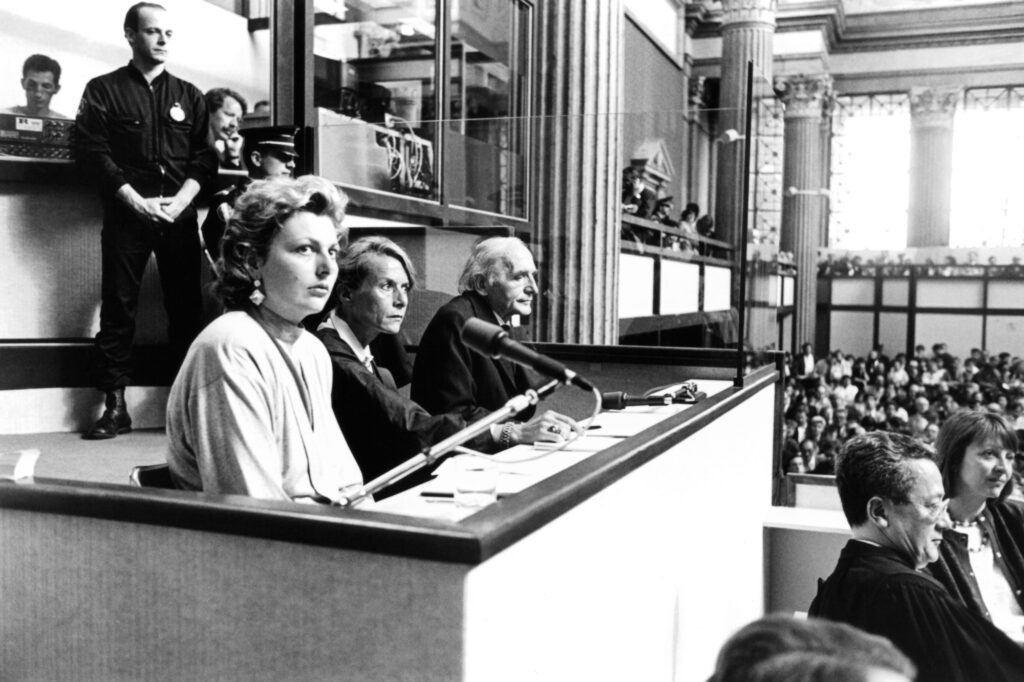
In Hotel Terminus (1988), the other of Ophuls’s films to be widely distributed in the United States, he follows the career of Klaus Barbie, the head of the Gestapo in occupied France, known as “the butcher of Lyon.” Barbie was a monster, but the movie is less about his war crimes than the trail of slime he left behind—the sheer number of people and institutions Barbie came into contact with who accepted his invitation to corruption. Ophuls begins with the Lyon establishment, which kowtowed to Barbie during the war and afterwards was content to make one minor traitor named René Hardy the scapegoat for the entire system of cooperation with the Gestapo. He continues to Germany, where the American occupation forces were happy to hire Barbie and his Nazi friends to spy on the Soviets and eventually to help him escape to Bolivia (with the help of the Catholic church). The Bolivian dictatorship in its turn wasted no time in employing Barbie for his skills in state repression.
The film is a merry-go-round of moral turpitude, almost comic in the variety of colorful villainy on display. Not actually comic, of course, because Ophuls gives plenty of time to the Resistance members Barbie executed and the Jews he deported. As always in Ophuls’s films, partisans and Holocaust victims recount torture and bravery in a terrible, matter-of-fact way. “Had I found a way, I might have killed myself,” recounts a bespectacled man in jacket and tie, who as a Resistance member was tortured by Barbie for weeks in his headquarters, the hotel of the film’s title. One Jewish woman, Simone Lagrange, revisits her old house in Lyon and recalls how, when she and her family were arrested en route to deportation to Auschwitz, one neighbor named Madame Bontout tried to rescue her from the SS by pulling her inside her apartment quietly as she passed. She was caught and got a slap for her trouble. All the other neighbors kept their doors closed. “This motion picture is dedicated to the late Madame Bontout,” a voiceover concludes, “a good neighbor.” Some people do meet Ophuls’s moral standard. Indeed, it does not take much. The tragedy is how rare they are.
Ophuls got an Oscar in 1989 for Hotel Terminus. An earlier movie about Nazis on trial had won him less affection. The Memory of Justice, released in 1976, uses archival footage of the Nuremberg trials and extensive interviews with their participants to tell the story of the prosecution of the top Nazis remaining alive after the war. The interviews, with everyone from Karl Dönitz to survivors of the Ravensbrück concentration camp, are as penetrating as any in Ophuls’s other films, and if he had confined the movie to World War II, it probably would have been a success. He didn’t, though: the second half of the film is an examination of French war crimes in Algeria and American war crimes in Vietnam, posing the question of how the Nuremberg prosecutors would have judged the conduct of soldiers and leaders in these wars.
The film was a flop and went virtually unseen. In 1989, a reminder that the CIA used Nazis against the Soviets was acceptable; in 1976, the suggestion that there could be any comparison between what America did in Vietnam and what the Nazis did in World War II was not. Pauline Kael, who had praised The Sorrow and the Pity, said the film “serves to domesticate evil.” In the New York Review of Books, Harold Rosenberg condemned it for its “commiseration for the Nazis,” which he called “intellectually degrading and morally degenerate.” (Ophuls replied with a wrathful letter calling Rosenberg a bigot for whom hatred was “a security blanket.”) Hannah Arendt had come in for similar criticism for her reporting on the trial of Adolf Eichmann. His crimes had nothing of “banality” about them, it was said: they were evil and exceptional, demanding fervent condemnation rather than cool analysis.
Join our newsletter
New pieces, archive selections, and more straight to your inbox
Revisited today, the criticism of Ophuls appears unfair. The film does not coddle Nazis, nor does it draw an equivalence between Vietnam and Auschwitz. Rather, Ophuls draws attention to American war crimes to limit the righteousness allowed those rendering judgment. The title of the film refers to Plato’s idea that there exists an original, ideal form of Justice of which human beings retain only some imperfect memory. Ophuls’s approximation of this ideal is simply the now-battered principle of international law, which, as Ophuls put it, could be “a practical alternative to the revenge of the clan and to racist bloodbaths.” One of the heroes of the film is Telford Taylor, the straight-arrow Army lawyer for the prosecution who later wrote a book examining U.S. conduct in Vietnam in light of the principles established at Nuremberg. Fifty years later, Pete Hegseth promises an “overhaul” of the Judge Advocate General’s Corps of lawyers to relax nettlesome “rules of engagement” and “untie the hands of our warfighters.”
Ophuls maintained The Memory of Justice was his best film. It is longer than it should be—close to five hours—but still consistently exciting thanks to its enormous range of interview subjects. American war resisters and patriotic war widows, prosperous Nazi defense lawyers and former slave laborers are all quizzed in Ophuls’s gentlemanly style. Ophuls claimed to believe in a certain ideal of justice when it came to his interviews as well. “When a filmmaker tries to pin someone against the wall,” he told the French weekly Télérama in 2012, “the audience feels it, and their sympathy passes very quickly from the filmmaker to his victim. . . . I prefer that there be a moral contract between the person in front of the camera and the person behind the camera.” And indeed, Ophuls the interviewer has a kind of old-world cordiality, just as polite when talking to a famous politician as a local bigot. This is especially striking when he talks to Nazis, in particular his interview with Admiral Dönitz.
“Don’t you think,” Ophuls asks, “there is some connection between the existence of extermination camps and a speech in which you talk about ‘the corrosive poison of the Jewish race’?”
Ophuls’s voice is raised so the old man can hear, but his tone is almost gentle.
“Is there no connection? Don’t you see one?”
“No!” barks Dönitz, mouth quivering. No further interrogation is really necessary, although the feeble excuses Dönitz proceeds to offer only make him look guiltier.
In contrast to Dönitz’s brittle defensiveness, Nazi architect and logistics chief Albert Speer appears thoughtful, composed, and rather mysterious. In his autobiography, Ophuls refers to Speer as “a major war criminal and charming man,” and their long conversations in Speer’s home are relaxed and even friendly. Ophuls was obviously susceptible to charm, and this is one of the reasons his movies—three-, four-, and five-hour epics on the most serious subjects imaginable—are so enjoyable to watch and even to rewatch. What the viewer remembers of Mendès-France in The Sorrow and the Pity, just as much as his sorrowful recollections of his persecution and imprisonment, may be the picturesquely Parisian twist to his story of escape from prison. Perched at his window late at night and ready to jump to freedom, he heard voices below: it was a couple on a bench in the middle of an attempted seduction. “She ended up saying yes,” Mendès-France says with a smile, later adding, “let me assure you that I was even happier than he was. I’d really like to meet him someday and let him know how much I experienced with the two of them that night.”
Ophuls had a knack for allowing subjects to appear as perfect specimens of their type. Taylor, the Army lawyer, appears both noble and the slightest bit comic, a man so upright and sincere that even his amateur orchestral compositions, which he plays on camera at Ophuls’s request, sound like military music. And Anthony Eden shines as the archetypal British aristocrat, who speaks an unforgettable French: grammatically correct but without the slightest attempt at a French accent, pronouncing every word as though it were posh English (“Wee. Say sah.”). Ophuls cuts effortlessly between celebrities like these and ordinary people of every description and social role. Of one such subject, Ophuls writes in his memoir that “his guilty conscience was extremely photogenic”—all his subjects are clearly chosen as much for their cinematic as their sociological value. On screen, his shopkeepers and pool players and Nazi sympathizers command the viewer’s attention like movie stars. I think of the suspiciously forgetful retired CIA agent in Hotel Terminus, filmed in front of his Christmas tree, or the swinish ex-Wehrmacht officer in The Sorrow and the Pity, radiating self-satisfaction, his gold tooth glinting.
The university presidents and law partners hurrying to cooperate with Trump: What would they say under Ophuls’s questioning? What evasions would they make, how would they explain themselves?
Charm aside, it’s hard to watch Ophuls’s films today without thinking of the slow catastrophe of our current politics. The United States is not France in the ’40s, but as Trump sends National Guardsmen into city after city, the specter of occupation, a war on nebulous enemies “within,” looms. Viewing The Sorrow and the Pity now, one gets a chill when a man recalls how, once the occupation began, he began thinking differently of his neighbors. “We didn’t know what the butcher thought, or the milkman, or the engineer, or the intellectual. . . . Like everyone else, we stayed on our guard.” Another man, a high school teacher, when asked about a Jewish colleague who was fired under the new racial laws, responds feebly that “I think we tried, to the best of our ability, to get these people some work tutoring.” The university presidents, law partners, and media executives now hurrying to cooperate with Trump: What would they say under Ophuls’s courteous, insistent questioning? What evasions would they make, how would they explain themselves? Ophuls was a student of human frailty as much as of fascism, and his films remind us that under pressure from authoritarian regimes, most people make whatever compromises are necessary and then justify their behavior afterward. Courage, in his films, is real but rare. Most of Simone Lagrange’s neighbors didn’t open their doors.
The most unsettling thing about watching Ophuls’s movies today, though, might be seeing how different the world they depict looks from ours. This is true even of his later films. In The Troubles We’ve Seen (1994), Ophuls goes to Sarajevo under siege and makes a film about “the aristocrats of our profession,” the war correspondents. These range from pathologically brave photographers and reporters who’ve been shot at (or shot) in a dozen wars to TV anchors who fly in for twenty-four hours so that they can be filmed making a report in front of a bombed-out building. On display are courage, ego, posturing, vanity, humility, cliques, and status hierarchies, along with the uncomfortable truth, admitted by the best of these journalists, that running around war zones is the most fun they’ve ever had in their lives. Ophuls, like all the war reporters he talks with, is on the side of the besieged Bosnians and against the besieging Serbs. But the villain of the movie is the French media establishment, which, to maintain its comfortable neutrality, allows itself to be manipulated by Serb propaganda into presenting the war as an ancient ethnic conflict with violence on both sides. The film is not Ophuls’s best—it’s a little self-indulgent and goes too deeply into French media debates—but it’s a fascinating subject, and he squeezes a good deal out of it, once again exposing the shallowness of the bien-pensant elite. But The Troubles We’ve Seen is impossible to watch today without thinking of Gaza. Here there are no foreign journalists allowed, neither vain news anchors nor courageous freelancers. The job of reporting is done by Palestinian journalists, who are killed by the hundreds, often deliberately massacred. What place would there be for Ophuls’s skeptical eye?
One also thinks of Gaza because Israel was the subject of Ophuls’s last, unfinished film, Unpleasant Truths, which he began working on a decade ago. With Eyal Sivan, a dissident Israeli filmmaker living in Paris, Ophuls went to Israel with the idea that Jerusalem would play the same role as Clermont-Ferrand in The Sorrow and the Pity. Ophuls, age eighty-six, hits the streets and speaks to French fascists, Palestinian intellectuals, Israeli peace activists and settlers, and many others. This was 2014, in the middle of the Gaza war going on at that time. (Ophuls intended to go to Gaza as well, but this proved impossible.) The film was never released, but the excerpts available online show Ophuls in fine form. In one scene, he sits down with Avraham Burg, a left-wing Israeli politician, former speaker of the Knesset, and interim president for a short period in 2000. “Was it such a good idea, Mr. President,” Ophuls asks, “to bring Zionism into a country which was basically a desert, and surrounded by enemies?”
“I’m sorry,” Burg replies without hesitating, “but it’s a stupid question. So, what, you take eight million people and you copy-paste them to Normandy? It happened.”
Ophuls, crouched across the table from Burg, smiles with delight at this perfect Israeli bluntness. It’s a great exchange, a fragment of the kind of conversation Ophuls excelled at on film, a conversation between equals, between intellectuals, between men of the world. But in the case of Gaza, this sort of conversation has been blasted into irrelevance by events. Ophuls’s frank anti-Zionism, cheeky and bracing at the time, has been shouted in slogans for years, and voicing it in the United States has in the past nine months been grounds to be hauled off and deported. One has to ask: in 2025, when Israel has razed over half of Gaza to the ground and its prime minister makes speeches exhorting his country to become a “super-Sparta,” what use is irony, drollery, subtle argument? The hypocrisy of leaders like Trump and Netanyahu is so grotesque that it hardly takes an Ophuls to expose it.
Ophuls’s intellectualism, his wryness and urbanity, his discerning moral sense—these may have been useful when criticizing a liberal establishment that did not live up to its own ideals. One naturally wonders how useful they are when confronting anti-liberal forces with bad ideals, or none. Ophuls made films at a time when he could count on his viewers’ attention span and the existence of a self-confident liberal establishment, firmly in command and practically begging to be exposed for its hypocrisy. Both are in decline, and the forces that drove Ophuls and his family out of Europe are on the rise again.
The tension between liberal ideals and illiberal instincts animates The Memory of Justice, the film Ophuls called his most personal. On one side, the idea, voiced ruefully by British lawyer for the prosecution Hartley Shawcross, that “all law is created by the victors.” On the other, the Nuremberg principle: the ideal of international law and individual accountability. That ideal—always fragile, always vulnerable to the charge of hypocrisy—is nowadays eclipsed more and more by cynicism and the politics of revenge. This makes viewing Ophuls’s films today even more powerful. For all their sophistication, their cast of international villains and heroes, they are perhaps most worth watching for their idealism—reminding us, in a time when cynics are on the ascent, how the case for decency can be made with subtlety and even style.
Independent and nonprofit, Boston Review relies on reader funding. To support work like this, please donate here.