
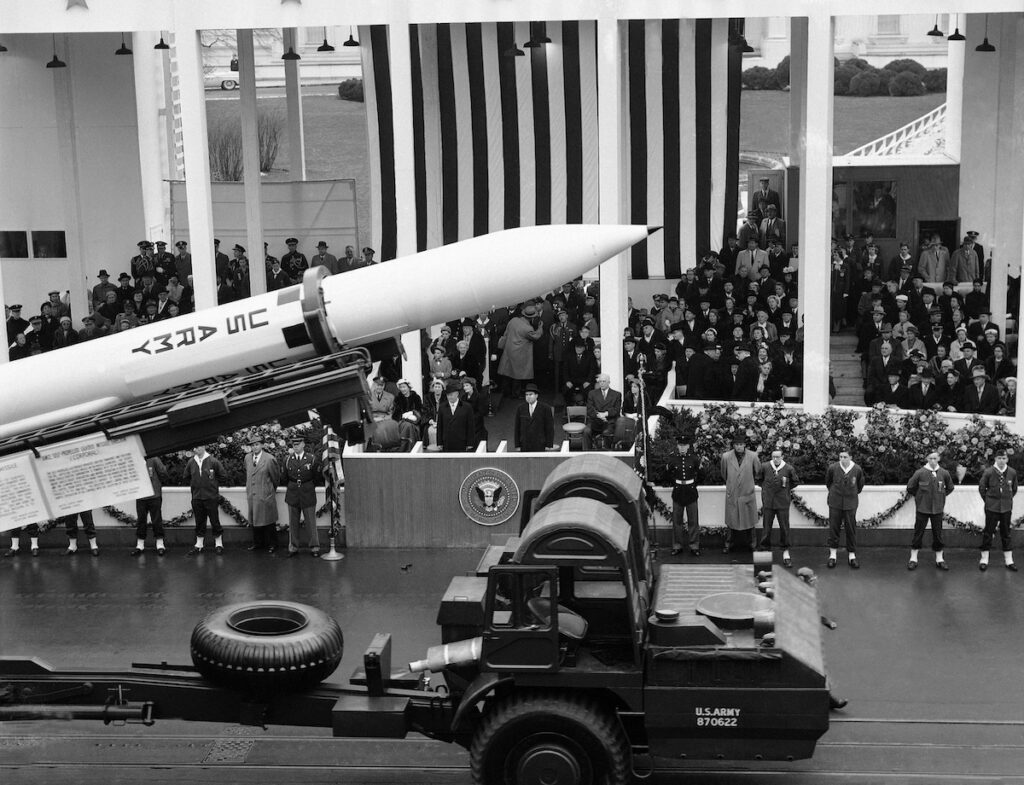
When the United States brought nuclear weapons into the world, the resulting age of terror was quite predictable. A 1945 petition to the president, circulated by Leo Szilard, one of the creators of the atomic bomb, and signed by sixty-seven of his fellow atomic scientists, prophesied that “a nation which sets the precedent of using these newly liberated forces of nature for the purposes of destruction may have to bear the responsibility of opening the door to an era of devastation on an unimaginable scale.” The petition argued that the United States, as the creator of this terrible power, had “the solemn responsibility” not to use it. It warned that otherwise the United States would eventually find itself threatened by its own Frankenstein’s monster, and that “the cities of the United States as well as the cities of other nations will be in continuous danger of sudden annihilation.”
But the U.S. government, not content with developing and perhaps demonstrating this weapon, went on to use it, exploding nuclear devices on the populations of two major cities. That there was no military necessity for these bombings is now widely recognized-though of course not included in American history textbooks. The U.S. Strategic Bombing Survey, for example, concluded unequivocally that “Japan would have surrendered even if the atomic bombs had not been dropped, even if Russia had not entered the war, and even if no invasion had been planned or contemplated.” Fleet Admiral William D. Leahy, Chief of Staff to both Roosevelt and Truman, flatly declared: “. . . the use of this barbarous weapon at Hiroshima and Nagasaki was of no material assistance in our war against Japan. The Japanese were already defeated and ready to surrender.” Asked in 1945 for his opinion on dropping the atomic bomb, General Eisenhower replied: “I was against it on two counts. First the Japanese were ready to surrender and it wasn’t necessary to hit them with that awful thing. Second, I hated to see our country be the first to use such a weapon.”
Why, then, was it used? As early as 1948, P. M. S. Blackett, British Nobel Laureate in physics and wartime military expert, concluded that “the dropping of the atomic bombs was not so much the last military act of the Second World War as the first major operation of the cold diplomatic war with Russia now in progress.” Modern scholars have hotly debated this proposition. Some agree that the bombs were dropped primarily to intimidate the Soviet Union. The opposing position admits that the bomb was used as a diplomatic weapon against the Soviets, but argues that this was irrelevant to the decision to drop it on Japan.
Certain facts are not in dispute. Throughout July 1945, the United States intercepted a series of Japanese government cables indicating their desire to surrender if they could retain their emperor. Meanwhile, the Soviet Union had pledged to declare war on Japan no later than the second week in August, and had already moved large armies into position for the attack. The only precondition for the Soviet entry was an accord with the Chinese government of Chiang Kai-Shek. President Truman asked Chiang’s government to drag out its negotiations with the U.S.S.R. Truman also stalled the convening of the Potsdam conference to await the test of the atomic bomb. In late July, at Potsdam, the U.S.S.R. pledged anew to declare war no later than mid-August. Truman deleted from the Anglo-American ultimatum to Japan a provision allowing retention of the emperor, thus, intentionally or not, eliminating the likelihood of an immediate surrender. The first atomic bomb was hastily dropped on Hiroshima August 6. Thus the bomb was used on Japan before it could surrender and just before the Soviet Union entered the war. And when the Japanese surrendered, they were allowed to retain the emperor, thereby meeting the terms they had been seeking in July. So, by delaying Soviet entry into the war and by not accepting an earlier Japanese surrender, the U.S. government, whether by design or not, was able to display both its new weapon and its willingness to use it, could claim that this weapon had decided the war, and now could brandish it as a threat against the Soviet Union.
Secretary of State Byrnes believed that “our possessing and demonstrating the bomb would make Russia more manageable in Europe.” Vannevar Bush, chief aide for atomic matters for the Department of War, testified that the bomb “was delivered on time so that there was no necessity for any concessions to Russia at the end of the war.” Secretary of War Stimson hoped to use the bomb “to get less barbarous relations with Russia.” President Truman later wrote that the bomb “put us in a position to dictate our own terms at the end of the war.”
Unilateral nuclear disarmament now seems a bizarre utopian fantasy. But between 1945 and 1949, after starting the nuclear arms race by engaging in unilateral nuclear armament, the United States had the ability to bring about immediate global nuclear disarmament simply by destroying our atomic bombs. As the only nation with nuclear technology, the U.S. could have led the world to a treaty outlawing the production and use of nuclear weapons. Not surprisingly, since it was in their interest to do so, the Soviet Union proposed just such a treaty on June 19, 1946. It provided for the destruction within three months of all finished and unfinished atomic weapons and the prohibition of the production, storage, and use of atomic weapons. The United States rejected the Soviet proposal and, just twelve days later, conducted at Bikini the first of many postwar atomic test explosions. The only U.S. suggestion during this period for nuclear control, the Baruch Plan, actually proposed that the United States should maintain a monopoly on atomic weapons until some unspecified date in the future, when an international control agency would be established, while in the meantime any other nation attempting to build atomic weapons would be subjected to “swift and sure punishment.” Each Soviet attempt to achieve nuclear disarmament, including its support of the “ban-the-bomb” popular movement, was dismissed as a treacherous maneuver designed to deprive us of our military superiority.
Meanwhile, the United States moved in the opposite direction, constantly trying to increase that military superiority. Beginning in 1945, U.S. forces encircled the Soviet Union with a noose eventually consisting of 429 major military bases and 2,972 secondary bases, stretching from Greenland and Iceland through Europe, the Middle East, southwest Asia, the Pacific Ocean, Alaska, and Canada. While placing Boeing B-29s armed with nuclear bombs at many of these forward bases, within striking range of all major Soviet cities, the U.S. Air Force began developing the first intercontinental strategic bombers. Exactly one year after Hiroshima, the first Convair B-36 was flown for the newly formed Strategic Air Command; the next year came the Boeing B-47, to be followed a few years later by the same corporation’s B-52. In 1949, the United States, clinging to its atomic monopoly, began mass production of the B-36. In the fall of 1949, the U.S.S.R. tested its first atomic bomb. Two months later, our government, still bent on holding a monopoly of terror, unilaterally initiated the most fateful escalation of the nuclear arms race: it began full-scale development of the thermonuclear (hydrogen) bomb, based on fusion. Atomic bombs, though frightful, were probably not powerful enough to threaten the extermination of the human race. Thermonuclear weapons, a thousand times more powerful, could easily do the job. A single B-52 armed with hydrogen bombs now carries destructiveness equivalent to over 3,000 Hiroshima-type atomic bombs.
On and on raced our nation, contriving one new weapons system after another: the strategic missile and the tactical missile, the nuclear submarine, MIRV (Multiple Individually Targeted Re-entry Vehicle), the strategic cruise missile, MARV (Maneuvering Re-entry Vehicle), new pinpoint accuracy missiles designed not for retaliatory deterrence but for first-strike against hardened launch sites, and now the MX, the neutron bomb, and the shuttle designed to turn space into a battlefield. No new round in the arms race has ever been initiated by the Soviet Union, which has merely played catch-up with each new weapons system, while continuing to press for both nuclear and general disarmament.
As Edgar Bottome exhaustively documents in The Balance of Terror, the United States has been “fundamentally responsible for every major escalation of the arms race.” Bottome’s book was written in 1970, just as the U.S. again unilaterally and qualitatively escalated the arms race with the decision to produce the MIRV systems (another Boeing product). Bottome accurately foretold the results:
Faced with increasing American superiority, the Soviet Union will be forced to escalate its own arms program. During the 1970s, they will develop and deploy MIRV. Then, just as the leaders of the United States have cited the 1970 Soviet achievement of ICBM parity as proof of their wisdom in the 1960s, they will tell the American public, “I told you so.” There has never been a better example of the self-fulfilling prophecy.
The quest to maintain and extend military superiority has been based on a belief in the inherent technological superiority of the United States, along with a kind of science-fictional vision of planetary hegemony based on technology. For decades, U.S.policy makers failed to accept the fact that the Soviet Union had achieved approximate parity in science, technology, and production, so that it was capable of developing any new weapon deployed against it. Recognizing this parity as a fact of late twentieth-century life, the Soviet Union has refrained from deploying any novel weapons, for their policy makers acknowledge that any new weapon system merely “starts a new round in the arms race.”
Meanwhile, the military, corporate, and political powers that make decisions in America have carried out almost every imaginable kind of provocation except actually starting a direct military attack upon the Soviet Union or Eastern Europe, or using nuclear weapons in the U.S. military assaults upon Soviet allies such as North Korea, the Democratic Republic of Vietnam, and Cuba. And who knows how close we may have come to committing even these fateful acts?
For as early as 1949, the U.S. Defense Department worked out a complete plan for a full-scale preemptive nuclear assault on the Soviet Union (Operation Dropshot, published as the book-length volume Dropshot: The United States Plan for War with the Soviet Union by Dial Press in 1978). On January 11, 1951, a top-secret Cabinet-level report recommended massive bombing of China and diplomatic maneuvers intended to establish “moral justification” for a nuclear attack on the Soviet Union.’o President Eisenhower acknowledged that during the Korean War he explicitly threatened the Chinese with the use of nuclear weapons.”‘ On February 10, 1953, General Omar Bradley, then Chairman of the Joint Chiefs of Staff, told the Senate Foreign Relations Committee in a closed-door testimony that we were now considering “very seriously the use of the A-bomb, if we found a suitable target now in Korea”:
Of course, you know there are no strategic targets worth mentioning in Korea. We have looked for a long time and studied the possible tactical uses in Korea, and it is rather hard to find a target at this time that we think is sufficiently remunerative as a target for the expending out of the stockpile.
The following year, as the French colonial forces faced defeat in Vietnam, Secretary of State John Foster Dulles suggested to French Foreign Minister Georges Bidault the possible use of one or more U.S. nuclear weapons near the Chinese border against supply lines, and two to be used against the Viet Minh at Dienbienphu.” To Dulles, it seemed normal and prudent to engage in what he aptly called “brinkmanship,” and we know that President Kennedy led us at least once right up to that brink.
Meanwhile, we Americans were being deluged-in school, the media, movies, literature, and church-with images of the Soviets and other Communists as vicious, treacherous, ruthless, fanatical “aggressors” whose main goal in life was to destroy America or take it over. Within just three years of the wartime alliance with the Soviet Union, every American, in order to be deemed “loyal,” had to regard the Soviet Union as “the enemy.” Our own consciousness may now constitute an essential part of the predicament in which we find ourselves.
Born in 1934, I entered my teens in 1947, just as anti-Communism and anti-Sovietism were gaining total control of America’s foreign policy and domestic cultural environment. So I believed without the slightest doubt that America was in mortal danger both from Communist subversion and an imminent Soviet nuclear attack.
I took these beliefs along when I began my three-year stint as an officer in the United States Air Force in January, 1956. There I helped, in a minor way, to take us to the brink of nuclear war. I spent two of these years as a navigator in the Strategic Air Command, assigned to a squadron of Boeing KC-97 tankers engaged in mid-air refueling of Boeing B-47s and B-52s in the far northern latitudes. When I was not flying, I worked in combat intelligence, eventually becoming the Squadron Intelligence Officer, in charge of all our classified documents. There I learned that the main mission of SAC Intelligence was to help convince the American people that we were under the threat of an imminent nuclear attack by the Soviet Union, a threat which U.S. intelligence had concocted. In fact we knew that the Soviet Union, at least as late as 1958, lacked any means of delivering nuclear bombs to the continental United States.
Nevertheless, SAC bombers, carrying nuclear bombs, flew repeatedly in massive numbers toward the Soviet Union, ostensibly because we believed we were under attack.” On April 7, 1958, President Eisenhower acknowledged that the SAC strategic strike force had launched toward the Soviet Union many times, actuated “by alerts created by meteoric flights registered on the DEW Line radar scopes, or by interference of high-frequency transmitters creating artificial ‘blips’ or by the appearance of foreign objects on the scope flying in seeming formation, which have never been explained.”
From the top-secret documents in my custody, and from observations on the missions I flew, I learned that many of the bombers we were refueling were engaged in missions of espionage and provocation over the Soviet Union. Meanwhile, Soviet charges about these overflights were dismissed by the U.S. government as examples of Communist propaganda. When U.S.bombers were shot down over the Soviet Union, our government asserted that they had made navigational errors and cited the Soviet actions as examples of Communist ruthlessness. But later, Secrets of Electronic Espionage, a 1966 book glorifying these missions, openly boasted that U.S. B-47s, fighter-bombers, and electronic reconnaissance planes “often intruded on Soviet airspace”:
Electromagnetic reconnaissance carried out by ferrets furnishes Intelligence information essential to our national security, but ferreting is a highly dangerous activity. Between January, 1950, and May, 1964there were 108 there were thirty-eight reported incidents in which U.S. aircraft were fired upon by Red aircraft, antiaircraft guns,or missile batteries. Twenty-six aircraft were shot down or forced to land in or near Communist territory.
On the other hand, no Soviet planes were ever shot down over U.S. territory, or even over territory occupied by U.S. forces. The explanation offered for this disparity has appalling implications:
The Soviet planes were able to gather much information about our electronic weapons by cruising one hundred miles or so from our borders because U.S. radar and radio men unfortunately kept their equipment operating all the time. But Soviet radar and radio men realized that when they kept their equipment turned on, U.S. ferrets could plot the locations of the stations and deduce their capabilities. Accordingly, the Soviets did not turn on their equipment unless they thought the U.S. plane was actually going to attack them. And so the restraint exercised by Soviet radar men forced U.S. ferrets to intrude on Soviet airspace and simulate an actual attack to get the Russians to turn on their radar. Once the Russians turned on their radar, they stopped shooting. [Italics mine.]
Though such actions contain an obvious potential for accidental nuclear war, they were ordered by men upon whose rationality we rely to decide from day to day whether or not civilization will continue to exist.
This is neither ancient history nor an aberration in U.S. policy. Today the men who lead our nation are suggesting that in a thermonuclear war one nation would be a “winner,” to use the word of George Bush, former head of the CIA and now Vice President. Before that, President Carter issued Presidential Directive 59, a plan for a “limited” and “prolonged” thermonuclear war. James R. Schlesinger, the Secretary of Defense in the preceding Administration, was merely “reaffirming longstanding U.S. policy” when he announced on July 1, 1975, that “the United States might make first use of strategic nuclear weapons against selected targets in Russia”: “Under no circumstances. could we disavow the first use of nuclear weapons,” he boldly proclaimed. And Melvin Laird, later to be Nixon’s Secretary of Defense had written as early as 1962: “Step one of a military strategy of initiative should be the credible announcement of our determination to strike first if necessary to protect our vital interests.”
Opposed to all this stands the official Soviet position, which has renounced both the first strike and the concept of limited nuclear war. Since 1976, the Soviet government has at least three times called publicly for a mutual pledge between the Warsaw Pact states and the NATO states that neither side would be first to use nuclear weapons, against the other. As recently as October, 1980, Foreign Minister Andrei Gromyko repeated before the General Assembly of United Nations that the Soviet Union rejects the concept of a nuclear first strike, renounces any strike at all at countries having no nuclear weapons on their soil, and wishes to sign at once with the United States a mutual renunciation of a nuclear first strike. In the words of Lieutenant-General Mikhail Milshtein, a leading Soviet military theoretician:
… our doctrine is that we will never use nuclear weapons unless an aggressor uses them first. We believe that nuclear war will bring no advantage to anyone and may even lead to the end of civilization. And the end of civilization can hardly be called a “victory.” Our doctrine regards nuclear weapons as something that must never be used. They are not an instrument for waging war in any rational sense. They are not weapons with which one can achieve foreign policy goals.
Yet our own government refuses to sign the mutual pledge against first use of nuclear weapons, and even continues to develop weapons and tactics for a first strike.
Among the many possible explanations for the difference between the U.S. and Soviet positions on disarmament is the difference between the two nations’ forms of political economy. The drive for profits is certainly one of the main forces activating the arms race within the United States. This drive is especially powerful in the area of strategic arms because of the colossal sums of money involved, and because the gigantic facilities that produce strategic weapons systems have become too specialized to participate in socially useful production within our economic framework. In the Soviet Union and the other socialist nations, on the other hand, the manufacture of armaments produces no profits whatsoever and merely drains badly needed capital, resources, and labor from the tasks of socialist construction. This is undoubtedly one reason for the Soviet push for nuclear disarmament.
The purpose of this essay is not to evaluate either the Soviet system or Soviet foreign policy, but to scrutinize what our own society has done and might do with nuclear weapons. What are the forces that keep propelling our nation, with its vast creative resources, down a path that may lead to annihilation? And can these forces push us over the brink, if we find no way to leave this path? To answer these questions we must explore deeply the relation between our political economy and the immense alien destructive forces it has produced.
The radical militarization of our economy has now been amply documented. By 1974, the amount budgeted for military spending by the U.S. government exceeded the gross national product of every other nation in the world except for the U.S.S.R., Japan, West Germany, France, the United Kingdom, China, and Italy. The giant. armaments makers, especially the aerospace companies, control strategic parts of our society. They are at or near the center of much more than our economy, and as the core of what Eisenhower called the military-industrial complex, they have enormous political power. The corporate institutions that depend for their very survival on military spending reach into nearly all aspects of American society, controlling the media, choosing candidates for public office, and interpenetrating with institutions of higher education.
By 1972, for example, the corporations represented on the Board of Trusties of Stanford University were already producing more quantities of advanced military hardware than possessed by any but three nations in the world; these companies were making nuclear submarines, the missiles fired by these submarines, and all the equipment needed to run underseas missions, as well as warplanes such as the F-5 and F-ill and land-based ICBMs.
Even our culture is profoundly influenced, in ways we rarely contemplate, by these corporations with their own needs and fears. The aerospace industry had a major role, for example, in shaping post-World-War-Two science fiction, helping to form our visions of cosmic reality now manifest in such expressions as video games, Star Trek, the militarization of inner space, and the Star Wars epic.
Clearly, the nuclear arms race can be neither understood nor stopped with, ‘out comprehending the size and nature of the aerospace companies. Here are the latest estimates (by the Value Line Investment Survey) of the 1981 revenues of five large aerospace companies (in billions of dollars):
| Boeing (B-52; Minuteman; MIRV; cruise missiles, MX missile) |
$9.5 |
| McDonnell Douglas (56 percent of sales are various military aircraft, spacecraft, and missiles) |
7.4 |
| Rockwell International (space shuttle; B-I Bomber; MX) |
7.1 |
| Lockheed (Trident and Poseidon missiles; 59 percent of sales are military) |
6.2 |
| General Dynamics (F-16 and F-111; Atlas and Centaur boosters; cruise missiles and tactical missiles; Trident submarines) |
5.3 |
| Total | $35.5 billion |
Each of these five companies has annual sales far greater than the national budget revenues of the overwhelming majority of countries in the world. Comparisons with most of the nations of Africa and Asia are grotesque. For example, the sales of Boeing are almost four times the national budget revenues of Pakistan, over ten times those of Zaire, and almost twenty times those of Tanzania; India’s national budget revenue exceeds Boeing’s revenue by only 10 percent. Even comparing these corporations to the relatively more developed regions of the Third World is startling. The combined national budget revenues ($43.1 billion) of all the countries of South America (Argentina, Brazil, Bolivia, Colombia, Paraguay, Peru, Chile, Guyana, Suriname, French Guiana, Uruguay, Ecuador, and Venezuela) are only about 21 percent more than the revenues of just these five companies which themselves form only -a fragment of the armaments industry. Only two countries of South America (Brazil and Venezuela) have national budget revenues exceeding the current revenues of Boeing.
The largest armaments makers, like other capitalist enterprises, must constantly increase their sales just to maintain their present level of profits. Even during the peak spending years of the Vietnam War, some of the strategic arms makers were still not getting big enough contracts to keep them out of financial crises, partly because they were geared to produce systems for all-out war (such as nuclear missiles, nuclear submarines, and strategic bombers) rather than for “limited” war.
For example, during the four years from 1969 through 1972, Boeing averaged only 22 cents a share in earnings, was forced to cut its dividend by 75 percent, and saw the price of its stock plummet from a 1967 high of $25 to a 1970 low of under $3, thus wiping out $2.1 billion-or 89 percent-of its market value. Boeing was then helped by the Pentagon’s decision to use its.B-52 bombers in massive raids over North Vietnam in 1972. Dozens were shot down or severely damaged by surface-to-air missiles and fighters, thus yielding hundreds of millions of dollars in new contracts. (Prior to this, B-52s had never been deployed against North Vietnam, precisely because of the anticipated severe losses.)
Even more dire was the fate of Lockheed during this period. After averaging $4.60 per share earnings for each of the five fiscal years from 1964 through 1968, as Vietnam expenditures were climbing, Lockheed actually lost $2.90 a share in 1969.and $7.60 a share in 1970, and its stock crashed from a high of almost $74 in 1967 to a low of under $3 in 1973, thus virtually wiping out the investments of all those continuing to hold the shares. And the biggest shareholders were of course the large financial institutions, including the giant banks and insurance companies. So it is no wonder that the U.S. government rushed to the rescue, making Lockheed a preeminent example of welfare capitalism.
It is axiomatic among investment analysts that capitalist markets and decision making are driven by the contradictory forces of “fear and greed.” Critics of the military-industrial-financial complex tend to overstress greed, the weaker of what Barron’s National Business and Financial Weekly is fond of calling “those two noblest motives of mankind.” Greed is a relatively timid force compared to the fear, sometimes sliding into panic, that often moves corporate finance and capitalist markets. The giant manufacturers of strategic arms wobble back and forth between fabulous profits and prospects of doom. So as each new round of military budget planning approaches, these behemoths are themselves gripped by uncontrollable motive forces. Since their very survival is at stake, their behavior may get quite desperate. Fear, even more than greed, makes them capable of irrational acts with frightening potential.
Nor are the major armaments makers detachable segments of the U.S. political economy. The giant automobile companies, for example, are all major producers of military hardware; Ford, for example, in May, 1981, was awarded a $4 billion contract to produce mobile anti-aircraft guns to protect Chrysler’s M-1 tanks. The mining companies, the steel companies, the electronics companies, the precision instruments companies, and the oil companies, to cite obvious examples, are all inextricably intertwined with military production. The largest financial institutions, as well as virtually all colleges and universities, have major portions of their funds invested in the “defense” industry. The cost overrun alone on the Trident and F-16 programs by early 1981 amounted to $33 billion, which equals the total in Reagan’s proposed 1982 budget for the National Institute of Health, Land Conservation, the National Endowment for the Humanities, the National Endowment for the Arts, Elementary and Secondary Education, Vocational Education, the Black Lung Trust Fund, the National Science Foundation, Child Nutrition, Child Support and Aid to Families with Dependent Children, Museums, and Food Stamps. 2 9 It seems safe to say that if we were able to redirect the money, the time, the intelligence, the creativity, and the effort now being used to forge the means of our own potential extermination, we could easily meet all of our needs that can be satisfied by material goods. So what stands in our way?
It was in the context of the Vietnam War that many Americans began to be aware that the fundamental problem was not the war industry but the system which required the war industry in order to survive, a system of global imperialism. It was this system that had expanded under the umbrella of America’s nuclear hegemony and that was now being torn apart by the national liberation struggles of the peoples whose lands and labor were the primary source of the fabulous wealth and power of the banks and corporations dominating the “Free World.” Jesse Hobson, one of the theorists for that system, speaking in 1951 at the Stanford Research Institute, explained that “our present defense economy” is essential for us “to maintain this position”:
This nation occupies 6 percent of the land area of the world, has 7 percent of the world’s population, but it now produces 50 percent of the world’s goods and possesses 67 percent of the world’s wealth.
The world was in enough peril during the heyday of this empire, when it expanded while rattling its nuclear bombs. But the Vietnam War, in which the mightiest war machine ever assembled was defeated by a small impoverished nation, has helped change all that. In the post-Vietnam-War world, our leaders find themselves without a reliable ground army to deploy against the revolutionary forces that threaten their interests in Latin America, Asia, the Middle East, and Africa. They are forced to depend ever more on a strategic weapons colossus whose financing threatens an already disintegrating economy. This system in its decline may pose increasingly more ominous threats to our survival.
Doomsday visions have now actually spread from science fiction into the financial press. Front-page headlines in Barron’s scream “THE SKY IS FALLING” (February 25, 1980) and “APOCALYPSE NOW” (April 7, 1980), and a swarm of leading best sellers tells us how to survive the coming economic catastrophe. While this system was expanding or just beginning to contract, the men who had the power to ignite the day of doom were no doubt restrained by their sense of all they had to lose. But as the base of their power becomes threatened, this sense may fade. What happens if those who now have so much power believe that they are losing all of it except the power to destroy? Could they have impulses like those expressed by that white Rhodesian hotel manager on the eve of black rule in Zimbabwe: “Somehow I wish there was one button you could push and blow up every country on earth, every one.”
Though our situation is perilous, it is by no means hopeless. We human beings do have the potential to gain control of our own history. If the nuclear arms race is essentially the creation of the United States, then it may be possible that the United States has the ability to terminate that arms race and liberate the potential for nuclear disarmament. And if our nation does indeed possess this ability, then we ourselves, the American people, might prove to be the decisive factor in taking the world off its present course toward what many analysts see as a very likely, if not probable or even inevitable, thermonuclear doomsday.
For those Americans who believe that we live in a democracy, a government of the people, by the people, and for the people, the task is relatively simple: just educate the American people about the past, present, and likely future of the nuclear arms race, so that the people can vote into office a government representing our desire for peace. For those of us who believe that we live in an empire ruled by the class that owns the banks and corporations, the job seems somewhat more difficult, for it would require the destruction of the military-industrial-financial hegemony and its replacement by a true democracy dedicated to peace and the fulfillment of human needs. In either case, the essential question for Americans who wish to eliminate the nuclear threat to human survival must be: what can we do?
Independent and nonprofit, Boston Review relies on reader funding. To support work like this, please donate here.