
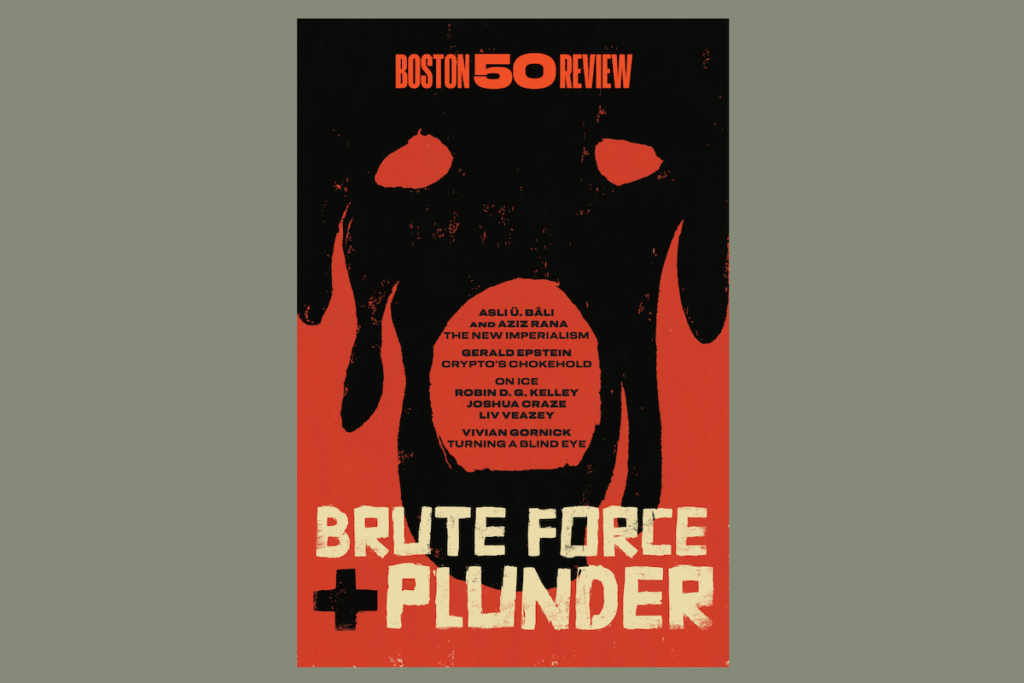
See the Table of Contents here.
Steve Bannon named the tactic in 2018: “flood the zone.” Since resuming office last January, Trump has doubled down on the maneuver, unleashing a campaign of rapid-fire destruction on immigrants, the federal government, Latin America, and beyond. The scale of the damage is staggering and growing. This issue looks at the violent reconfiguration of U.S. politics and power and what it means for democracy and resistance.
We open with Olúfẹ́mi Táíwò’s column on MAGA’s “vice signaling”—the shameless celebration of transgression. Unlike virtue signaling, which indicates allegiance with group values, vice signaling aims simply to own the opposition. It thus renders “the moral commitments of the in-group . . . irrelevant,” eliminating any “practical constraint on anyone’s behavior.” This impunity plays out today in brutal displays of force that shock the conscience of most Americans.
Several other essays illuminate Trump’s goal: not only to dominate but to coerce, humiliate, and silence. A special section focuses on the lethal and symbolic power of Immigration and Customs Enforcement: how violence pervades even the language of asylum hearings (Joshua Craze), how raids on Canal Street threatened both spectacular and anonymous force (Liv Veazey), and how the murders of Renee Good and Alex Pretti reflect terror tactics long deployed by U.S. police (Robin D. G. Kelley).
Tracking raw power in global affairs, Aslı Bâli and Aziz Rana trace the origins of the “Trump Doctrine” through years of U.S. lawlessness in the Middle East. Now the coercion has reached its purest form, casting aside any pretense of international law, alliances, and limits. The effect is to signal that what little sovereignty less-powerful states might have had is now openly conditional on the whims of the United States and its “civilizational superiority.” The “peace” plan in Gaza exemplifies this new old imperialism, Bâli and Rana explain: it “doubles down on American presumptions that force can substitute for legitimacy and that the weak will suffer what they must.”
Of course, from ICE terror in Minneapolis to regime change in Venezuela, the goal is not just an accumulation of power but the further enrichment of elites, whether through lucrative government contracts or the broader massive transfer of wealth and security away from the rest of us. Gerald Epstein unpacks crypto’s designs on the global financial system, while Marie Gottschalk documents the financial entanglement of local jails with the federal deportation machine.
How do you successfully resist the shameless exercise of brute force and power? Can we avert what Vivian Gornick calls the “capitulation and inertia”—the daily accommodation of the rise of authoritarianism? Reading a memoir of a childhood in Nazi Germany, she warns that even those with moral commitments may struggle to act.
But action is essential, from anti-ICE mobilization to electoral politics. David Austin Walsh examines the promise of Zohran Mamdani’s experiment in New York. Meanwhile, the fierce resistance of the people of Minneapolis has forced a national reckoning. For the Democratic Party, massive protests have challenged the decades-old conviction that moderation is the way to win and govern. Against demands to dismantle ICE, Democrats finally acted to block a DHS funding bill. But as of this writing in early February, they are poised to settle for far less: what Senator Tim Kaine insists are “reasonable” checks on ICE. Drawing lessons from movements that have reversed democratic backsliding abroad, Adam Bonica and Jake Grumbach argue that Democrats’ poll-tested timidity is precisely the wrong way to defeat authoritarianism.Their bracing call for change within the party opens a large debate, with fifteen responses you can read on our website.
Finally, the archive feature in this issue brings our fiftieth anniversary year to a close. We want to express our deepest gratitude to all those who have read, shared, and supported our work as we move forward together.