
See the Table of Contents here.
In 1877 a German immigrant wrote home to his parents, “The demand for war in many of the American newspapers and especially in Texas is caused by the speculators who want to make fortunes furnishing war supplies.” Little has changed. Writing from El Paso, Honora Spicer documents the sordid history of the land in Texas where a massive immigrant detention center recently opened. With plans to expand to be the largest in U.S. history, it will deliver $1 billion in federal money to a private contractor.
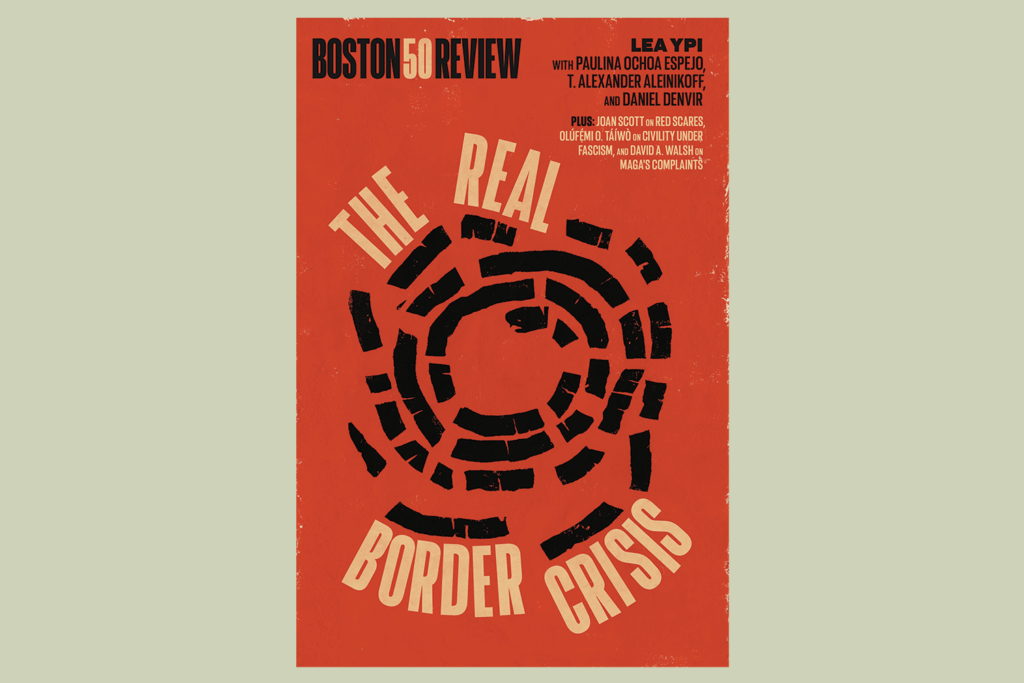
Leading this issue’s forum, Lea Ypi argues that the so-called border crisis—the “immigrant invasion” decried by the Trump administration that supposedly requires more prisons—reveals not a civilizational threat to our culture but a political-economic crisis of liberal democracy brought on by global inequality, driving people from their homes. While the wealthy buy their way across borders and into political power, liberal democracies have abandoned Enlightenment commitments to freedom, equality, and solidarity. For Ypi, the only path to reviving universal values is an international movement built around the working class.
Respondents resist Ypi’s analysis: people don’t always migrate out of need; a vice grip on defining who belongs need not be a prerogative of the state; and solidarity must start at home. But they share Ypi’s dismay at the broad abandonment of immigrants, agree that liberalism is in crisis, and recognize that the path forward will not be easy.
The current crisis of liberalism takes shape in other ways in this issue. Olúfémi O. Táíwò and Eric Reinhart reflect on recent political violence, showing what common responses get wrong. Panashe Chigumadzi questions the usefulness of talk of apartheid—along with its rights-based remedy—as the paradigm for repairing structural injustice. Tracing a century-long argument among Black South African activists about whether equal rights can deliver freedom, she situates apartheid in a much longer horizon of racial violence that began with indigenous land dispossession and the slave trade. The liberal international order, she argues, foreclosed the possibility of addressing those harms.
Liberalism might handle gender badly too. With feminism in retreat and misogyny on the rise, Lorna Finlayson reviews three recent books and asks that we resist the temptation to blame easy enemies: Russia, Trump, social media. In her view, gender troubles are systemic. She finds hope in Andrea Dworkin’s radical account of the challenges women face—Dworkin’s “exaggerations”—precisely because they offer a real glimpse of “something dark just below the surface of ordinary life,” shining a light on what too many fail to see.
Crises call for clear-eyed vision, about the moral appeal of liberal values as well as their imperfect realization. Aaron Labaree profiles Marcel Ophuls (1927–2025), the remarkable documentary filmmaker who explored the twentieth century’s great crimes and urged liberal societies to discipline their “illiberal instincts” through international legal standards. “This ideal—always fragile, always vulnerable to the charge of hypocrisy—is nowadays eclipsed more and more by the politics of revenge,” Labaree writes. “In a time when cynics are on the ascent,” these films show “how the case for decency can be made with subtlety and even style.”