
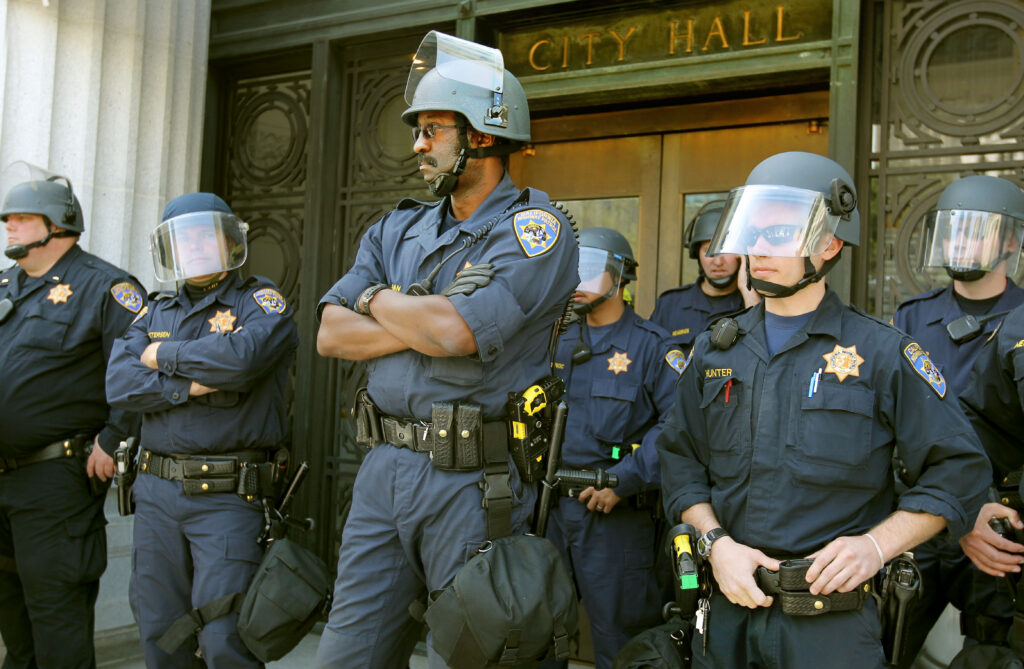
Last April, as the Trump administration gleefully decimated the federal government, police officers received a love letter in the form of an executive order promising to “strengthen” and “unleash” police forces on the American public and release them from “legal and political handcuffs.” And unleash them Trump did. Racial profiling has returned in full force with the blessing of the Supreme Court. ICE’s budget has exploded as its agents invade cities, terrorize communities, and throw tens of thousands into gulags without due process. Meanwhile, police continue to kill at record rates. Under Trump, police can break laws and impose racial hierarchies without pretending to care about “community policing” or even the Constitution.
Suffice it to say, much about U.S. policing has gotten worse. But whether all this marks a substantive departure from the so-called police reform era is less clear. According to historian Stuart Schrader, a prominent scholar of policing and the carceral state at Johns Hopkins University, policing got set on this course decades ago. His new book, Blue Power: How Police Organized to Protect and Serve Themselves, exposes a major but often overlooked driver of law enforcement’s stranglehold on U.S. society: the political clout of police unions.
Schrader dubs this political influence “Blue Power,” taking readers through the early years of police politicking through benevolence associations to the modern day and the political machinations of groups like the National Fraternal Order of Police, which has spent over $2 million on federal lobbying in the last decade. The book draws a straight line between local, granular fights within police departments and government institutions, be they small-town agencies or big cities, and the impunity that permeates our national politics. Last week, I called Schrader to discuss the history of police unions’ rise, their place in the broader labor movement, and the path they cleared to electing Trump twice. Our conversation has been lightly edited.
—nia t. evans
nia t. evans:In Blue Power you make a distinction between “operational” power and “political” power. Can you explain these two key facets of Blue Power and how they interact with each other?
Stuart Schrader:By operational power, I mean the way police exert control over both society and individuals through their tactical repertoires. This includes everything from stop-and-frisk to traffic stops to large-scale protest control, as well as more hidden forms of surveillance and political repression. Thanks to the work of scholars, journalists, and movement activists over the last several decades, we have a pretty good understanding of how police operational power works in real time.
But police also engage in more directly political activity, which we have been less successful at analyzing. Much of this happens behind closed doors, through lobbying, campaign donations (often in local races where a relatively small amount of money goes a long way), and get-out-the-vote drives—vanilla tactics that any political organization might engage in. Through their unions and associations, police have been consistent in using these tactics and have developed long-standing, continually replenished relationships to keep using them.
“Police learned from—and in some cases, literally stole ideas from—organized labor without preserving the fundamental principle of solidarity at the core of the labor movement.”
Police also engage in more overt and confrontational tactics, such as strikes, walkouts, and slowdowns. In general, these are all unauthorized—if not illegal—tactics among police that other types of unions can and do engage in. A strike at a factory is meant to hurt the boss’s wallet, but a police strike is meant to hold a city hostage, putting regular people at risk of crime sprees and other chaos. Police also supplement these tactics with intimidation and other forms of aggression toward elected officials. The book includes several examples of this: police show up unannounced at elected officials’ offices to give their input on legislation that is coming up for a vote, or they launch social media campaigns attacking elected officials and their families. In 2020 the head of the New York Sergeants Benevolent Association targeted Mayor Bill de Blasio’s daughter when she was arrested in a protest.
My point in drawing this distinction is not to say that operational power is not also political. It’s to put the political tactics police use to get their way at the foreground of our analysis, against the more familiar background of their operational tactics.
evans:Can you walk me through the early years of Blue Power? How did rank-and-file officers exercise political power a century ago versus their chiefs? And when did unions become a vehicle for honing that influence?
Schrader:The book relies on a distinction between police management and the rank-and-file. Over the middle part of the twentieth century, chiefs ruled departments with an iron fist and maintained dominance; the rank and file were essentially powerless in relation to chiefs, just as many workers in other workplaces were powerless in relation to bosses.
This situation came to a head in the 1960s, when there developed a sense among elected officials—as well as within the profession itself—that police were just not up to the task of managing civil rights protests and urban rebellions, as well as crime. To modernize and transform policing into a more capable force, there needed to be a set of reforms—and these would be led by chiefs. Departments’ rank-and-file members were unhappy, to say the least. The reasons for this are multifaceted, but part of it was that the reforms chiefs were demanding changed their daily routines. For example, in the 1960s, many police officers worked during daylight hours even though crime tended to happen after dark. When chiefs, informed by evidence-based scientific research, reallocated shifts so that more officers were working after dark rather than during daylight hours, patrol officers resisted. That’s just one of many examples of simple transformations, implemented from the top down, that displeased rank-and-file officers.
Of course, not only was the civil rights movement happening during this time; second-wave feminism was blooming, and the public sector union movement was exploding. These social transformations were intertwined. John F. Kennedy and Lyndon Johnson both supported public sector unionization, and in state after state, new legislation was being passed to enable it. Police rank-and-file officers rode this wave and started to bargain over compensation and working conditions, pushing back against some of the reforms chiefs were introducing. It wasn’t always easy to push back because of the way labor law was written, but they nevertheless ramped up resistance.
The high point of chiefs’ political power came around 1968, when the massive anti-crime bill that we associate with the War on Crime was passed. The International Association of Chiefs of Police had a modicum of sway over that legislation, and was rewarded by a new kind of funding that became available at the federal level. After that moment, chiefs never really regained their dominance within the profession; the police union movement and national organizations dedicated to the rank-and-file started to gain a lot more members. Not only were there more unions across the country and more resources to serve them—these unions also started to develop more political clout at the municipal, state, and federal levels.
evans:I’m glad you brought up public sector unions, because I want to dig into that a little bit. On their face, police unions can be a tricky subject for the left: it can seem hard to craft a relentlessly pro-labor message while carving out an exception for one particular class of workers. Prison guard unions deserve our attention here too—they have played a key role in keeping prisons open and highly staffed even while fewer people are being incarcerated. What’s been the relationship between police and prison unions and associations and organized labor more broadly? How do you make sense of the distinct politics of public sector unions in general?
Schrader:The best way to put it would be that police learned from—and in some cases, literally stole ideas from—organized labor without preserving the fundamental principle of solidarity at the core of the labor movement. There are very straightforward examples where police union leaders went to, say, a seminar taught by a union on how to organize, lobby politicians, or get out the vote. They would go and learn, take notes, go back to the union hall, spread the word, put it in their newsletter, and so forth. In the book, I show how the San Francisco Police Officers’ Association attended classes on political tactics offered by the American Federation of State, Municipal and County Employees (AFSCME), even though the association was not a member of that union.
In fact, many police unions benefited from apparent connections to powerful labor unions, even though they did not belong to them. For example, police unions used the threat of allying with organized labor to intimidate or scare elected officials. They would say, If you don’t sign this contract with us, or if you don’t give us this set of benefits, we’re going to sign up with the Teamsters, and you sure as hell don’t want that. In most cases, this didn’t necessarily actually happen—the threat of affiliation with a mainstream union like the Teamsters was of greater interest to the police than being part of it. But cops still needed to learn how to run a union!
“A strike at a factory is meant to hurt the boss’s wallet, but a police strike is meant to hold a city hostage.”
At the time, police unions were inexperienced and new to the game, and therefore not sophisticated in bargaining and negotiating contracts. Municipal officials thought they could take advantage of the inexperience of police unions. The Teamsters, by contrast, had a long history, experienced lawyers and negotiators, and a reputation that if they didn’t get their way, they were willing to engage in a walkout or a strike. That was why the threat was potent.
When opportunities arose for police to join what I would call a non-police union—AFSCME, Teamsters, Service Employees International Union, etc.—sometimes they did, but for the most part, they preferred to have police-only unions or police-only shops within broader unions. In general, they did not want to be affiliated with organized labor, which goes back to the long history of fears of communist infiltration within the labor movement present throughout the twentieth century. Cops were deeply anti-communist, and they didn’t want to risk getting in bed with the reds, so to speak.
And on the other side, organized labor was skeptical of police unions’ intentions. In the book, I have quotes from labor leaders who are like, These dudes beat us over the head with their batons—why would we want to sign them up and share resources? So the distrust and animosity were mutual.
While police unions from the late 1960s until the present have done quite well for themselves, maintaining their status among elected officials and local media, the same cannot be said for other unions. For example, while officials like Scott Walker, the former governor of Wisconsin, consistently pushed to end public-sector bargaining rights, they always included a carve-out that said “with the exception of police and firefighters.” There’s never a carve-out for teachers or library workers. Union density has been declining for the past fifty years, but police unions and prison guards, as you mention, have largely been insulated from these macro trends—though Trump did cancel the collective bargaining agreement for the Council of Prison Locals last September as part of the administration’s broader attacks on the federal workforce. But he retained the unionized status of the Border Patrol.
Join our newsletter
New pieces, archive selections, and more straight to your inbox
evans:In the book, you also note that one of the reasons Blue Power is distinct from organized labor is their capacity to engage in violence specifically as a method of organizing. Can you break that down for me?
Schrader:I found a photo that didn’t make it into the book of a bargaining session in Milwaukee in the early 1970s. In it, a police union leader is standing up at the bargaining table and the pistol on his belt is revealed. That was long ago, but police showing up armed to labor meetings continues in the present: in conversations with labor movement leaders, they’ve talked about Central Labor Council meetings in cities where all the unions come together and representatives of the police unions have their guns. It has real symbolic value that says, We stand apart from everybody else. We are different. I would also characterize it as intimidation.
The history of police unions, particularly at the municipal level, is a history of engaging in outrageous types of intimidation. There’s an example in the book of a conservative Democrat, the mayor of Elizabeth, New Jersey. The city was on the verge of bankruptcy and he was saying “Look, we just can’t pay the bills,” and the cops in the city surrounded his house in the middle of the night seemingly ready to break down the door. He called for help, but no help came from any other police. The point is that when the cops in the city were faced with an issue they couldn’t resolve to their satisfaction at the bargaining table or with elected officials, they resorted to illegal tactics that mixed their political and operational power. In my research, I encountered many of these types of stories.
A host of labor and legal experts, as well as labor sociologists, who looked at the rise of police unionization in the late 1960s and early 1970s concluded that police were a big part of that era’s moment of social turmoil—that they were engaging in protests and being obstructive in the same way college students and anti-war activists were. Most thought that once police unions got their contracts and their grievance procedures, they would be locked into a set of legal agreements and begin to be pacified. But that just hasn’t happened. Instead, they’ve continued to use the methods of getting their way that some experts thought were going to disappear—intimidating tactics, unauthorized types of slowdowns, “blue flu” (calling in sick en masse to get around no-strike laws)—all the way up to the present.
evans:There is a history of other unions engaging in violence as a form of protest—the Teamsters, for one, or garment workers in the twentieth century. Do you draw a distinction between that violence and what we’ve seen from police unions?
Schrader:To me, that’s connected to this broader question about police: Why are they able to get away with certain behaviors or actions that would get other people punished, prosecuted, or sent to jail or prison? One of the consistent goals of the police unions I cover in the book is to reduce the likelihood of any kind of penalty for misconduct, either from their departments or via criminal punishment. They have worked hard to insulate police and institutionalize impunity.
“Democratic officials had given the police unions a great deal materially, but the rhetoric and criticisms of police coming from Democrats at all levels left them wanting more immaterial support—and that’s precisely what Trump was able to offer.”
I show in the book how the so-called “law-enforcement officers bill of rights” came into existence and spread across the country. In some cases, the bill of rights is enshrined in state law, and in other cases it is built into union contracts or civil-service regulations. In general, these laws protect police officers when they come under investigation in ways that typical criminal suspects are never protected. For instance, officers may be afforded lengthy delay periods prior to an interview after an incident. And in some cases, the conditions of an interview or interrogation are stipulated in advance: time of day, location, duration. These protections were the achievement of unions and other police associations, and they have tried—not always successfully—to maintain them, even as these bills of rights have come under fire in the past decade.
What I try to show throughout the book is that there is a deep connection between police using violence or intimidation as a political tactic and police engaging in violence and misconduct in their operational activities. Facilitating the political tactics through operational activities is central to the story of Blue Power.
evans:Speaking of harnessing violence as a political tactic, would you say police power and politicking in the 2000s set the stage for the rise of Trump and the far right?
Schrader:Yes, but it starts on the other side of political spectrum. We tend to think of police as a bulwark of the right. But the history I tell from the 1960s through the 1990s is one of police unions being very successful with Democratic Party officials—both mayors and senators, like Joe Biden or Congressman Mario Biaggi, who himself had been a cop. Obviously, there’s also Bill Clinton with his 1994 crime bill, the implications of which we still tend to underestimate. And all of this is happening as police themselves tend to be conservative. If they live in a city with mostly Democratic politicians, they are typically overrepresented in Republican-leaning city council districts, like Staten Island, widely considered New York’s whitest and most conservative borough. For that reason, one story in the broader trend the book charts is one of Democratic officials being convinced by the arguments of police organizations and leaders and, in many ways, genuflecting to their demands for greater resources, protections, and impunity.
But police interest in supporting a kind of demagogic right-wing figure had been brewing for some time. In the book, I reference several moments when, even as Republicans were not totally on board with the police union movement and Democrats were going out of their way to help them, police officials started to see something they liked in conservatives’ law-and-order and anti-immigrant rhetoric. Then, amid the rise of the more zealous right associated with Trump, a light bulb went off in the minds of police union leaders. It was only when Trump came along that movement conservatism fused with police unions, even in Democratic cities. In 2016 the Border Patrol union (the National Border Patrol Council) and the Fraternal Order of Police—two large unions that are concentrated in different parts of the country, the former in the Southwest and the latter in the Rust Belt—came out in support of Trump, doing the same in 2020 and 2024. Some municipal unions endorsed Trump in his multiple campaigns, too. Endorsements from police unions are valuable because these organizations tend have many retired members who reliably vote, and officers’ families also do vote. Other voters may take a cue on how to vote based on those endorsements.
Democratic officials had given the police unions a great deal materially, but the rhetoric and criticisms of police coming from Democrats at all levels, all the way up to Obama, left them wanting more immaterial support—and that’s precisely what Trump was able to offer. In 2016, Trump was not calling for a crime bill or higher bonuses for them; he offered a type of rhetorical and symbolic support that the leaders of the Fraternal Order of Police and Border Patrol believed to be important and worth supporting. And now, in Trump’s second term, it has spread far beyond that.
evans:Let’s talk about ICE and the Border Patrol union—how do they fit into the Blue Power arc, especially from a labor perspective? The National ICE Council (Council 118) used to represent around 7,000 ICE employees under the American Federation of Government Employees; it was decertified in 2022 in the wake of internal divisions. How does that story fit into your analysis?
Schrader:I don’t write about ICE in the book—it was one more can of worms that I couldn’t quite open—but I do write about the Border Patrol, and their story is interesting. In some ways, it’s the reverse of how other police gained political power. Most police union leaders figured out how to gain power at the local, then state, then federal level: a relatively straightforward transition of going up in scale. But Border Patrol is funded and authorized by Congress, so they needed to make sure they were in Congress’ good graces to get what they wanted. In the 1990s, when there was growing anti-immigrant sentiment and new tactical crackdowns on the border—including so-called “prevention through deterrence,” a program that essentially tried to kill border-crossing migrants by redirecting their travel into “hostile terrain”—the Border Patrol union realized they needed anti-immigrant Congresspeople to engage in legislative maneuvering to their benefit. To do so, they worked at the local level to gin up fears of crime committed by what they would call illegal immigrants to get congresspeople in the borderlands to take that message to Washington.
It took some time for this to start working and, of course, vehement anti-immigrant rhetoric in Congress is not solely attributable to the National Border Patrol Council, but it absolutely can be linked to them. Leaders of the union were frequently testifying in quite heinous, bigoted, anti-immigrant ways to get more attention and resources for their work.
September 11 and the creation of the Department of Homeland Security (DHS) also changed the picture. For one, ICE and Customs and Border Protection (CBP) were created. There was a massive infusion of funds, but also a real transformation of their mission: now, these agencies are there to prevent terrorism, which gave them a new lease on life. That was a real moment of empowerment because now they could assert their importance and centrality to national security, and invocations of national security tend to go unquestioned.
Today, Trump’s One Big Beautiful Bill has lavished more money on DHS than it knows what to do with—there’s literally no real plan for how ICE and CBP are supposed to spend all this money. But I would say this is a quantitative increase after the qualitative transformation that came with the creation of DHS, and some of what the National Border Patrol Council was seeking in the 1990s was realized in the DHS itself.
evans:On the point of narrative and symbolic maneuvering, there’s something interesting happening right now post-ICE rampages, where police departments that staffed protests are starting to frame themselves as victims. In Portland, they’re saying they can’t afford the record amounts they spent on overtime. In Minneapolis, police are reporting symptoms of PTSD. It seems like the ground is being laid for another infusion of cash for police departments despite spending all this money on ICE. How do we keep coming out of cycles of state violence handing even more money to cops?
Schrader:The fact it seems inevitable that the response to a crisis will be further allocation of resources to and empowerment of police—this is Blue Power in action. You’re right that in these situations police have been major beneficiaries. You have Democratic officials at municipal levels saying look at ICE, they’re fascists, they’re evil, they’re doing terrible things in contrast to our well-trained, highly disciplined and never bigoted local police. Police are very attuned to that distinction and have tried to use it to their advantage—by making the argument that ICE brought on this crisis, or that ICE has harmed the legitimacy of the municipal police force in Minneapolis or Los Angeles, or that police are getting blamed for things they didn’t do and therefore local officials who support police and have been defending them against conflation with ICE should follow that up with appropriations when the next budget gets approved. It’s likely that will happen in a lot of places.
Another factor, which I recently wrote about in the New York Review of Books, is the way some police unions in Los Angeles, Washington D.C., and elsewhere have used the federal invasions as opportunities to gain advantage in longstanding fights with local progressive officials. In D.C., the head of the police union, who has been at war with progressives on the city council for years, supported the federal invasion because it undermined the control of the city council over the District. He argued that it was necessary for the feds to come in because progressive legislation passed by the City Council made it so that the police couldn’t be effective in fighting crime.
Time will tell, but it seems to me that the result of these types of situations is that city councils, in order to get these bombastic police unions to stop attacking them, will give them what they want—be it a more favorable contract or the pay bump they’ve been seeking. Cities want to settle these disputes and move on. If these exogenous shocks by the Trump administration unsettle stalemates between municipal governments and police unions, the evidence suggests that city councils will relent a bit and give in in order to restabilize the situation.
evans:I’ll end with a question about the future. Much attention has been paid to Zohran Mamdani’s relationship with the NYPD and its commissioner, Jessica Tisch—and the ways the NYPD’s largest union, the Police Benevolent Association, has thrown fuel on the fire. Are there any examples of a city successfully bringing its police union to heel? What strategic lessons do you draw from your research?
Schrader:In the book, I focus on divisions within police departments, specifically between command level or management and the rank-and-file. My hope is that this approach can help us make sense of what is going on in New York and some of the potential pitfalls facing progressive officials. If there is a point in the future where police unions do not get their way, history tells us it will most likely be a result of the empowerment of command rather than the broad disempowerment of the police department or police power. What has seemed to be the trend is one side or the other within the police department hierarchy gaining or losing power.
It’s still too early to tell how the dynamic will develop between Mamdani and the NYPD. He’s absolutely trying to be careful not to end up in a situation like de Blasio’s, where the police unions effectively declared war on him, and police engaged in apparent work slowdowns. Some of Mamdani’s staff are ex–de Blasio staffers, and they are probably telling him to be careful, particularly because he voiced stronger criticism of the police in the past than de Blasio ever did.
City police unions, on the other hand, have already revealed that they are ready to pick a fight. The ridiculous incident with the snowball fight in Washington Square Park is a prime example. After a few cops got in the middle and had snowballs thrown at them, all the police unions went on the attack, immediately trying to leverage the incident to lay blame on Mamdani and castigate him as anti-cop. They seem to be champing at the bit to go on the attack against the mayor. We’ll see what happens.
The Police Benevolent Association has a contract to negotiate with Mamdani’s administration, so they are in a position where being extremely aggressive might not work in their favor at the bargaining table. The cycle of bargaining, as I make clear in the book, does have some effect on the types of tactics police unions use. Sometimes they’re aggressive on social media, and sometimes they’re aggressive toward politicians and denounce them, but once the contract gets signed, the nasty social media posts and rhetoric start to diminish.
Ultimately, Blue Power is a book of history, and I hope the history it examines reveals the hidden political dynamics around what gains police are trying to get in the moment, as well as the broader political project they have championed for decades: entrenching their power, gaining more resources, and enhancing their impunity and protection from punishment.
Independent and nonprofit, Boston Review relies on reader funding. To support work like this, please donate here.