
Unforgettable Fire
Edited by Japan Broadcasting Corporation
Pantheon, $7.95 (paper)
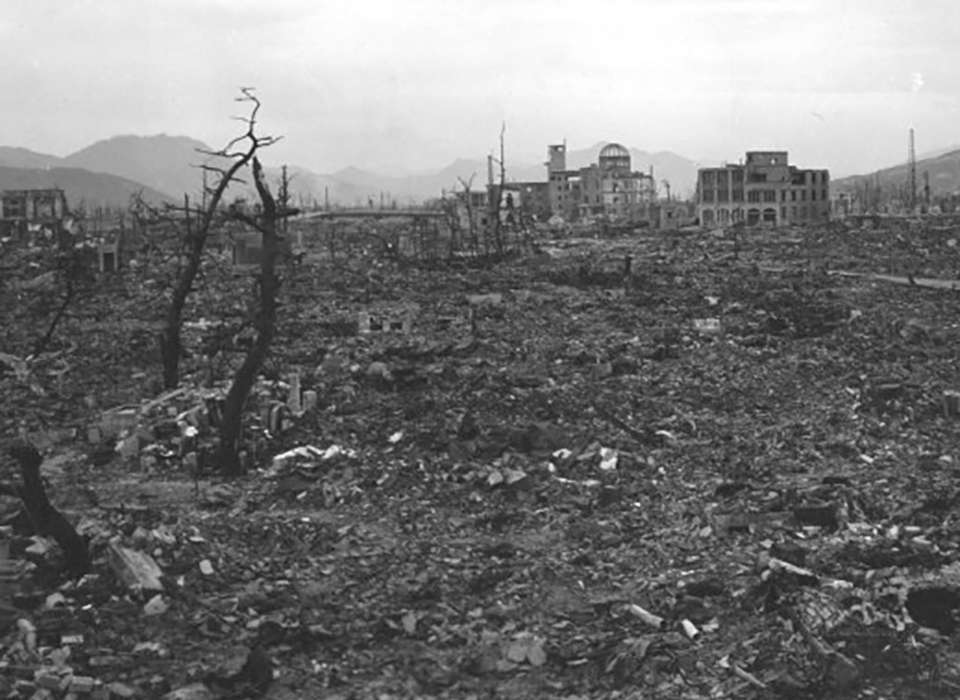
They have not forgotten. Have we? They cannot erase the scenes from their minds. Can we? They were walking across Yorozuyo Bridge, feeding a child in Hijiyama Park, gossiping on the Hakushima trolley. It was August 6, 1945. Where were you? Or had you even been born? Is Hiroshima real to us? It should drive us all mad to keep such images alive, the images which remain seared into the minds of the survivors of the first atomic bombs. No, they have not forgotten. The intensity of the horror has kept each pitiable, agonizing moment of that apocalypse alive for posterity to consider now, once again, as the nations talk about new nuclear holocausts.
There are Japanese adults who can still draw, in painstaking detail and in the manner of children and primitives, memories of more than thirty years ago: crushed and ‘mutilated bodies, women with their hair standing straight on end in ultimate horror, terror and pain, ghostly shadows of people who had simply evaporated as the 300,000 degree temperature engulfed them, children with heads like swollen monsters, blood gushing from eyes, seared skin dropping off or hanging in tatters.
If you have read this far, and you are willing to confront the drawings by survivors of two atomic devastations, you are, I believe, a brave human being. It is undoubtedly necessary that we all confront them, feeling our own nausea as the palest reflection of what it must have been like to have been in Hiroshima on August 6, 1945, and in the days afterward, or in Nagasaki on August 9, and for the years of living in pain they all endured.
Unforgettable Fire is a selection of 104 pictures from a total of 975 sent to the Japanese Broadcasting Corporation in response to a television appeal made in 1974. The collection began when an old man, Iwakichi Kobayashi, visited the NHK studio in Hiroshima with a picture he wanted very much “to leave to posterity.” The simple drawing was of a scene of innumerable burned and dying people near Yorozuyo Bridge. When the station managers appealed for more pictures by survivors, they poured in, sometimes accompanied by survivors themselves, many of whom sobbed uncontrollably as they recounted the events they had depicted in pencil, crayon, magic marker, India ink, or water color, on the backs of calendars, paper from sliding doors, advertising posters, even on children’s lined school paper. Reporters went to interview survivors afterwards. A typical response: “My hands are trembling and my heart throbs as I think of how I should explain the reality of that situation so that you can really understand.” Can we understand?
Each of us undoubtedly has a limit beyond which we cannot confront horror without losing our ability to cope with reality. Years ago, in a famous accident, a munitions ship exploded in Halifax Harbor, Nova Scotia. One of the doctors who tried to cope with the reality of what he saw-hundreds of cruelly dismembered bodies-went out and committed suicide. Hiroshima and Nagasaki were no accidents. They were planned holocausts in a war that becomes increasingly difficult to explain to a generation that cannot believe any war could be called a “good” war. Historians have long argued whether or not the atomic bombs were necessary to put an end to World War II. Harry Truman thought he was doing the right thing: saving a million Americans who would have died if we had had to invade the mainland of Japan. Already twenty million Russians, ten million Poles, six million Jews, countless Chinese and Malaysians had died. In a war that had required the fire-bombing of Dresden to help stop Nazi Germany, perhaps the atomic bombs dropped on Hiroshima and Nagasaki were not considered potential horrors. Perhaps we were all too saturated with horrors by then to worry about the consequences. We were fighting for our own survival in a war we believed was necessary. The consequence has been that we of that particular generation have been living ever since with the repressed memories of Hiroshima and Nagasaki.
Yet those memories are precisely what the Japanese Broadcasting Corporation pleads with us, through the images of the survivors, not to repress. The drawings are published in the name of peace, to ask for the abandonment of the nuclear arms race as an intolerable insanity. They ask us to look at these crude pictures, none of them by professionals, and listen to the screams which emanate from each of them. They are the screams we will hear in our own cities if ever the military of any country persuades us that there are “acceptable” losses; if, in other words, the military of any country believes it can once again bring to the world that unquenchable fire.
Susan Sontag has written eloquently of looking at the devastating photographs of Nazi concentration camp victims and of how that experience changed her life. John Hersey, who gave us his own remarkable account of Hiroshima, is quoted on the jacket of Unforgettable Fire: the crayon and pencil drawings are “more moving than any book of photographs of the horror could be, because what is registered is what has been burned into the minds of the survivors.” It seems odd that a book of drawings could be more effective than a book of photographs, for we are accustomed to think of photography as the ultimate medium for capturing the details of anguish. Yet the anguish recorded by these diagrams and brief texts, water-color paintings that are hardly more than amateurish scrawls and crayon daubs, is more evocative than any photographs I have seen.
Perhaps, for once, photography has been surpassed in its ability to convey emotion. When we look at photographs, we are always conscious of the single isolated moment in time which the camera is capturing. The drawings in Unforgettable Fire are the distillations of more than thirty years of memory, with irrelevant details-those very details for which the camera is often praised-obliterated as the emotional content burns its way onto the page. The presumed objectivity of the camera and its ability to seize decisive moments—and we had many of those in the last days of the Vietnam War—have given us masterpieces of recorded suffering. But we do not want masterpieces about the mushroom cloud of pain; we recognize the immediacy of the memories which the survivors are asking us to share.
Memory offers a vividness of imagery that perhaps no photograph can ever match. I remember the first days of the atomic bomb as one specific, intense memory. I was seventeen, working as dishwasher in the kitchen of a Cape Cod restaurant. It was a blazing August day, with a Van Gogh sun searing through the tops of the pine trees across the road from the restaurant. The water of the bay was the purest turquoise. The remote, peaceful clamor of seagulls drifted into the kitchen, where the French cook was fussing with a gauze bandage she had on her thumb: she had been cut, not badly, when an ancient fan had snapped one of its blades and hurled it into the oven just as she was opening the door. It was the end of the lunch hour. Suddenly, all the bells in the harbor began ringing, the fog horns were blowing, people out on the docks were screaming and shouting. Everyone in the restaurant ran to the windows or out onto the small dock, and I, unthinking, rushed into the off-limits dining room with my sodden, greasy apron wrapped around my jeans. Someone shouted, “The war is over! The war is over!” and we all fell on each other’s necks, sobbing and laughing and screaming with joy. In about ten minutes, I was asked to return to my chores in the kitchen. Later, I recall hearing the President of the United States making a radio announcement in the most solemn voice imaginable: the world had changed forever. I was frightened and chilled; I looked down at my bare arms and saw the hair standing on end. The goose-flesh was almost painful.
At that moment, in Hiroshima, halfway around the world, human beings of all ages were watching seared flesh fall from their arms.
Can we understand? Can we stop the fire before it starts? Or will we, one day in the not-too-distant future, envy the fortunate dead?
Independent and nonprofit, Boston Review relies on reader funding. To support work like this, please donate here.