
John O’Connor made his first modest contribution to the nuclear weapons race during the early 1950s. As a young chemist recently graduated from Harvard, O’Connor did bomb detection work in a laboratory in downtown Boston, analyzing the radioactive residues that had collected on filter papers. The filters had been on board remote-control pilotless “drones” that flew over or near British, American and Soviet nuclear test sites. His job was to determine the characteristics associated with different kinds of blasts.
Today, three decades later, the Arlington resident is still very much a part of the same arms race. In the Solid State Sciences lab at the Rome Air Development Center, Hanscom Air Force Base, John O’Connor grows quartz crystals that are nearly flawless. “Basically,” O’Connor explains, “you start with impure quartz and place it in the bottom chamber of a two-chamber autoclave, which is really just a fancy pressure cooker. Then you fill both chambers with a sodium hydroxide solution, seal it up, raise the temperature to 400 degrees Centigrade and the pressure to 15,000 pounds per square inch, and see what happens.”
Under the intense heat and pressure the quartz in the lower chamber dissolves and the particles migrate through a baffle, into the upper compartment. There, over a period of several weeks they arrange themselves in a perfectly symmetrical pattern, around a tiny seed crystal. Sometimes the forming crystals explode—”we call them ‘bombs,'” says O’Connor—but more often the autoclave yields a dense transparent piece of quartz that is shaped like a brick with its corners shaved off. The crystal, typically two inches wide, two inches deep, and five or six inches long, is then “oriented,” cut in a particular direction—horizontally, vertically or diagonally—according to the properties desired in the resulting segment.
O’Connor and his colleagues are not told where the crystals are sent or what they are used for. “We do know they’re not production crystals. They’re for research and I’m very sure they’re used for strategic weapons work. In our work we’re striving for two things: to make quartz crystals that are more resistant to gamma, neutron and electromagnetic pulse radiation such as results from a nuclear blast, and to make crystals that have less drift than those currently available.” The latter property—which determines a crystal’s accuracy when used in a timing device—is important in navigation and guidance work.
In some respects, O’Connor, fifty-seven, is characteristic of the men and women who work on nuclear weapons. He’s a middle-aged, middle-class suburbanite, a former Army man who has worked in the defense field virtually all of his adult life. He believes that the United States must maintain a strong military posture, but unlike many of his coworkers, O’Connor feels the nuclear weapons race has gotten out of hand, and he’s not afraid to say so. “People shrug and say, ‘Oh, nuclear weapons have always been around.’ But the danger they posed thirty-five years ago is nothing compared to the danger they pose today. Back then it wasn’t a question of wiping out the entire population on earth. Today if the United States and the USSR get involved in a full-scale war, everybody’s going to die.”
O’Connor, who has been arrested for his anti-nuclear activities off the job, is outspoken on the job, handing out petitions, tacking up relevant news-clippings on the bulletin board, urging his coworkers—many of whom agree with him, he says—to be more vocal in expressing their opposition to the arms race. In a tight-lipped, often self-defensive weapons-making community, his candor is refreshing.
When asked about the nuclear weapons work being done in this state, corporate spokesmen often say, “But we don’t make nuclear weapons in Massachusetts.” It is true that no local company builds the blunt-nosed Trident submarines; they do that in Connecticut. Nobody here builds medium-range Pershing missiles or F-11 strategic bombers; they do that in Florida and California. Nor is there a facility here for enriching uranium or assembling warheads; these tasks are performed in Kentucky, Tennessee, Ohio and Texas. But while it’s true that no Massachusetts firms actually make nuclear weapons, it’s also true that companies here provide the sophisticated technology that makes those weapons work.
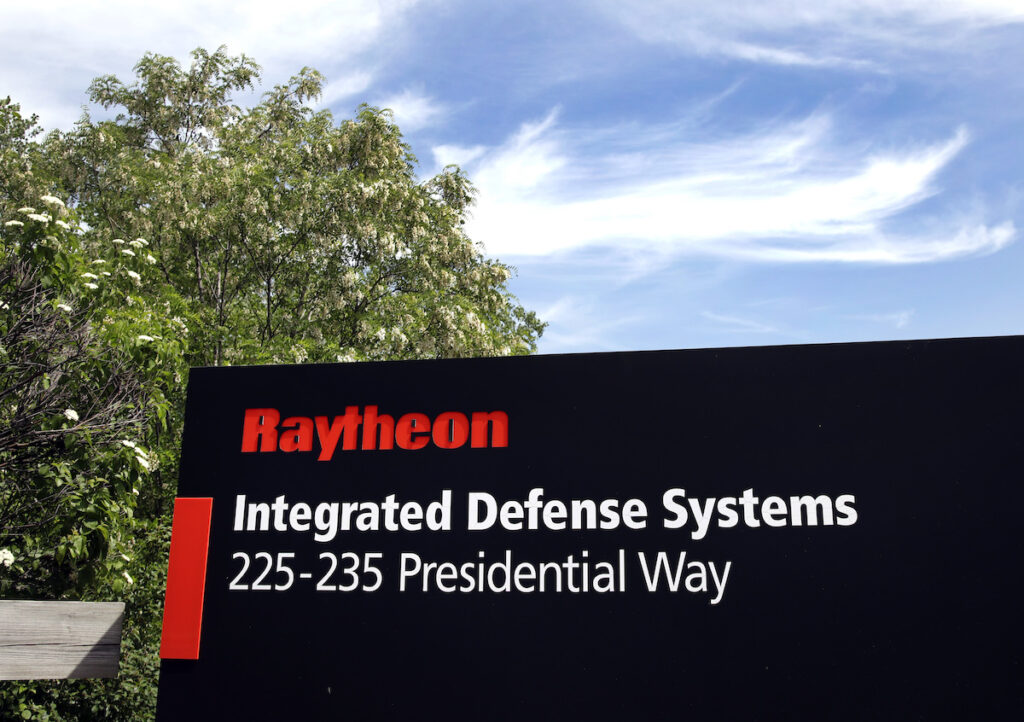
Massachusetts corporations and institutions—like Draper Laboratory, Northrop, Avco, and General Electric—design and build the intricate control-navigation-and-guidance systems and the re-entry vehicles that take strategic and tactical nuclear missiles to their targets. Others, GTE and MITRE, for example, devise the massive communications networks that link strategic missiles to their commanders and to the White House, the Strategic Air Command (SAC), the North American Air Defense Command (NORAD) and the Worldwide Military Command and Control System (WWMCCS). In Massachusetts, too, the Raytheon Corporation and its subcontractors devise the state-of-the-art radars that monitor Soviet ICBM tests and those that will warn if a nuclear strike has been launched. The Air Force’s Electronics Systems Division (ESD) in Bedford manages the civilian contracts for the conversion of Boeing 747s into E-4Bs. These are the Airborne Command Posts that will allow the highest-ranked surviving military authorities to conduct a nuclear war while airborne perhaps en route to the fortified Cheyenne Mountain Complex in Colorado (whose communications systems are updated with technical assistance from the MITRE Corporation).
The state’s primacy in the nuclear weapons field dates from the first years after World War II, when MIT emerged as the nation’s top breeding ground for electronics specialists. During that period, the Armed Forces repeatedly tried to relocate some of the government’s Boston-area research facilities to other parts of the country. But much to the dismay of military planners, MIT graduates and faculty members who had staffed military labs-during the war were unwilling to relocate. The Air Force was forced to stay.
Over the next thirty-five years, the Massachusetts-based Air Force bureaucracy, the MIT-bred research community and a constellation of entrepreneurial companies thrived on three related technological trends: the growth and diversification of the nation’s strategic weapons arsenal, the military’s hunger for more sophisticated nuclear weapons delivery systems, and the consequent ascendancy of the Air Force as custodian of the nuclear battlefield.
Because U.S. military spending data is not subdivided into separate categories for conventional and nuclear weapons spendings it is virtually impossible to say precisely how many millions of dollars are spent annually in Massachusetts on nuclear weapons systems. But given the concentration of high-technology contractors here, it is safe to say that nuclear-related weapons spending forms a large part of local Department of Defense spending, which is in turn a vital sector of the state economy.
In fact, defense spending in Massachusetts is on the rise. “In the ten years from 1969 to 1978, inclusive, there was a substantial increase in defense-related employment,” says Ernest Lucci, Massachusetts Commissioner for Commerce and Development. “In 1969, there were 509,000 people employed in that sector. By 1978, the figure was 603,000, an increase of 20 percent. In 1980, 5.9 percent of personal income in the state was derived from defense-related industries, double the national average.”
Though Massachusetts ranks tenth in population among the fifty states, in fiscal year 1980 it ranked fifth in the battle for Pentagon “prime contracts.” A study done for Congress showed that the Bay State, which encompasses only 2.6 percent of the nation’s population, received 5.3 percent of the prime contract money awarded in 1979, a total of $2.98 billion. At the same time, a survey of subcontracting indicated that Massachusetts lands over 6 percent of all subcontracts and manages to keep an unusually large share of that money within the state.
Not surprisingly, military spending reaches into every corner of the Commonwealth. During fiscal year 1980, Barnstable County netted $18.4 mil-lion in Department of Defense (DoD) prime contracts; Berkshire County, $93.6 million; Bristol County, $96 million; Suffolk County, $109 million; Norfolk County, $234 million; and Middlesex County—home of Raytheon, Digital, Draper, MITRE, Prime, divisions of Wang, General Electric, GTE, Avco, Lincoln Laboratory and Honeywell—a staggering $1.6 billion. The state’s 1980 total figure of $3.7 billion does not even include contracts of less than $10,000; subcontracts awarded to Massachusetts companies by out-of-state prime contractors; contracts made by other government agencies but with DoD funds; or the $2 billion budget of the Air Force’s Electronics Systems Division.
A large percentage of this money is funneled into the Massachusetts nuclear weapons complex, which is in many respects a microcosm of its national super-structure. The participants can be classified as belonging to one of four broad categories: Massachusetts-based divisions of major corporations; nonprofit institutions, including but not restricted to universities, primarily involved in research, development, testing and evaluation (RDT & E); small or medium-sized locally based entrepreneurial companies and small corporate divisions, which support the work of large prime-contracting firms; and a military bureaucracy—the powerful Electronics Systems Division (ESD) of the Air Force Systems Command—that oversees much of the weaponry done here.
Because of long lead times and the high level of sophistication in a typical weapons communication or delivery system—dozens of components and subsystems conceptualized, engineered and manufactured by dozens of corporate and institutional contributors over a period of ten to fifteen years—these four subsectors of the state economy have formed an ongoing partnership. Dominating that partnership are the Bay State-based divisions of major corporations: GTE’s strategic Systems Division in Needham Heights and Westborough, Northrop’s Precision Products Division in Norwood, Avco’s Systems Division-in Wilmington, the Avco Everett Research Laboratory in Everett, General Electric’s Ordnance Division in Pittsfield and Raytheon’s Equipment Division in Wayland. These divisions thrive in a Pentagon contracting system that last year gave 50 percent of its $77 billion in prime contracts to only thirty-two corporations.
Raytheon, for example, has been a key contributor to the Navy’s Fleet Ballistic Missile Program for the last twenty years, providing guidance system electronics for all generations of the Poseidon, Polaris and Trident submarines and missiles. Before the concept of anti-ballistic missile defense was abandoned as too dangerous and provocative, Raytheon held contracts for development of anti-ballistic missile site radars. -The company performed a study of guidance for the ASALM, the advanced strategic air-launched cruise missile originally intended to be carried on the B-1 bomber, but also adaptable to B-52s and F-111s.
But Raytheon’s most visible and spectacular work has been in the field of defensive radars. The Equipment Division’s Pave Paws (phased array coastal radars) provide a good example of the kind of specialization that distinguishes so many defense-related projects. The two installations, one on the West Coast, the other located on Flatrock Hill at Cape Cod’s Otis Air Force Base, are ten stories high. Each radar “building” has five working levels and five mezzanine levels, kitchen facilities and office spaces. Two of the building’s walls act as radar faces, each tipped back about 20 degrees from the foundation line, looking up at a slight angle and out to sea. These two walls are embedded with hundreds of rod-shaped radar units whose multiple target-tracking ability is coordinated by computer. Seven interlaced software programs contribute to the radar’s “mission”: to track sublaunched missiles from as far as 3,000 nautical miles, and relay attack and impact warnings to the National Command Authorities, the Strategic Air Command in Omaha and NORAD, in Cheyenne Mountain, Colorado.
GTE’s Systems Division is another prominent member in the state’s nuclear weapons group, widely known for its work in strategic missile C3 or C-cubed—the electronics-based command, communications and control systems that link military commanders to their data-gathering hardware and their weapons control equipment. Based in part on its previous track record with C3 for the silo-based Minuteman missiles, GTE won a $325 million five-year prime contract for the full-scale engineering development of the MX missile’s C3 hardware and software.
Should the MX be approved for production in its original land-based, “shell-game” mode, GTE would probably win a new round of contracts for the production of some 30,000 miles of fiber optic cable, 5,000 computers of varying complexity, 10,000 transmitters and receivers, 10,000 encryption devices, 1,000 radios and an immensely complex package of software to govern the whole communications system. Of course, the company may end up producing smaller quantities of the same components.
GTE’s MX work illustrates how weapons projects both exploit and advance state-of-the-art technologies. According to GTE’s MX program director, Frederick Giggey, the C3 system now in development “will be the largest application of fiber optics technology to date. Fiber optics transmission lines (hollow, hair-thin filaments of purified glass) are especially appropriate in this kind of situation, first because they can transmit, via laser pulses, much larger volumes of data than can be carried by conventional copper wire. Secondly, fiber optics are much less susceptible to the transmission disruptions caused in copper wire by the electromagnetic pulse radiation that saturates a nuclear blast site. And our own GTE labs in Waltham have been leaders in developing that technology.”
Giggey, who sometimes offers his guests coffee served in a mug stamped with GTE’s MX logo, says “another advance in this system is the high degree of automation, the high level of integration of computers. This will make it more flexible, faster and more secure from enemy countermeasures such as decoding or jamming efforts. That level of computer use calls for still other innovations in software and here I think we’ll be advancing the state of the art especially in computer protocols.”
Giggey cites still other examples of MX-related innovations: the use of Norden computers, sophisticated militarized versions of commercial equipment sold by Digital Equipment Corporation (DEC) of Maynard; the development of improved middle-frequency radios; a state-of-the-art word and data processing system (using DEC hardware) that helps GTE’s MX managers monitor the thousands of sequential tasks that go into sophisticated weapons design.
Just as Raytheon has cornered a large piece of the radars market and GTE much of C3 work, so have other companies here carved out their specialties. Northrop’s Precision Products Division in Norwood manufactures gyroscopes for the guidance systems of submarines, commercial and military marine vessels, aircraft and missiles. Northrop-Norwood is now working under a $36 million contract for full scale engineering development of the gyroscope for the Advanced Inertial Reference Sphere (AIRS), the MX’s inertial guidance unit.
The Avco Corporation’s Systems Division in Wilmington which received $75 million in RDT & E money for fiscal 1980, probably comes as close or closer than any company in the state, to doing the kind of weapons work the public usually envisions. The division, whose credits include development of penetrating warheads for the Pershing II, holds a contract for development of an “advanced airburst fuze” for the MX. Pursuing one of its specialties, Avco is also doing the full-scale engineering and development of the MX re-entry “bus,” the vehicle that is released from the missile to fall toward earth, all the while distributing warheads—an MX missile will carry ten—to their preprogrammed targets. This is the logical follow-up to Avco-Wilmington’s re-entry work on the Minuteman II and Trident missiles. Meanwhile, Avco’s Everett Research Laboratory is pioneering on the next military frontier, outer space, where directed energy weapons (lasers) may be used to neutralize or destroy foreign data-gathering military satellites, thus rendering the targeted country vulnerable to nuclear attack.
The second subsector of the state’s nuclear weapons complex is occupied by three influential nonprofit research facilities, all MIT offspring: the Charles Stark Draper Laboratory, the MITRE Corporation and MIT’s Lincoln Laboratory. Last year, 113 nonprofit institutions were listed among the 500 top recipients of Pentagon research and development contracts. Of those 113, Lincoln Lab, with $129 million, MITRE with $110 million and Draper with $57 million in contracts ranked third, fourth and fifth. (By comparison, Harvard was a very distant 29 with $5 million in contracts and Boston College, with $2.4 million, ranked 48.)
The three research facilities differ markedly in their technological specialties, but they all serve key support roles in Massachusetts nuclear systems work. Draper, the most famous of them, is an organizational and spiritual descendant of the old Aeronautical Engine Laboratory at MIT where, in 1931, “Doc” Draper and his associates began a half century of pioneering work in gyroscopic instrumentation. Their research led to dramatic improvements in air and marine navigation, the development of sophisticated gunsights and artillery fire-and-control mechanisms, and the evolution of guidance, navigation and control (GN &C) technologies for manned and unmanned flight.
Draper-designed GN & C units have governed the flight of succeeding generations of strategic missiles: Thor, Titan II, Polaris, Poseidon, Trident I, and Minuteman III. Some of Draper’s navigational instruments are so infinitesimally sensitive that a human thumb print or a single mote of dust can throw them out of alignment. At the same time, they can guide the unpiloted flight of a thirty-five-ton missile traveling at tremendous velocity; measure at any given moment, and within a tolerance of a thousand feet, the distance traveled since launch and the distance remaining to target; correct and recorrect the flight path through the vacuum of space; sense when velocity, altitude and angle of attack are in proper conjunction and then generate a signal for the jet-propelled engine to be shut down and the payload, a re-entry vehicle armed with one or several warheads, to be released for freefall toward its target area.
Although MIT bowed to political pressure and divested itself of the lab in 1973, informal ties between the two institutions remain. The newly constituted Draper Laboratory built its headquarters in Technology Square, two hundred yards from the MIT campus. A Draper spokesman recently told a local television station that some fifty to seventy-five “resident students” from MIT graduate programs work as research assistants at Draper, with their stipends being paid from Laboratory funds. And it is commonly known that many MIT faculty use their one-day-a-week consulting privilege to moonlight as consultants to Draper.
Lincoln Laboratory in Lexington was founded in 1951 by MIT at the joint request of the Air Force, Army and Navy. Originally established to develop new techniques to protect the country against attack from the air, the Laboratory was involved in the 1950s in designing three major early-warning and air-defense systems: the DEW Line, the SAGE system and the Ballistic Missile Early Warning System. Lincoln Lab has since moved into work on long-range, high-resolution radars, space object surveillance, ballistic missile offense and defense and military satellite communications. Employing several hundred professionals and an even larger support staff, Lincoln Lab is still operated by MIT and still receives the lion’s share of DoD prime contracts, $129 million out of the $153 million awarded to the university.
MITRE, a nonprofit research facility based in Bedford, spun off from Lincoln Laboratory in 1958, at the request of the Defense Department. The corporation serves as “system engineer” for ESD, assisting the Air Force in systems planning and engineering, feasibility and cost studies, testing and evaluation. Eighty-five percent of revenues for MITRE’s Bedford Operations division comes from ESD.
MITRE, which specializes in C3, is updating the Defense Intelligence agency’s vast computer. These systems receive and-process such data as attack warnings, order of battle and targeting priorities. MITRE also helped test the E-4B command posts for resistance to electromagnetic pulse radiation, made technical contributions to the Pave Paws radar program and has occasionally served as a technical trouble-shooter. Last year MITRE was one of the three Bay State contractors (Lincoln Laboratory and Bolt, Beranek and Newman in Cambridge were the others) called in to determine the cause of an electronics malfunction that triggered a false warning of a submarine-launched missile attack on the United States and sent Strategic Air Command pilots rushing to their planes where they waited, with engines running, until a “false alarm” report came through.
The people who run the Electronics Systems Division at Hanscom Air-force Base in Bedford are fond of saying that ESD, with its $2 billion annual budget is, in essence, “the fourth largest industrial concern in Massachusetts.” Commanded by three-star Lt. General James Stansberry, the highest ranking military man in New England, ESD is charged with meeting the long- and short-term C3 needs of the Air Force, sponsoring basic research that dovetails with those needs, and then acquiring from civilian contractors the communications hardware and software that link Air Force commanders and National Command Authorities (NCA) to their bewilderingly sophisticated array of missiles, planes, satellites, radars and command posts.
While the Division’s influence has grown, its budget has increased seven-fold in the last fifteen years. During that period, ESD has forged strong ties with Massachusetts companies. The close relationship between business and the military is seldom as evident as it was one day last spring when about two hundred people gathered on Boston Harbor’s South Pier to witness the recommissioning ceremonies for the USNS Observation Island. The twenty-seven-year-old vessel-from whose deck President John F. Kennedy had watched the submarine launchings of Polaris missiles in 1963-was being reincarnated as a radar ship designed to monitor ballistic missile test launchings deep inside the Soviet Union. Under a $60 million contract managed by ESD, Raytheon’s Equipment Division in Wayland and a host of subcontractors had taken the 563-foot vessel out of mothballs, fitted her with a massive phased array radar-four stories high, weighing 250 tons, and able to track multiple targets simultaneously. Finally, they painted her white from stem to stern.
ESD’s General Stansberry told the crowd, “this project is a good example of something I think we all tend to forget about-patriotism. It shows that a lot of men and women from a number of different companies can work in close cooperation with the Armed Forces to produce a piece of hardware that’s of vital importance to our nation’s security. We at ESD intend to continue to provide an environment where that kind of teamwork can flourish.” When the speeches were over and the principals were given a round of applause, the guests crowded into the ship’s galley to eat sandwiches, drink coffee and nibble at dessert, a large rectangular chocolate cake with white frosting. As if the point had not already been made, a careful hand had written in candy icing on the cake’s corners: Army Navy Air Force Industry.
Finally, numerous small businesses and small corporate divisions comprise the fourth segment of the state’s nuclear weapons-making community. Hundreds of these firms support the large, prime contractors in such areas as parts and equipment manufacture, computer software design, and systems testing. To insure their share of business from year to year, they may develop an esoteric specialty, maintain a close relationship with a particular prime contractor, or even generate “rifle shot” research proposals, hoping to catch the attention of an influential Pentagon planner.
All kinds of companies find a niche in the defense spending structure. SofTech, for example, a tiny Waltham firm, saw its 1980 revenues skyrocket 57 percent to $13.8 million when its Federal Systems Division won a contract to do the full-scale engineering and development work on a JOVIAL compiler for the MX. (A compiler is a sophisticated device that can translate several different programming codes-instructions written by engineers for a computer-into a single more complex machine language the computer can comprehend more readily.)
Valtec, a 170-person West Boylston firm that’s held by two conglomerates, is producing 138 kilometers of fiber optic cable, which GTE will use in its test-phase MX C3 system. Dynamics Research Corporation of Wilmington-which recorded $27 million in sales last year, half coming from government contracts-has a long history in strategic weapons work: assisting the Navy with guidance systems for Polaris, Poseidon and Trident missiles; testing gyros and accelerometers for the Navy’s Fleet Ballistic Missile Program; developing data retrieval-storage-and-analysis technology for the MX guidance system. DoD records show that Visidyne Inc. of Burlington reported on a project titled Modelling of Optical Backgrounds (which one student of nuclear weaponry describes as a study of the effects of nuclear explosions). Visidyne’s report is indexed in the Pentagon’s Technical Abstract Bulletin under such vivid categories as Nulear explosions, Airglow, Shock waves, Fireball, Atmospheric heave, Chemiluminescence, Background radiation, Nuclear explosion simulation.
It is impossible to assess how deeply and to what end nuclear weapons spending influences Massachusetts’ economy. Again the best one can do is consider the impact of defense spending as a whole. Traditionally, supporters of high levels of military spending have argued that the influx of defense dollars creates jobs, stimulates the state and municipal economies and creates technologies that can be adapted, for profit, by the civilian sector.
Locally, at least, this view prevailed until the economy of the post-Vietnam War years showed that military spending can stimulate inflation, deplete the innovative capacities of the civilian technical-industrial base, and subject communities or regions to the “bust” phase that invariably follows defense-related “booms.”
According to Ernest Lucci, a new round of defense spending increases could cause some disruption in the state’s high-tech industry. “It’s really a supply and demand issue,” says Lucci. “There’s already a scarcity of scientists, engineers and technicians here. If the demand increases as a result of new defense contracting, you’re going to end up with a bidding process wherein the defense programs will usually be able to bid a little higher for people’s services. They’ll gravitate out of the civilian sector and into defense work.”
Lucci acknowledges that such a bidding process is per se inflationary because it drives up the cost of doing business without adding to productivity. But the real danger, he feels, lies in the depletion of the civilian sector’s technology base. This theme is common among opponents of increased military spending. According to Paul Walker, arms control specialist for the Union of Concerned Scientists (UCS), “military spending, especially for re- search and development, monopolizes one of the economy’s most important resources, innovative thinking. You’re using a lot of brain power to develop products, weapons, that are meant not to be used. This is certainly one of the factors that contributes to the nation’s declining productivity and our poor standing—in automobiles, television, consumer electronics—relative to other industrialized nations.”
Opponents also cite the wrenching economic “busts” in arguments against increased military spending. Lucci believes the Route 128 high-tech belt is now not as vulnerable to the bust phase as it was in the late 1960s and early 1970s, when thousands of people lost their jobs due to large defense cutbacks. “A lot of companies learned a hard lesson when that happened. They started to diversify into other markets, less profitable maybe but more stable, so they wouldn’t be so hard hit by fluctuations in military funding. Raytheon is a good example. They’ve diversified into kitchen appliances, publishing and commercial aircraft.”
Nonetheless, companies with heavy investments in weaponry can have the rug pulled out from under them, sometimes on short notice. The ever-approaching, never arriving MX missile system offers a timely example. According to GTE’s Fred Giggey, if the original Nevada-Utah land-basing system is rejected in favor of a sub-based mode, a more widely dispersed land-based mode, or a smaller version of the original land-based mode, his designers will have to go back to the drawing board and revamp the plans they have been working on since 1972. Although the DoD would finance any design changes, in the long run, a scaled down version of the MX could cost GTE tens of millions of dollars in previously anticipated revenues. A giant multinational corporation can adjust to that kind of change of plans. Small corporations, which often hold subcontracts on major defense projects, have a much more difficult time adjusting to the loss of business and, according to Giggey, many get out or stay out of defense work because they consider the risks too high.
Why do people and corporations and institutions get involved in nuclear weaponry? For profit, for patriotism, for the challenge.
With both individuals and businesses, money is an obvious motivation. In last year’s tight economy, revenues for SofTech’s Federal Systems Division were up 42 percent. MITRE’s revenues were up 25 percent. Raytheon’s earnings rose 17.5 percent. Draper’s income increased by 20 percent. Avco Systems Division’s revenues jumped 95 percent.
John O’Connor says that even his colleagues who oppose the nuclear weapons buildup stay in the field because they’re afraid of what will happen to them if they get out. “A lot of these guys are my age, in their late fifties, and they own houses and have kids in college. They want to protect their jobs. If they get sacked or if their own projects are eliminated they’re not going to find other work real fast. They’re scared.”
Paul Walker of UCS thinks that for many involved in nuclear weapons work the money is a secondary factor. “The technological drive is more important. If there’s a challenge, an exciting way to design a new system, something that’s bigger and faster, then people will be very interested in doing it. They get trapped in their own fascination with the puzzle they’re trying to solve. They refuse to take responsibility for the end-product of their work.”
The “we don’t fire them, we just build them” rationale that Walker alludes to is commonly expressed by rank-and-file workers involved with nuclear weaponry. But farther up the organizational line, among program directors, division heads and corporate vice presidents, the opposite attitude prevails: we build them, we believe it’s important they be built, and though we always defer to the authority of the elected leadership, we willingly assume a portion of the responsibility for safe-guarding the nation.
Stepping momentarily out of his role as a representative of GTE, Fred Giggey explains some of his personal feelings about the work he does: “It’s not true that there exists an evil cabal of war-loving generals and industrialists who form a consortium of merchants of death. There’s a lot of introspection in this business. Like all citizens, we have a stake in the future of this country, and history shows that the Soviet Union is a criminal nation whose leadership has murdered tens of millions of its own citizens and committed countless criminal acts against other countries. Our sickening fear is that if we don’t do our jobs well and make our voices heard in the debate-to show that our country is at great peril-we will have failed.”
Like Giggey, John O’Connor feels our country is in peril, but from within as well as from without. And like Giggey, he hopes to make his voice heard: “When I was first working in this field I had no feelings about it. I thought, ‘Hey, this is a great way to make a buck.’ But gradually I began to realize that if we didn’t make nuclear war obsolete, it will make us obsolete. Why do I keep on in this work? If I didn’t stay, who would talk to people, ask them to sign petitions, put things up on the bulletin board? The whole picture is getting worse and worse. I read once that in a limited nuclear war, two-thirds of the American population would survive. That means 70 million dead. That just didn’t sound too good to me.”
Independent and nonprofit, Boston Review relies on reader funding. To support work like this, please donate here.