I had been staring at his medical records for a couple of hours, reminding myself of the details of the case. Back in 2021, I wrote a “County of Origin Expert Affidavit” for a man in Immigration and Customs Enforcement (ICE) detention I’ll call Chuol (I’m using a pseudonym to protect his privacy). For such statements, I’m supposed to lean on my years of experience doing research in Sudan and South Sudan—since 2010 I’ve conducted extensive fieldwork in the Horn of Africa—to render an opinion on the likely consequences of someone being deported to one or the other country. Chuol was born in 1987, at the peak of Sudan’s second civil war (1983–2005), in what is now South Sudan, rendering him vulnerable to deportation to both states. As a child, he fled to Ethiopia, where he spent almost a decade in a refugee camp before being resettled in Virginia in 2009.
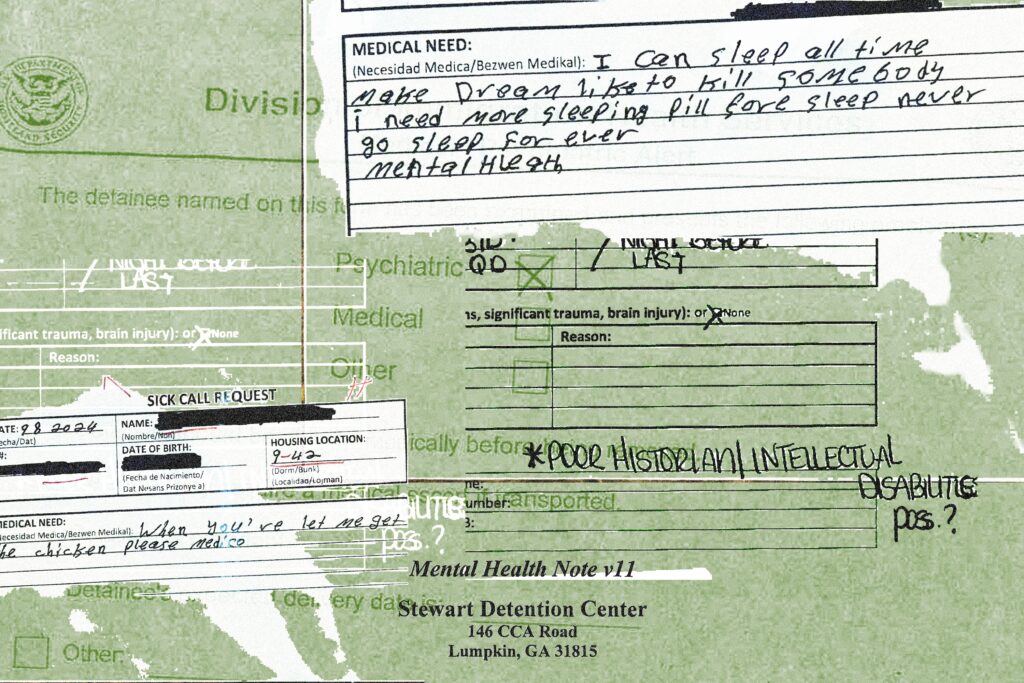
His case file was confusing. Chuol wrote that as a child, he was conscripted into a Christian militia, though no such organization has ever existed in Sudan. It wasn’t clear whether his father was killed in 1991 or 1996, or if Chuol was captured by the Sudanese government in 2000 or 2002. His story was full of holes, and the more he explained, the more confused I became. This was perhaps to be expected: Chuol had a long history of psychiatric trouble, and it is understandable that a severely mentally ill man would only have a minimal grasp of events that had occurred when he was a child. His medical records stated that he had trouble remembering things accurately. A doctor’s note pondered whether he had “intellectual disabilities” and accused him of being a “poor historian.” If you read his testimony with sympathy, however, you can glimpse a reality broken into pieces by poverty and violence, and marked by the absences that trauma leaves. The holes are the story. That didn’t stop government lawyers from arguing that his case should be thrown out. For Department of Homeland Security (DHS) staffers looking for evidence of fraud, all the contradictions and messiness of life are invitations to a deportation.
If imagining racialized violence abroad was beyond the U.S. immigration system, the judges could at least empathize with being deprived of antidepressants.
In 2021 Chuol’s case never made it to court, after ICE released him from detention for reasons I never quite grasped. Three years on, he found himself back in prison, facing deportation once again. I was preparing to testify in his case. The situation in the Sudans had not improved. A civil war had begun in Sudan in 2023 that had devastated the country, turning it into the world’s worst humanitarian crisis. Just before he left office, Biden declared a genocide had occurred in Darfur. People of southern Sudanese origin were being executed, their bodies left in mass graves. In South Sudan, a government counterinsurgency was blowing up hospitals and massacring civilians. Neither country would be a viable home for Chuol.
Not that America had been much of a refuge since he arrived in 2009. Chuol only had a minimal command of English, and had never really held down a job. He had spent long periods being homeless, and had accumulated a litany of crimes, principally theft and resisting arrest. His “A-file,” the legal document containing his immigration history, charts, in the clinical language of the state, his descent into addiction and mental illness. His rap sheet meant that he would no longer be eligible for a renewed asylum claim, which is disbarred to all those convicted of serious crimes, no matter the situation in their country of origin. His last hope of remaining in America was what is known as a “Deferral of Removal” under the Convention Against Torture. It’s a high bar. To get a DCAT ruling, as they are called, a lawyer has to show that it is more likely than not someone will face torture if they are deported, and that such torture has the acquiescence or sanction of a public official. This is precisely what was likely to happen to Chuol: the U.S. State Department and the UN have found that torture in detention by the security services of both countries is ubiquitous, a fact I hoped to make clear in my testimony. But even if Chuol got DCAT, his deportation would simply be deferred, and the matter could be re-opened at any time.
I used to get a couple of DCAT files a year, but since Trump slouched into office last January, my caseload has gone up asymptotically. None of the refugees whose cases I work on have actually fled the region’s wars, despite Sudan’s status as the world’s worst displacement crisis. Would that these refugees could reach the United States: the U.S. resettlement program was cancelled at the beginning of Trump’s term and Europe has hired militias to block refugees from coming north. Those that flee Sudan tend to be warehoused in camps in the Horn of Africa. The people whose cases I’ve been working on all came to the United States as children in the ’80s and ’90s, when the country’s refugee policy was more open and its concern for the Sudanese people more deeply felt.
All these refugees have a similar story. After arriving in America, they fell between the cracks, careening between halfway houses and prisons, desperately looking for something onto which they could hold. To read their files and speak to them over bad phone lines from state prisons is to encounter fractured homes, failed schools, and fingers lost to frostbite while drunk in Minnesota. One refugee was found ineligible for asylum due to a “serious crime”—in this case, assaulting an ICE officer by spitting on him as he tried to arrest her, while she was strapped to a gurney having a psychotic episode. None of these people understand anything about Sudan’s wars, which are as incomprehensible to them as to their white suburban counterparts. The only thing people like Chuol know is the name of their own ethnic group—the very fact that, in the countries to which they may be deported, will put their lives in danger.
Despite the parlous situation in the Horn of Africa, I hadn’t been successful in convincing the courts that people should not be deported to countries like Sudan, where the American government had already acknowledged a genocide was occurring. Being tortured or raped on account of your ethnic or racial background proved impossible for immigration judges in Denver or Phoenix to fathom. The centrality of Big Pharma to American life, though, turned out to offer us unexpected assistance. Most of the people for whom I wrote affidavits were severely mentally ill, and had long lists of prescription medicines accompanying their diagnoses. Neither Sudan nor South Sudan had any means of providing care for those with psychiatric problems, and neither country imported any of the drugs relied upon by the refugees I was trying to assist. In the burned remnants of hospitals in El Fasher and Old Fangak there is no Tylenol, let alone Sertraline, Risperidone, or Mirtazapine. The lawyers for those threatened with deportation used my affidavits to argue that to be deprived of one’s God-given American right to antidepressants was itself a form of torture. To my astonishment, this argument convinced judges. We won, and won again, and kept winning. If imagining racialized violence abroad was beyond the U.S. immigration system, the iniquities of the country’s health care meant that judges could at least empathize with being deprived of drugs, and to such an extent that this deprivation could be the basis for DCAT decisions. I hoped we could obtain such a ruling for Chuol.
Join our newsletter
New pieces, archive selections, and more straight to your inbox
I’d been asked to testify in his deportation proceedings back in October 2024, but the case had kept getting rescheduled, leaving Chuol languishing in jail. It was June 2025 by the time his file finally came to the docket, and I was in Watamu, Kenya, a quiet town on the Indian Ocean. Reading over Chuol’s medical records, I was struck by his obsession with white meat. In note after note, Chuol demanded chicken. “When you’re let me get the chicken please medice,” one entry read. His repeated demands would have been inexplicable if not for a later note in which Chuol told his doctors that he vomits when he eats anything else. In one three-month period in prison, he lost eight pounds. Maybe he has Crohn’s disease, one friend speculated. It was hard to tell from his medical records. Ailments surged up and then disappeared without a trace. One note he wrote reads:
MEDICAL NEED (Necesidad Medica/Bezwen Medikal):
I can sleep all time
Make Dream like to kill somebody
i need more sleeping pill fore sleep never go sleep for ever
Mental hleath
As I looked through Chuol’s file I kept checking my watch. The trial was due to begin at 2 p.m. Eastern Time—9 p.m. on the Kenyan coast. I joined the virtual courtroom early, only to hear Chuol’s lawyer chatting with his DHS counterpart. When I first started doing deportation cases, the degree of collaboration between what I thought were dueling opponents shocked me. The final decisions always felt like a conversation—a way of getting the two lawyers and the judge to agree together on a reasonable account of what should happen. Nothing about this felt reasonable. How could they discuss deporting someone who had only known America—and encountered the core of America’s problems, the racism and the homelessness and the willful blindness—to a country that didn’t even exist when Chuol last set foot in Africa, sixteen years ago? The lawyers were talking like old friends.
DHS: If he gets DCAT, we might just send him to Libya.
Chuol’s lawyer: Who is handling the removal proceedings from Djibouti? [Eight migrants were being held there, pending legal appeal, on their way to South Sudan, though most of them—Vietnamese and Laotians among their number—had no link to the country.]
When the lawyers realized I was online, their friendly chatter ceased.
The courtroom was one square of the virtual grid. Another was occupied by Chuol’s translator. Chuol himself was absent. He had been transferred to Texas, and the prison guards didn’t seem able to get him to a conference room to attend his own hearing. Regardless, the case continued. The DHS lawyer had been tardy in filing some paperwork, and the judge berated him. “When there are no consequences for actions, then people will do whatever they want,” she told the courtroom.
After I was called to the virtual stand and swore my oath, I had to prove my eligibility to be an expert witness. After twenty years of working as a conflict researcher in the Sudans, I’ve always been recognized. The DHS lawyer seemed resigned to letting me testify, and only wanted to insist that—as must be obvious—I am not an expert in mental health. He proffered this point as a gotcha, as if it invalidated what I was about to say.
If Chuol dies like other Sudanese or South Sudanese, the DHS lawyer continued, it’s not personal. He is just dead.
Chuol’s lawyer opened proceedings. Most immigration lawyers are harried and harassed, with too many cases and not enough time. If they have country of origin expertise, it is in Central America, not the Horn of Africa. Chuol’s lawyer was no exception, and while I have no legal training, I thought his questions were poor. The Padang Dinka, the group from which Chuol hails, were being forcibly recruited into government militias. Instead of asking me about this, and so establishing the particularity of Chuol’s situation, the lawyer simply noted that militia recruitment in general was ongoing in South Sudan—a point the DHS would later seize upon in cross-examination to establish that the risk to Chuol was no greater than that posed to the general population. “He might be recruited,” the DHS lawyer claimed, “but only because everyone will be recruited.” In her ruling, the judge would primly note that “sovereign nations have the right to enforce laws of conscription and penalties for evasion.”
After a cursory examination by Chuol’s lawyer, my cross-examination was held up for a moment: Chuol had finally arrived in the virtual courtroom. He wore an oversized orange jumpsuit, and nodded as his translator briefly explained the case to him. A prison guard slumbered on a chair nearby.
During cross-examination, the DHS lawyer acknowledged that while Dr. Craze had shown there are almost no mental health facilities in South Sudan, and those that did exist in Sudan had been destroyed by the civil war, and while yes, he conceded, there was only one psychiatric ward in Juba, South Sudan’s capital, with only twelve beds (three were recently broken and there was no money to replace them), and while yes, he admitted, in Juba, if you were lucky and mentally ill, you went to the central prison, and got chained, naked, to the floor on which you defecated, in a dark room devoted to “the lunatics,” he insisted that we should not be in the business of looking down at African standards of care. That the mentally ill were beaten with rubber hoses spiked with plastic fragments went unmentioned during his remarks. The judge later noted in her final judgment that “torture does not include . . . gross overcrowding and inadequate access to food, potable water, sanitation, heating, ventilation, lighting, or medical care.”
The cross-examination became a grandstanding performance by the DHS lawyer. It might be the case, he continued, that there is a civil war in Sudan, and a counterinsurgency in South Sudan, and both countries might be in the grip of humanitarian crises, but if Chuol dies like other Sudanese or South Sudanese, then he is simply dying, and he is not dying because he is Chuol, because of some special reason, some special thing, that makes him Chuol. It’s not personal. He is just dead. And as he will die, just like other Sudanese, he is not eligible for DCAT.
Chuol was unmoving, entirely mute.
After the cross-examination concluded, there was no redirect from Chuol’s lawyer. I was told that I could leave, but I stayed on to hear the closing arguments.
Chuol’s lawyer took less than five minutes to argue for DCAT. His phrasing was generic. There was a civil war in Sudan. Conditions were bad. Chuol shouldn’t be deported.
The DHS lawyer, in closing, made what seemed like an entirely spurious argument. Yes, Dr. Craze has shown that it is likely that security officers will burn Chuol with cigarettes. Yes, he will be beaten with sticks and rubber hoses. That is unfortunate. But if Chuol is indeed detained by national security at the airport after being deported, he will likely not be kept in detention for long, because he is a nobody, a nothing, not a rebel, and so not a threat to the government. (It was no longer clear, at this point, if the lawyer was talking about Sudan or South Sudan, not that anyone seemed to mind.) Because Chuol will likely be quickly released from detention, he will not have been burned with sufficient cigarettes for it to constitute torture.
The whole farce took two hours. The judge declared that she would make a decision within thirty-one days. She told Chuol, “I will never see you again, but I will pass my judgement to your lawyer.” Chuol’s translator didn’t translate the message. The screen went black.
A month later, on July 8, the judge ruled that Chuol was inadmissible for DCAT. He would be, as the ruling put it, “REMOVED to South Sudan or Sudan.”
Independent and nonprofit, Boston Review relies on reader funding. To support work like this, please donate here.