In “On Fairy-Stories,” his essay on the nature of fantasy, J. R. R. Tolkien famously distinguished between two kinds of escapism that fantasy might elicit: that of the Deserter, who flees real-world obligations out of fear or cowardice, and that of the Prisoner, who attempts to break free from the suffocating arrangements of society, or if failing to do so “thinks and talks about other topics than jailers and prison-walls”—refuses, in other words, the metaphysics of their oppressors. Tolkien’s point was that while many critics and readers might dismiss the fantasy genre as nothing more than escapist frivolity, fundamentally unserious and ultimately irrelevant, the best of it is fundamentally subversive, able to interrogate what passes for political reality—the set of taken-for-granteds the sociologist Pierre Bourdieu called doxa. Our hegemons love conflating the real and the possible, but our best fantasists never will. Nor will they confuse the real for the true, the number one magic of elite consensus everywhere.
You don’t need to squint hard (or raise your visor) to mark which escapism A Knight of the Seven Kingdoms, HBO’s latest installment in the TV franchise that began with Game of Thrones, fights for. The show might ostensibly be about knights and their derring-do’s and derring-don’ts, but under all that plate armor and chain mail, it also feels uncannily relevant to our conjuncture.
Be warned: if you are a fan of the original Game of Thrones and can recite the words of all the Houses, adjust your expectations accordingly. A Knight of the Seven Kingdoms is a smaller, less epic production, running only six episodes. Yet for all of its economics the series is a taut, gripping piece of entertainment that suffers none of the numbing portentousness of House of the Dragon or the contractive absurdities of Game of Thrones’s latter seasons. Scaled down though it might be (literally, for there are no dragons in the series) A Knight of the Seven Kingdoms is nevertheless peak fantasy, the rare lance that strikes true.
If the original series was a literal Game of Thrones, A Knight of the Seven Kingdoms can be described as A Question of Honor.
There are, of course, some problems. Many of the racial and gender maluses of the original series are in full display in A Knight of the Seven Kingdoms. The show is obsessively white and obsessively masculine. There is race in this world, but no one seems at all aware of it. And while the series is quite explicit about framing the ruling Targaryen family as literal hyperwhites, it is not at all interested in exploring how whiteness itself gets centered throughout. As for the female characters, they are given short shrift, relegated primarily to sex workers, rescue objects, and a nearly mute young princess. As for the two women of color with speaking roles, one has her fingers snapped and the other, an adolescent, is murdered outright.
For some this “imagination gap,” in writer Ebony Elizabeth Thomas’s phrasing, might be enough to stay away, and yet despite these drears, the show has proven a massive hit with audiences woke and non-woke alike—with the penultimate episode being lauded as among the finest thirty-seven minutes of television in years. A surprising outcome for a show that is nowhere as rousting as it presents, that by its conclusions proves to be an uncharacteristically mournful affair.
Like the original television series, A Knight of the Seven Kingdoms is set in the harsh war-riven Euro-medieval realm of Westeros in an era where a pale colonial dynasty, House Targaryen, presides uneasily over their fractionally less white conquered kingdoms. Former dragon riders, the alien Targaryen have civil-warred the last of their former steeds to death, and without their flying weapons of mass destruction their aura of legitimacy and invincibility has significantly diminished.
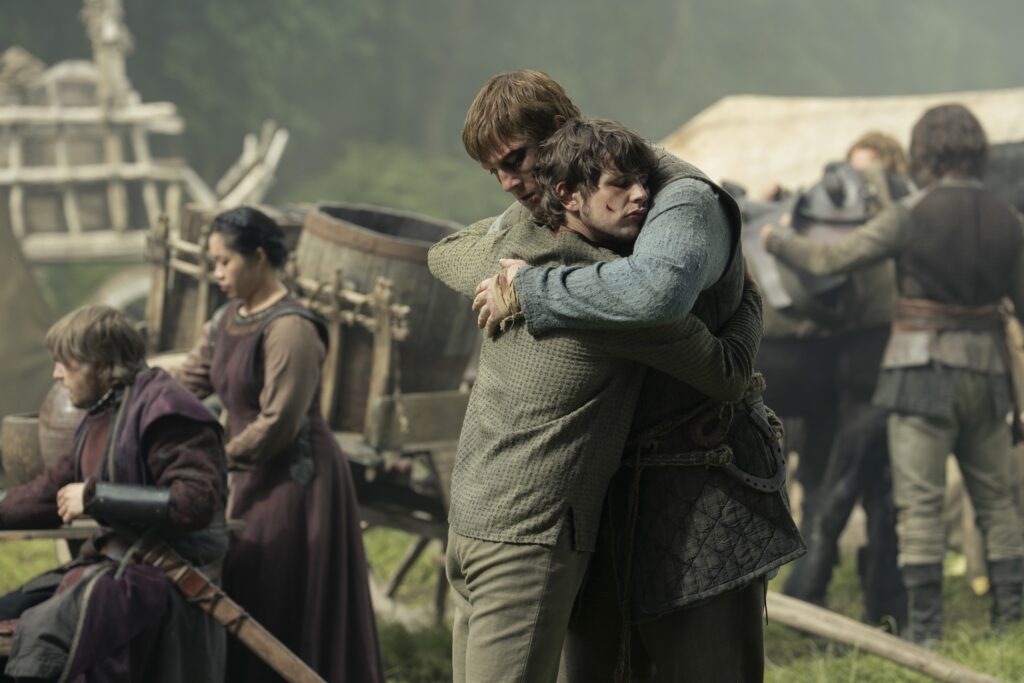
Into this unsettled state of affairs rides Ser Duncan (played with a haunted sincerity by Peter Claffey), a poor hedge knight seeking to make his fortunes at a royal tournament. Hedge knights are the gig workers of the chivalric economy, are to house knights what adjuncts are to tenured professors, and Duncan’s claim to even that lowest rung of chivalry is dubious at best. He’s a ghetto-raised orphan without relations or patrons; his knight master, Ser Arlan, recently died on the road, and as no one witnessed Duncan being knighted, there are questions as to his legitimacy. Duncan is a sub-sub knight, a poor young damaged idealistic nobody trying to make it in a world that devours the poor, the young, the damaged, the idealistic, and the nobody alike. His only advantages are his claim to, and belief in, chivalry and the knightly panoply he salvaged from Ser Arlan’s corpse.
On the lead-up to the tourney, Duncan acquires a very bald, very posh, very pale boy squire named Egg (played by the incredibly convincing Dexter Sol Ansell), struggles to secure a place on the list (no one remembers Ser Arlan), and ultimately and unfortunately runs afoul of the alien Targaryen overlords when he forcefully stops one of their princes from sadistically abusing Tanselle, a Dornish puppeteer he’s taken a shine to. Tanselle’s crime? That she dared portray a dragon being killed in her puppet show, which the Targaryens, the people of the dragons, interpret as an act of treasonous incitement. Important point: in the lore of Westeros, the Dornish tend to be coded as ethno-racial others. (The actor playing Tanselle, Tanzyn Crawford, is mixed-race Black.)
Join our newsletter
New pieces, archive selections, and more straight to your inbox
In defending the defenseless Tanselle and upholding the Davidic ethic of chivalry, the sub-hedge knight Duncan has acted like a true knight. But the former dragon riders are not famous for their moderation, forgiveness, or sanity. The Targaryens pay Duncan back by falsely accusing him of kidnapping a member of the royal family—no matter that said royal family member can testify to the opposite. In Westeros, as in Twain’s California, as in our America, it’s easy enough to swear away a vulnerable person’s life with a single lie. Duncan’s only chance to keep all his hands and feet attached to his body is to prevail in a seven-on-seven trial by combat. This poor nobody whose dead master no one remembers and whose knighthood comes with an asterisk now only has to convince six other knights to fight on his behalf against some of the most powerful, well-trained elite killers in the realm.
If the original series was a literal Game of Thrones, A Knight of the Seven Kingdoms can be described as A Question of Honor. In an era like ours where the dishonorable rule with utter impunity and prey on the weak as inhumanly as a dragon might, such questions—What do those who have owe those who do not have? What should one risk in the face of disgraceful injustice?—feel impossibly, uncomfortably timely, and the series grapples with its fictional dilemmas with surprising feeling and nuance. Duncan’s lonely desperation, his heroic refusal to succumb to Targaryen power and to become like the dragons themselves in spite of having nothing at all, and the terrible costs of standing up to injustice are indelibly rendered. The series, like Duncan, acquits itself, well, honorably. The rest of the realm? Alas, not so much. But isn’t that always the way it goes?
A Knight of the Seven Kingdoms pivots away from Game of Thrones and House of the Dragon—all human, no dragon, and certainly no bogus gravitas. And for my coin it’s better for it, a much lighter series than its other dragon siblings—more yuks, more playfulness, a sense that the creators and the actors are actually enjoying themselves. But for all that levity, A Knight of the Seven Kingdoms is simultaneously a darker, more disturbing show than its draconic older siblings, haunted by grief and loss in ways that the earlier series only ever gestured at. It’s surprising that it’s taken this long. Westeros, after all, is a land of forever wars fought at the behest and for the profit of cruel elites—sound familiar?—but unlike the franchise’s previous installments, A Knight of the Seven Kingdoms delves more deeply into the actual human costs paid by those who fight them.
The high fantasy that the strongest would defend the weakest will strike many in our current political climate as too ridiculous, too impossible.
Duncan’s master, Ser Arlan (portrayed in flashbacks by a pungent, reeling Danny Webb), is a wandering alcoholic veteran, shattered by his many years of service, as textbook a case of complex PTSD as can be imagined. A difficult, often abusive man whom Duncan both grieves and longs to redeem, Ser Arlan is a tragic figure: he sings Dothraki songs, alluding to foreign wars, and cuts himself up in his drunken revelries, the lure of self-annihilation never far. More tragic still, however, is how the show frames Duncan’s attempt to elevate himself by the very means that destroyed his master as a tragedy whose full horrors are only revealed when, after Duncan prevails, the price paid by the so-called winners is reaped. Duncan gets what he wants in the end, a most terrible victory, one that Tolkien’s Frodo, unable to heal after his long trials, would have recognized.
Fantasists have long been aware of the truth effect of their art: think of Terry Goodkind’s description of fantasy as “stealth philosophy,” or Ursula K. Le Guin’s insistence on fantasy’s radical potential, or N. K. Jemisin’s contention that fantasy is a way to “train for reality.” But for me it is Tolkien who provides a particularly useful way of thinking about A Knight of the Seven Kingdoms. In his The Lord of the Rings, the greatest of the Elves, Lady Galadriel, shows our heroic fellowship a magical mirror and bids them to peer into it, if they wish. “For it shows things that were, and things that are, and things that yet may be,” Galadriel tells Frodo and Sam. “But which it is that he sees, even the wisest cannot always tell.”
Fantasies, after all, are not only subversive; even the finest examples of the genre, written by progressive heavyweights, will often contain regressive undercurrents and worse, much worse—Tolkien’s things that are and were. But by inviting us to contemplate secondary worlds, fantasies of all stripes not only shine a defamiliarizing light on our own worlds, they encourage an impulse for something else, something better, a generic weapon of the weak that challenges the prevailing orthodoxy that there is no alternative, that better worlds are not possible. The best fantasy, in other words, functions exactly like the Mirror of Galadriel—revealing through their distorted impossibilities who we really are and, better still, who we “yet may be.”
A Knight of the Seven Kingdoms portrays a reality whose militarized political economy is devourous, whose judicial system is beyond arbitrary and serves only the powerful, whose medical infrastructures are not only out of reach for the average person but when available prove pretty much useless, a realm haunted by heartbreaking sadness and impossible loss, a realm past its firebreathing peak, a realm no longer able to summon what is best and bright about its past but unwilling or perhaps incapable of stepping into the future. The show, then,gives us a West very much like our own, a West in which elite evil has left millions dead and countless other survivors, many of them veterans or veterans-to-be, cut loose, tilting in a tourney that’s rigged from the beginning.
No, you don’t have to watch A Knight of the Seven Kingdoms for too long to see ourselves reflected in Duncan, a gig worker with a probational asterisk over his head, to identify with his attempt to stay morally and physically alive in the predatory carcerality that is Westeros, or to dream of the day that Duncan and by extension ourselves could all finally escape from it. Yet it is not A Knight of the Seven Kingdoms’ grimdarkness that strikes the most dolorous blow. This is a series that imagines a world where the haves prey upon the have-nots with sadistic impunity, where a so-called officer of the peace can casually murder young Duncan’s girlfriend, the poor mixed-race trying-to-escape-her-poverty Rafe, but it is also a fantasy that imagines a world where both the most anonymous and greatest of the realm alike are willing to risk their own lives in defense of the weakest. Everything that happens to Duncan in A Knight of the Seven Kingdoms happens to him because he refuses to stand by while a defenseless woman of color is having her fingers broken by a cruel uber-Aryan elite. From one angle it’s white savior-ness all over again, but from another it’s exactly what we’re seeing in neighborhoods throughout our country, where folks of all colors are defending the vulnerable against the cowardly cruelty of our elites and risking much in the process.
It is this high fantasy in particular—that the strongest would defend the weakest— that will strike many in our current political climate as too ridiculous, too impossible, but yet the very fact it continues to have purchase on our collective imagination is both part of the reason that A Knight of the Seven Kingdoms is so popular and a sign that not all is lost. Many among us dream Targaryen dreams of putrid cruelty, but there are many more who dream with Duncan, with Egg, with Rafe, and who would see veterans like Ser Arlan healed and children protected. The best fantasy reveals the prison of our societies, the logic of our jailers. They show us broken, in the mud, and yet these tales call to us like Egg called to Duncan in that final horrible duel, urging us to rise, to get up, ser, get up. Whether we heed that call only the future of our cruel fractured dragonless realm can tell.
Independent and nonprofit, Boston Review relies on reader funding. To support work like this, please donate here.