The atomic age began when the first nuclear explosion shattered the darkness of a New Mexico desert night on July 16, 1945. At that moment, among several of the scientists who had worked feverishly for years to bring about this very event, there occurred a sudden revulsion, the beginning of deep misgivings about what they had done. These doubts grew instantly to real fears when the first atomic bomb was dropped on Hiroshima on August 6, 1945. And this was followed by a wave of outright protest from a large part of the nuclear science community when, three days later, a second bomb was dropped on Nagasaki.
Within weeks, what later became known as “the scientists’ movement” was born. This was perhaps the first time in American history that a significant portion of a powerful, scientific community had publicly contested official government policy. It was also the first time that a vitally important public issue was complicated, and to a large extent shrouded by, its scientific nature. Inevitably, the scientists’ movement was the locus of serious dissent over nuclear policy and became the pater familias of all subsequent disarmament organizations. Its members went on to found other groups, to advise politicians and the press, and to keep the idea of nuclear containment alive during the 1950s and 60s.
To this day, many members of the original organization of postwar scientists—the Federation of American Scientists (FAS)—are deeply engaged in the public debate over nuclear policy. Their experience of nuclear issues is firsthand and spans nearly forty years. Many of them helped design the first bomb, witnessed the first nuclear explosion, and still talk about the light, the cloud, the sound, the awesome stillness, and the finality of the desolation that spread across the already barren earth around them.
The young physicist who transported the precious plutonium core for the bomb from Los Alamos to the test site was Philip Morrison, now Institute Professor at MIT. Among scientists Morrison is known as a brilliant theorist with a keen analytical mind and an impressive capacity for acquiring and retaining information. Three years after obtaining his PhD under Robert Oppenheimer at Berkeley, Morrison joined the Manhattan Project, first in Chicago, then at Los Alamos. “I’d been a college radical in the thirties,” he recently told a class at Harvard, “but I was also a patriotic American and I wanted to help win the war.” Morrison then joined the team that assembled the Nagasaki plutonium bomb on the island of Tinian, and after Japan surrendered he flew over the devastated cities of Honshu. They all looked the same, he told a New Mexico radio audience on his return-a series of rust-red circles produced by hundreds of fire bombs. Hiroshima was also a rust-red circle, but its tell-tale scar was the work of just one bomb. That, said Morrison, was the new thing.
Deeply disturbed by what he had seen, and concerned about the future of nuclear policy, Morrison helped organize the Association of Los Alamos Scientists, then the national coalition of atomic scientists. This group was superseded by the organization, in 1946, of the Federation of American Scientists, whose first objective was to oppose a War Department bill that called for continued military supervision of atomic research. Hundreds of scientists felt that the bill’s provisions for secrecy and its militaristic tone would not only stifle further research but destroy the credibility of a U.S. offer to share the bomb. And sharing the bomb, many felt, was the only way to head off the inevitable arms race that would spring from U.S.-Soviet mutual distrust.
Morrison, meanwhile, continued to help with the technical work that was an indispensable part of the FAS’s goals. He helped prepare classified reports on how to detect clandestine nuclear laboratories, test sites, and assembly plants-essential background for the committee that drafted the U.S. international control plan of 1946. After the plan was presented to the United Nations Atomic Energy Commission in June, Morrison served for a time as consultant to the U.S. representative, financier Bernard Baruch. But Morrison regarded Baruch’s appointment as confirmation of the Cold War spirit in which the U.S. government was approaching negotiations. And in fact, much to the disappointment of the FAS, efforts for international control foundered on intractable political issues.
The FAS remains the principal channel through which Morrison has expressed his concern about nuclear weapons, serving as council member and sometime chairman. “The FAS is not a perfect instrument,” Morrison explains, “but it represents a self-help effort on the part of people who can knowledgeably criticize official policy.” Seeing himself as temperamentally an outsider, he likes to work this way rather than through the committees and consultancies’ that drew so many of his friends into government. Morrison has occasionally gone outside the FAS to explore alternatives to the nuclear arms race, most recently as co-author of The Price of Defense: A New Strategy for Military Spending, published by members of The Boston Study Group in 1979. The thoroughly documented study concluded that as of 1978 an ‘expenditure of $73 billion could have provided greater security than the high-technology-dependent systems that had cost $120 billion. The Pentagon found The Price of Defense very useful and bought a lot of copies, but for Morrison its overall impact was disappointing; for while the recommendations were widely applauded by those who already agreed, they were generally ignored by those who did not.
A slightly younger contemporary of Morrison’s and also a professor of physics at MIT, Bernard T. Feld was still a graduate student at Columbia when he became Leo Szilard’s assistant in experiments with Enrico Fermi that led to the first self-sustaining nuclear chain reaction on December 2, 1942. He completed his doctorate while working for the Manhattan Project in Chicago and Los Alamos. On his way to join the MIT faculty in 1946, Feld did a stint as a volunteer in the FAS Washington office, preparing testimony for Senate hearings, talking to newsmen, and grinding the mimeograph machine.
For Feld, the FAS was an apprenticeship. Immediately after the war Leo Szilard and other senior scientists who had known what it was like to feel part of an international community of science began talking about ways of re-establishing contact in order to discuss problems created by the bomb. The FAS tried to do this by starting international committees of correspondence, but in 1957 a more effective exchange began with the first Pugwash Conference on Science and World Affairs, named for the Nova Scotia village where it was hosted by industrialist Cyrus Eaton. Founded with the hope that views expressed by its participants, especially when there was consensus, would be conveyed to their respective governments, the Pugwash Conferences continued meeting regularly, in Canada, India, Western Europe, the Soviet Union, and the U.S. Feld soon took an active part in these annual or semi-annual gatherings at which scientists and specialists in other fields took up issues of biological warfare, nuclear test bans, accidental war, problems of the Third World and other topics on which exchange of views might contribute to peace. Feld began attending the Pugwash Conferences early on and eventually served as secretary general at the Pugwash London headquarters and currently as chairman of its executive council.
Meanwhile Feld had helped Leo Szilard to establish the Washington-based Council for a Livable World to raise funds for peace-minded political candidates and to set up a technical information service for members of Congress. The Council, Feld reflects, never got anywhere near its goal—a Senate majority ready to vote for substantial arms reduction—but its funds probably elected seven or eight members who made a difference, most notably George McGovern.
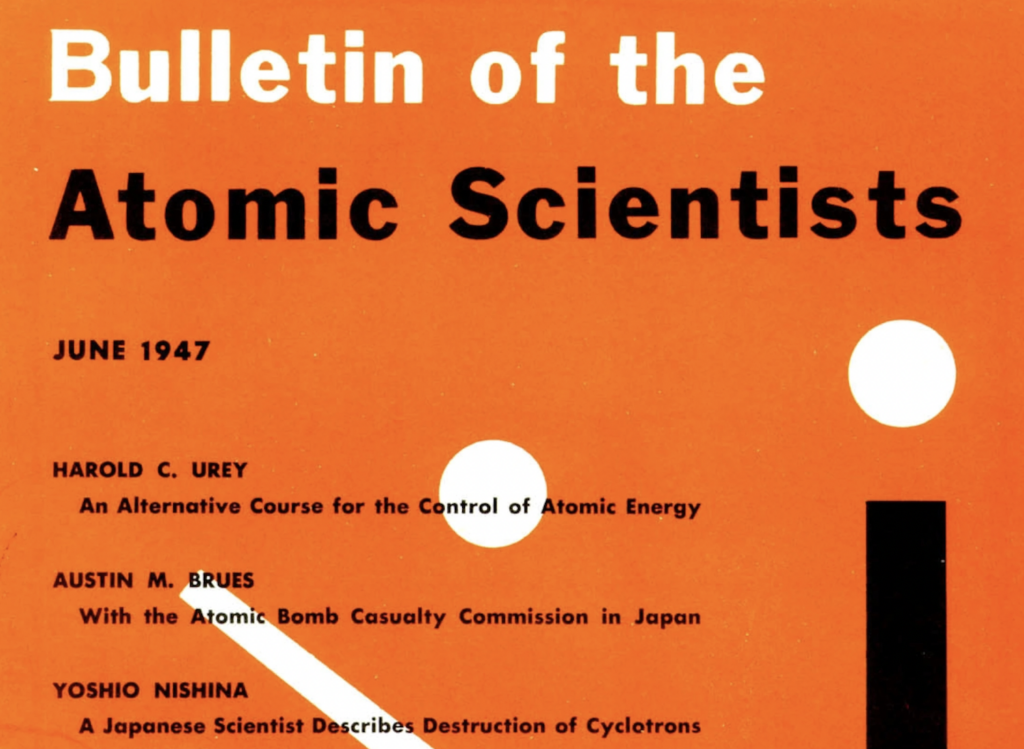
Over the years Feld contributed articles to the Bulletin of the Atomic Scientists whose editor, Eugene Rabinowitch, first got him interested in Pugwash. After Rabinowitch died in 1973, Feld’s name often appeared on guest editorials and in November 1975 he became editor-in-chief. The Bulletin is now widely considered the single most important publication dealing with nuclear policy.
Unlike his former Los Alamos associates at MIT, Harvard’s chemist George Kistiakowsky is a relative newcomer to the fight against nuclear weapons. As he readily admits, he was a weapons man through the 1950s; but during two years in Washington as President Eisenhower’s science advisor, he grew increasingly skeptical about high-technology weaponry. Kistiakowsky admired Eisenhower, who thought more clearly than he spoke and thoroughly distrusted the military leadership. Kistiakowsky was also frightened by civilian bureaucrats who made policy without knowing the facts or taking time to learn them. Subsequent service as chairman of the President’s Science Advisory Committee and on the advisory committee of the Arms Control and Disarmament Agency strengthened his belief in the sheer lunacy of ever increasing weapons overkill. Back in Cambridge, Kistiakowsky became a more outspoken critic of official policy, his criticism sharpened by a gift for forceful language and a caustic wit.
But only within the past decade has Kistiakowsky become a visible disarmament advocate by accepting the chairmanship of the Council for a Livable World. With its seminars for Senators, a library of foreign policy materials, and a monthly nuclear weapons fact sheet, the Council’s Washington office provides legislators with the information service Kistiakowsky had seen lacking when he was science advisor. The Council now lobbies on such issues as appropriations for chemical warfare and renewal of the ABM treaty and recruits witnesses for crucial committee hearings, concentrating on the Senate because of its role in treaty making. A second Council office was opened in Boston in 1980 because so many of its active members live nearby.
“I’ve become a dignified rabble-rouser,” Kistiakowsky told me recently, with a characteristically wry smile. “There is no use working as an individual in Washington, at least not in the field of nuclear weapons. Scientists have either been discredited there or have lined up with the military, which is the most powerful bureaucracy in the world.” Kistiakowsky now sees the only hope for arms control in a mass movement, and so he has allied the Council with the highly visible Physicians for Social Responsibility (PSR). The day after a February 1980 meeting at which Dean Hiatt of the Harvard Medical School described the effects of a nuclear attack on Boston, Kistiakowsky called Dr. Helen Caldicott, PSR president, and proposed the joint seminars which PSR and the Council have since sponsored in New York, San Francisco, Seattle and other centers of medical education.
These seminars, and indeed the very concept of the PSR, are direct descendants of the early efforts of the FAS. “Elitism” was not a household word in 1945, but the idea was implicit in the claim of Morrison, Feld, and others that they alone possessed certain essential information. It was on this basis that they demanded, and got, the attention of newsmen and legislators. At the same time, much of the FAS’s early educational work was based on the liberal belief that the average citizen, once informed of the facts, would vote the reasonable, responsible way. Now, though it has so far had only limited success, this two-pronged strategy—using professional prestige both to pressure policy makers and to educate the public—is the only one PSR and other groups believe they can pursue.
But perhaps the most significant legacy of the FAS and the scientists’ movement is that many scientists now take some responsibility for the uses to which their work is put. Scientists who refused to do research with any direct military application founded the International Society for Responsibility in Science. And in 1960, the American Association for the Advancement of Science declared that “scientists bear a serious and -immediate responsibility to help mediate the effects of scientific progress.”
Among the scientists who were involved with the development of the first nuclear weapons, that sense of responsibility is particularly acute. But it has never grown into self-doubt, for the scientists are protected by their own methods: if an experiment fails or a theory collapses they do not ordinarily waste time in self-reproach; they design new experiments or develop different hypotheses. That is why so many of those who helped make the bomb have not cried mea culpa but have instead devoted themselves unstintingly to the search for constructive solutions to the problems their own work created.
Independent and nonprofit, Boston Review relies on reader funding. To support work like this, please donate here.