
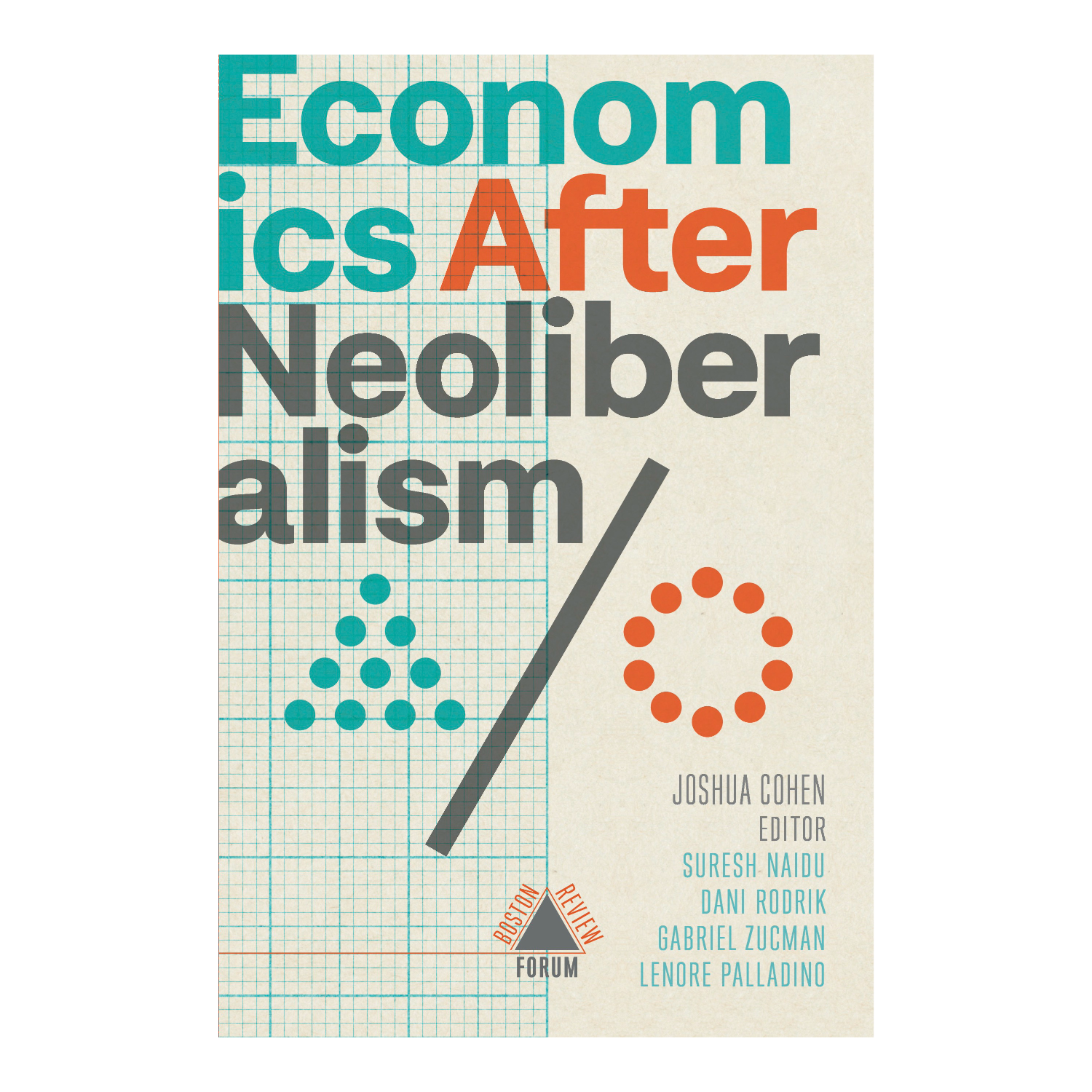
Economics After Neoliberalism offers a powerful case for a new brand of economics—one focused on power and inequality and aimed at a more inclusive society.
Three prominent economists—Suresh Naidu, Dani Rodrik, and Gabriel Zucman—lead off with a vision “for economic policy that stands as a genuine alternative to market fundamentalism.” Expanding on “the state of creative ferment” they describe, Boston Review has commissioned responses to their essay from economists, philosophers, political scientists, and policymakers across the political spectrum as well as new essays that challenge the current shape of markets and suggest more democratic alternatives.
Lenore Palladino explores the misguided logic of shareholder primacy and points to more equitable approaches to corporate governance—such as employee ownership funds. Amy Kapczynski examines how the courts have developed a new, anti-democratic First Amendment that protects corporate speech at the expense of regulation designed to protect public health and safety. And Robert Manduca explores the importance of public discussion about economics by revisiting Chester Bowles’s remarkable book, Tomorrow Without Fear, which explained Keynesian ideas to the public after World War II.
Forum: Lead essay by Suresh Naidu, Dani Rodrik, and Gabriel Zucman. Responses by Corey Robin, Debra Satz, William Easterly, Alice Evans, Margaret Peters, Marshall Steinbaum, Ethan Bueno de Mesquita, Arvind Subramanian, a group of “Complexity Economists,” Oren Cass, Gene Sperling, and Caleb Orr.
Essays: Lenore Palladino, Amy Kapczynski, Robert Manduca, Quinn Slobodian, and an interview with Samuel Bowles.