
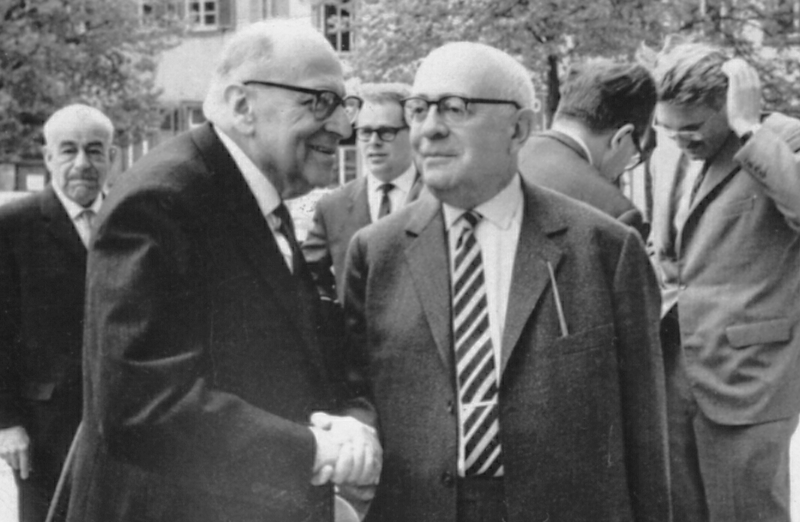
2023 marks one hundred years since the founding of the Institute for Social Research. Better known today as the Frankfurt School, the Institute’s theorists—among them Max Horkheimer, Theodor Adorno, Herbert Marcuse, and Jürgen Habermas—established a reputation as trenchant and sophisticated analysts of twentieth-century capitalism. Recent trends have also underscored their prescience.
Consider Prophets of Deceit, a 1949 study of the “techniques of the American agitator” by less familiar Frankfurt associates Leo Löwenthal and Norbert Guterman. According to intellectual historian Charles H. Clavey, the strategies discussed in Prophets—scapegoating immigrants, developing conspiracy theories, and cultivating a sense of persecution—foretold Donald Trump and his imitators. Trump may have lost the 2020 election, but the “social malaise” that enabled his rise persists. “Perhaps the most important lesson to be gotten from reading Prophets in the age of Trump,” Clavey concludes, “is that he is not an exception to postwar U.S. society but rather its inevitable fulfillment.”
For philosopher Seyla Benhabib, the ascendance of global right-wing nationalism and the sharpening of great power rivalries highlights the need to put “critical inquiry once more in the service of autonomy and emancipation,” as Horkheimer intended with his original 1937 formulation of critical theory’s mission. Unwilling to give in to “today’s widespread ‘left-wing melancholia,’” Benhabib argues that the “task of critique is interminable; it needs to confront ever-new forms of injustice, oppression, exploitation, and marginalization.”
Other essays on this week’s list include Vivian Gornick on Lawrence J. Friedman’s “thoroughly absorbing” biography of Erich Fromm; Peter Gordon on the left’s “shattered dreams”; Ronald Aronson on the fiftieth anniversary of Marcuse’s One-Dimensional Man; John Merrick on the fragility of progress; Andy Battle’s Benjaminian interpretation of the 1974 British cult classic Penda’s Fen; and much more.