
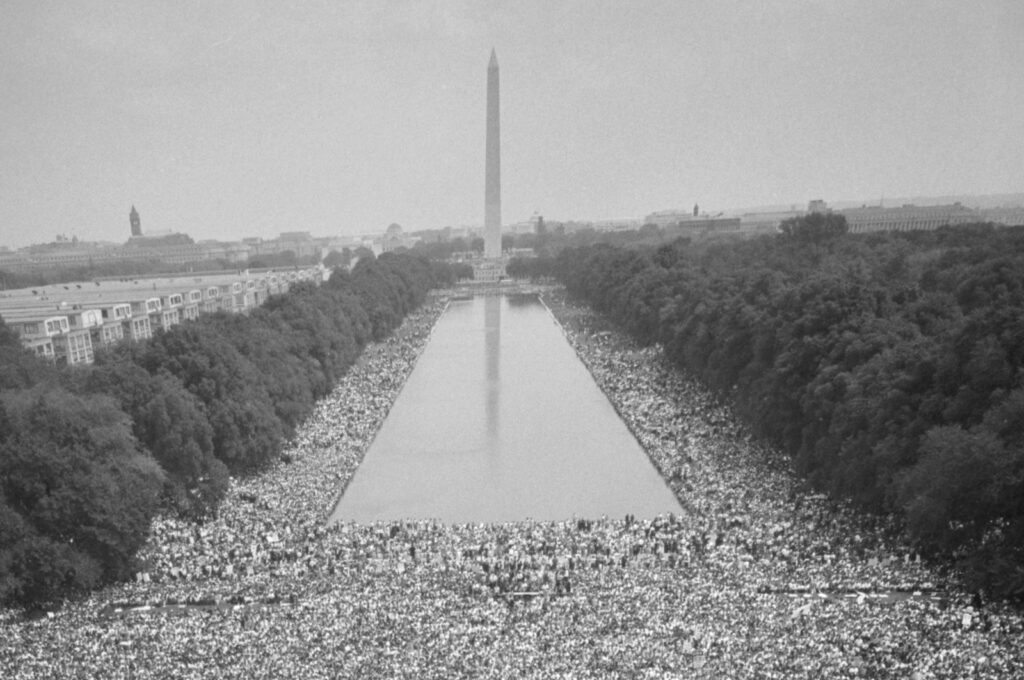
This week marks sixty-two years since Bayard Rustin and A. Philip Randolph organized the March on Washington for Jobs and Freedom, where Dr. Martin Luther King, Jr. delivered his historic “I Have a Dream” speech in front of the Lincoln Memorial.
Reflecting on the fiftieth anniversary of the march, historian Robin D. G. Kelley drew the following lessons:
The moral and political arc of movements for social justice is very, very long. And this is why it is important to think beyond the march, “the speech,” the spectacle. To understand August 28, 1963, is to understand the entire era. It requires following those movements that fall outside the spotlight, the movements organized and led by the very women who were excluded from the mic on that incredibly hot and humid Washington afternoon. The work of social movements is not always sexy, nor is it necessarily inspiring. But they are the engines for change and the incubators of new dreams.
Read the whole essay below, along with further analysis of the civil rights era from Brandon M. Terry, on King’s enduring but often misunderstood legacy, and Lerone A. Martin, on the surveillance and repression that J. Edgar Hoover’s FBI unleashed in the March’s wake.