
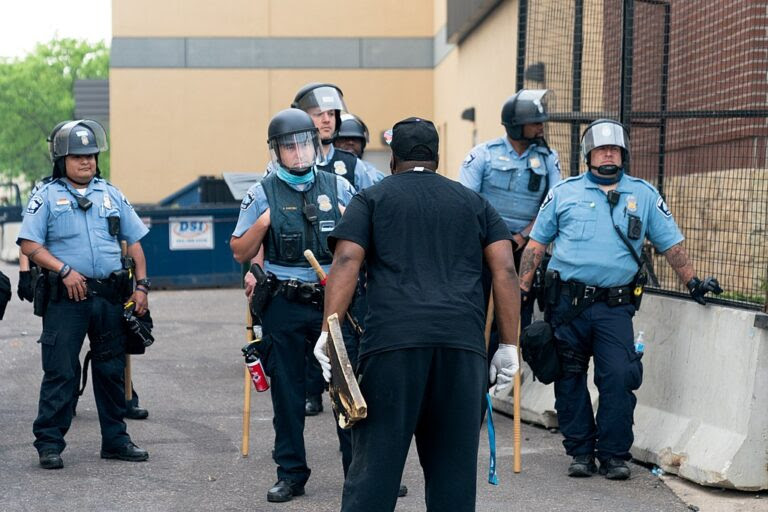
Earlier this month, Sonya Massey, a Black woman in Illinois, was shot and killed by a white sheriff’s deputy inside her home after she called 911 to report a possible intruder. Body camera footage of the disturbing incident has both reignited national outrage at police killings of African Americans and called into question the power of such images to put an end to the ever-recurring violence.
The pieces in this week’s reading list examine this cycle and imagine how to break out of it. Amanda Alexander and Danielle Sered detail the many ways we already know how to keep communities safe, without the police. nia t. evans explains how police lies—like the misdirection of Massey’s family by the Sangamon County Sheriff’s Office—are much more than a matter of individual misconduct. Brandon M. Terry talks with Judith Butler about the “grievability of Black lives,” while Christopher Lebron traces the “invisibility of Black women” throughout U.S. history. Benjamin Balthaser examines the political power of W. E. B. Du Bois’s provocative publication of lynching photographs. And Simon Waxman shows how the legal system far too easily condones police violence as “reasonable” behavior on the part of officers. The deputy who killed Massey has been arrested and charged with murder; whether he will be convicted remains to be seen.
Plus, four pieces—by Julian Zelizer, Daniel Geary, Elizabeth Hinton, and Stuart Schrader—discuss the legacy of the Kerner Report on the U.S. urban uprisings of the 1960s. The product of a commission appointed by President Lyndon Johnson on this day in 1967, the report concluded that the rebellions were fueled by economic inequality and the oppression and mistreatment of Black Americans at the hands of police.