
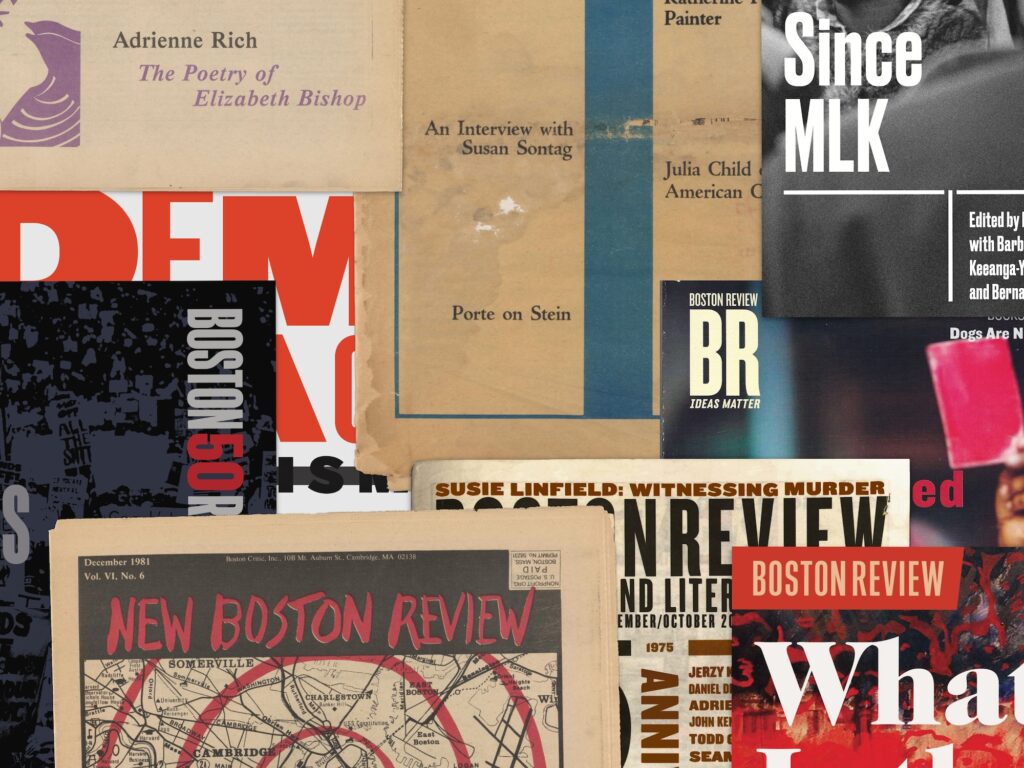
The first issue of Boston Review appeared in June 1975. To celebrate this milestone, fifty writers and editors selected an essay from our archive and shared what they love about it. Describing work that ranges from war reporting to cultural criticism to philosophical argument, “rigorous” and “startling” essays to debate-defining writing about our political, economic, and social arrangements, they praise these pieces for their “remarkable prescience” and “reasoned compassion,” for being “revelatory” and “essential” and “alive to the world.” We are grateful for their words—and proud, as one writer puts it, to be recognized as “a vital venue for discussions of how to build a more just world.”
You can read all the appreciations below—with links to the original essays—or enjoy an archive feature in our newsletter every week for the coming year. To learn more about BR and our 50th anniversary celebrations, read a letter from our editors here.
David R. K. Adler • Wajahat Ali • Seyla Benhabib • Wendy Brown • Elizabeth Bruenig • Daniel Denvir • Junot Díaz • Lisa Duggan • Noura Erakat • nia t. evans • Susan Faludi • John Ganz • Greg Grandin • Jennifer M. Harris • Jeet Heer • Katrina vanden Heuvel • Lily Hu • Walter Johnson • Jay Caspian Kang • Robin D. G. Kelley • Naomi Klein • Jessie Kindig • Larry Kramer • Mark Krotov • Pankaj Mishra • Evgeny Morozov • Samuel Moyn • Jan-Werner Müller • Martha Nussbaum • Osita Nwanevu • Martin O’Neill • Rick Perlstein • Brad Plumer • Corey Robin • Nathan J. Robinson • Dani Rodrik • Becca Rothfeld • Elaine Scarry • George Scialabba • Mark Schmitt • Nikhil Pal Singh • Quinn Slobodian • Ryu Spaeth • Alexander Star • Cass Sunstein • Astra Taylor • Brandon M. Terry • Rebecca Traister • Mark Tushnet • Lea Ypi
1. “Economics After Neoliberalism,” a forum led by Suresh Naidu, Dani Rodrik, and Gabriel Zucman (2019)
Published in 2019, Boston Review’s “Economics After Neoliberalism” forum reveals the magazine’s central place in some of the most important political and economic debates in this country. Kicked off by Suresh Naidu, Dani Rodrik, and Gabriel Zucman’s seminal essay, the forum serves a double role—first, as an owl of Minerva for the neoliberal age, providing a definitive account of the market fetishists’ many failures; second, as a battle cry for the post-neoliberal era, challenging economists to seize the opportunity of the field’s newfound “creative ferment” to recover its basic concern for humanity. With Donald Trump back in the White House, our challenge is not only to ensure that the coffin of neoliberalism stays closed. It is also to follow these authors into the fight over the economic paradigm to come: whether it will aid U.S. oligarchy, or force the oligarchy to yield to a new era of “inclusive prosperity.”
—David R. K. Adler, Co-General Coordinator of the Progressive International
2. Nir Rosen, “Anatomy of a Civil War,” “Something from Nothing,” and other Iraq War reporting (2006–2010)
If history rhymes, in the Middle East it bleeds and reverberates, traumatizing generations at the hands of the reckless, violent, and heedless. In 2025 the “America First” Trump administration is bombing innocent women and children in Yemen, giving a green light to Israel’s ongoing genocide and razing of Gaza, and illegally detaining and deporting Muslim immigrants. The “War on Terror” thus never ended; after originally setting its sights on Iraq—as revenge for a terror attack committed by nineteen hijackers, none of them Iraqi—it moved on and found new targets. Covering the war in the pages of Boston Review, reporter Nir Rosen chronicled the people in Iraq and the Middle East who are still forgotten and dismissed as “collateral damage” by war criminals like George W. Bush and Dick Cheney who failed up and passed the baton to other presidents who continue their legacy of cruelty. Rosen’s numerous articles remain a testament both to the integrity of Boston Review—which opposed the Iraq War from the start—and to the integrity of journalists “embedded” in violent conflicts, who risk their lives to tell the real story while their establishment colleagues serve as stenographers to power.
—Wajahat Ali, Daily Beast columnist and former New York Times contributing op-ed writer
3. Ephraim Isaac, Joshua Cohen, Abdul Mohammed, Mulugeta Gebrehiwot, Alex de Waal, and Solomon Dersso, “Remembering Andreas Eshete” (2024)
For 50 years now, Boston Review has promoted fresh voices, and has provided a platform for compelling debates about equality, solidarity, climate change, gender issues, the state and much else. Recently, BR published some deeply moving reflections focused on a singular figure, the Ethiopian philosopher, Andreas Eshete—“a revolutionary, philosopher, devoted patriot” and “one of Ethiopia’s leading intellectuals.” Reading these reflections, one learns about the virtues and vices of post-colonial liberation movements, their democratic aspirations and frequent authoritarian outcomes. Andreas Eshete’s struggles to combine liberalism and Marxism, and to find a new language of constitutionalism which he called “ethnic federalism,” should serve as a guide today for many movements in the Global South, and in the Middle East in particular. Thank you, Boston Review, for letting us remember the life of this extraordinary individual.
—Seyla Benhabib, political philosopher
4. “Is Multiculturalism Bad for Women?,” a forum led by Susan Moller Okin (1997)
In the October 1997 issue, New Zealand liberal feminist Susan Moller Okin fired a shot across the bow at transnational and postcolonial feminist theory and politics. Everything was wrong with the piece—from its caricatures of non-liberal gender regimes to its imagined emancipation of liberalism from “culture” and gender norms. But the piece did what Boston Review does so well: the argument was so bold and unapologetic that it generated a new and important chapter in feminist debates. The essay remains a touchstone for a still-hegemonic position that must be taken apart again and again to reveal Western liberal conceits about conditions of women’s freedom and equality.
—Wendy Brown, political theorist
5. “Angry Forever,” a forum led by Agnes Callard (2020)
Few would likely submit that anger is either wholly practical or wholly good, but what I did not realize until Agnes Callard explained it in her essay “Angry Forever” was that anger is tragic: we’re all subject to it despite the fact that it corrupts us morally by predisposing us to limitless vengeance—which is itself rationally justifiable. Her argument is subversive not just because she recognizes that vengeance and grudges are logical, but also because her premises taken together suggest that victims of injustice are made morally worse by their righteous anger. Boston Review has found itself a good match for itself in Callard: each seems totally undeterred by the countercultural implications of the truth. “Angry Forever” is a delicious, devilishly clever collaboration that winds readers through a series of unexpected turns and replaces old certainties with new questions, the mark of a fine piece of work.
—Elizabeth Bruenig, staff writer at The Atlantic
6. Harsha Walia, “There Is No ‘Migrant Crisis’” (2022)
Mainstream media is shot through with mystifications that prop up our nightmarish status quo. This is nowhere truer than the politics surrounding migration, as Harsha Walia shows in her essential essay “There Is No ‘Migrant Crisis’.” As she puts it, “mass displacement and immobility represent the outcome of the actual displacement crises of capitalism, conquest, and climate change.” Those are the crises—rendered invisible by our pundit class—that drive misery for vast majorities on all sides of every border. Indeed, Walia shows, borders construct and legitimate hierarchies among nations just as they do among people within nations. Whether at the nation-state line or in the mortgage deed, bordering—and the racism and nationalism that give it force—is about protecting the current distribution of property and power. We need essays like this, and magazines like Boston Review, to see through the self-serving narratives of the powerful and expose the injustice that so many insist on obscuring.
—Daniel Denvir, writer and host of The Dig podcast
7. Victoria-Lola M. Leon Guerrero, “An Open Letter from Guam to America” (2017)
For a brief time in 2017 Guam was in the news, following geopolitical saber rattling between China and the United States. In that moment Victoria-Lola M. Leon Guerrero’s extraordinary intervention appeared in Boston Review. Like so much of what the magazine publishes, “An Open Letter from Guam to America” is politically potent in all the best ways, but most invaluably it recalls America to itself, reminding the nation of three searingly inconvenient, interrelated truths: that it holds colonies with cruel impunity; that despite all our democratic mythopoeia we are an empire; and that the ideologies that bind us to these twin tines of the devil’s pitchfork are inescapably apocalyptic.
Eight years have passed, and Guam has slipped out of the news—the weapons-grade myths that America manufactures about itself to obscure reality are strong, after all. And yet precisely for that reason I return to Leon Guerrero’s open letter regularly—not only because it is subversive and ferociously, playfully alive with motherhood, with children, with invincible resilience in stark contrast to the undead thanocratic nightmare it describes. I return to it because only in engaging with work like this do we have any hope of truly waking up, from death into life.
—Junot Díaz, Pulitzer Prize–winning author of The Brief Wondrous Life of Oscar Wao
8. Sophie Lewis, “How Domestic Labor Robs Women of Their Love” (2021)
I read Boston Review religiously, often to find the latest essays by or interviews with well-known, deeply insightful writers including Robin D. G. Kelley, Noura Erakat, and Arundhati Roy. But I also go to BR to find emerging young writers who are turning our thinking about the world upside down and inside out by treating political economy and social formations like race, gender, sexuality, and citizenship as inextricable. One of those writers is the dazzling Sophie Lewis. Her review of books and a TV series on domestic labor, “How Domestic Labor Robs Women of Their Love,” takes the current widespread concern over “care work” (especially since the COVID-19 pandemic), and analyzes it with the razor sharp eye of a queer anti-work feminist influenced by Black lesbian feminism, various Marxist theories, and a wide array of other theoretical and historical literatures. What she offers is a uniquely penetrating synthesis, typical of Lewis’s work and of the welcoming wide perspective of Boston Review.
—Lisa Duggan, social critic and scholar of gender and sexuality
9. Charisse Burden-Stelly, “Caste Does Not Explain Race” (2020)
Boston Review has been an anchor in a resurgent and vibrant discussion on racial capitalism. For a case in point, look no further than Charisse Burden-Stelly, who has insisted upon a Black radical critique of U.S. racial violence that incorporates, rather than absolves, political economy. She does this masterfully in her review of Isabel Wilkerson’s much-celebrated book, Caste: The Origins of Our Discontents—published at the apex of uprisings at the murder of George Floyd. The book likens white supremacy in the United States to India’s hierarchical social system. Yet Burden-Stelly places this superficial reading in historical context, scrutinizing the rise of capitalism and colonialism in India as well as the African continent. More than that, the review illuminates how Wilkerson’s primary focus on upward mobility for Black people reveals an elitist commitment that not only betrays the most vulnerable Black communities in the United States but left us all ill-prepared to confront the fascism of Trump’s first term—and second.
—Noura Erakat, co-founding editor of Jadaliyya and author of Justice for Some: Law and the Question of Palestine
10. Robin D. G. Kelley, “Births of a Nation” (2017)
I must have been a few weeks into my 2021 fellowship at Boston Review when I found Robin D. G. Kelley’s “Births of a Nation.” Reflecting on the late Cedric Robinson’s analysis of racial regimes through D. W. Griffith’s masterful propaganda, Kelley offered a frame for thinking through the last half century’s march toward “the rewhitening of America.” Today the essay feels prophetic. Economic security was hardly the prevailing message of the Trump campaign; instead, it championed ethnic cleansing and mass deportation—a racial regime fueled by white rage and power. Kelley reminds us of Robinson’s timeless, yet overlooked analysis: “White patrimony deceived some of the majority of Americans . . . but the more fugitive reality was the theft they themselves endured and the voracious expropriation of others they facilitated.” White supremacy won’t pay your grocery bill, but—to quote Robinson—“it still serves.” Boston Review is one of the few places where you can count on urgent analysis like this, striking at the heart of race and class in America.
—nia t. evans, journalist and former Boston Review fellow
11. Vivian Gornick, “Feeling Paranoid” (2016)
On the day after Donald Trump’s 2016 election, which a lot of us spent doomscrolling, Vivian Gornick sought solace in a 448-page tome on democracy and paranoia in ancient Athens. Her bibliographic reflex brought her to the reasoned compassion that is so characteristic of Boston Review. Gornick took the scholarly book’s thesis—that societies and individuals thrive or implode on whether their paranoias darken into pathology or are defused by a desire to understand “the other”—and illuminated the electoral catastrophe by applying it, brilliantly, to herself. She showed us how the most personal of politicized decisions, her abortion decades earlier, led her to empathize with the very people who would deny her that option. “Feeling Paranoid” demands re-reading in the post-Dobbs era and our current political season, where the bonfire of conspiratorial rage may yet still be quelled by the empathetic impulse to—as Gornick puts it so well—“honor the existence of the one not like ourselves.”
—Susan Faludi, Pulitzer Prize–winning journalist and author of Backlash: The Undeclared War Against American Women
12. G. M. Tamás, “On Post-Fascism” (2000)
Published by Boston Review in 2000, G.M. Tamás’s “On Post-Fascism” has unfortunately turned out to be one of the most prescient and insightful political texts of the new century. Tamás foresaw the emergence of a “post-totalitarian” variation on fascism that did not require street-fighting, stormtroopers, the one-party state, or Führers, but could instead nest itself in the structures of representative democracy and the globalized economy to carry out its violently anti-Enlightenment project. That project was to roll back the universal expansion of citizenship—of the rights of man—and replace it with a narrower vision of national belonging based on race and ethnicity and to gradually turn domestic populations into foreign enemies. It is an essential text to understand our times. Boston Review is among a shrinking few publications that would publish material of this seriousness and depth.
—John Ganz, author of When the Clock Broke: Con Men, Conspiracists, and How America Cracked Up in the Early 1990s
13. David Waldstreicher, “The Long American Counter-Revolution” (2022)
Boston Review is invaluable, and so is Gerald Horne, a historian largely ignored by the profession’s bien-pensants. So the Review deserves extra praise for featuring a lengthy appreciation of Horne’s work, by historian David Waldstreicher. I came of political intelligence listening to Gerald Horne’s commentary show in the 1980s on WBAI in New York, and to this day I remember the clarity and sharpness of his analysis, his ability to make sense out of current events by placing them in a larger social context. Horne’s show was perhaps my first encounter with historical thinking. Lucky me. And lucky us we have Boston Review, willing to publish Waldstreicher’s demand that historians of the United States reckon with Horne’s indispensable scholarship.
—Greg Grandin, Pulitzer Prize–winning historian
14. Elizabeth Anderson, “Common Property” (2016)
Elizabeth Anderson’s “Common Property” uncovers the lineage of conservative support for social insurance. In unraveling the faulty game of telephone afoot between conservative thinkers like Hayek and contemporary conservatives, Anderson shows how, far from a slippery slope to socialism, Hayek and other conservatives like Bismarck saw social insurance as a bulwark against it.
Anderson’s account gets at what Boston Review does best—by taking an unrelenting curiosity to our largest, seemingly most intractable problems, we find a new way of looking at them, which perhaps offers new play space for overdue answers.
—Jennifer M. Harris, former member of the National Economic Council under President Joe Biden
15. William Hogeland, “Inventing Alexander Hamilton” (2007)
The best essays grow in stature and resonance over time. This is certainly true of William Hogeland’s “Inventing Alexander Hamilton,” which appeared in Boston Review in 2007—a full eight years before Lin-Manuel Miranda’s musical. The essay deftly describes and deliciously debunks an emerging Hamilton cult of centrist liberals and conservatives, who lionized America’s treasury secretary as a mythical hero of democracy and upward mobility. What makes this debunking effective is that it isn’t a merely negative exercise: Hogeland shows how Hamilton remains a central figure in American history, just a much more complicated one than we have been led to believe. Like the best Boston Review essays, Hogeland’s counter-narrative is work of brisk, common-sense radicalism. It presciently outlined the contours of the new elite ideology of militaristic plutocracy that disguised itself as a national origin story of democratic meritocracy.
—Jeet Heer, national affairs correspondent for The Nation
16. Elaine Scarry, “The Extortionist’s Doctrine” (2024)
Not many literary scholars have written important books on torture, war, and nuclear abolition. Yet Elaine Scarry’s literary bluntness reveals the terrifying specter and persistence of nuclear war and deterrence. In “The Extortionist’s Doctrine” she grasps how the mental architecture of deterrence may be the real impediment to unbuilding the nuclear architecture, since “the profound moral aberration of deterrence corrodes our sense of humanity . . . and makes thinkable the unimaginable.” With today’s armchair warriors weighing the use of “tactical” nukes on television, reality has overtaken Dr. Strangelovian satire. Scarry rightly protests this normalization of nuclear weapons, and it’s fitting that she warns of potential catastrophe in the pages of Boston Review—a necessary and independent space committed to creating a more just world.
—Katrina vanden Heuvel, editorial director and publisher of The Nation
17. “To Remake the World,” a forum led by Walter Johnson (2016)
What does it mean to say that slavery was “dehumanizing”? Not much, Walter Johnson suspects in his Boston Review forum essay, “To Remake the World: Slavery, Racial Capitalism, and Justice.” And that is just the beginning. Connecting theoretical shortfalls with ethical ones, Johnson sheds new light on the purpose and poverty of rights discourse, the fruitfulness of the analytic of racial capitalism, and the centrality of the revolutionary thought and actions of Black resisters themselves to a theory of racial justice. “To Remake the World” is that striking piece of writing that could only be published in Boston Review: scholarship freed from disciplinary anxieties; moral clarity without moralism; at once timely and timeless.
—Lily Hu, philosopher
18. “Black Study, Black Struggle,” a forum led by Robin D. G. Kelley (2016)
I assign this essay in just about every class I teach, and I think I’ve probably sent it to everyone I know. Like the best of Boston Review’s essays, it’s a moral, political, and intellectual astringent: it stings a bit. Kelley is admonishing us to tighten up our thinking and our practice, to pay careful attention to the capitalist and militarist underpinnings of university life, and to make sure that our work illuminates, evades, and even resists them. It urges us toward solidarity with people and movements outside universities, and toward holding ourselves accountable to something greater than an insistence on decency and diversity within compromised institutions.
—Walter Johnson, historian
19. Olúfẹ́mi O. Táíwò, “Identity Politics and Elite Capture” (2020)
In the summer of 2020, we needed a new way to think about identity politics, one that could acknowledge both the immense possibilities of what was happening in the streets of America while also warning about how it all might be rerouted into something much safer. Olúfẹ́mi Táíwò’s essay, “Identity Politics and Elite Capture,” detailed how identity politics, which had started as a way for queer Black women to participate in protest movements, many of which excluded and discriminated against them, had been repurposed—forcefully and against the wishes of its intellectual creators—into a decadent and sclerotic linguistic tool mostly used to settle scores and advance careers within the elite spaces of corporate America, the academy, and the media. What I’ve always appreciated about Táíwò’s work is that he has never fallen into cynicism or easy invective like many of those who have repurposed his critique to dismiss all liberation movements or to sneer at anything smelling of “idpol,” but rather has been resolute in his original reclamation project in the pages of Boston Review: “in the end, we’re in it together—and, from the point of view of identity politics, that is the whole point.”
—Jay Caspian Kang, staff writer at The New Yorker
20. Reverend Eugene F. Rivers III, “On the Responsibility of Intellectuals in the Age of Crack” (1992)
To call “On the Responsibility of Intellectuals in the Age of Crack” a provocation is perhaps an understatement. Published in the wake of the Los Angeles Rebellion, the piece—by Reverend Eugene Rivers, a Boston-based minister and political lightning rod—indicted Black scholars for failing to address the multiple crises facing poor African Americans: crack addiction, joblessness, violence, too many single mothers and too little church. As the founder of the Boston TenPoint Coalition to stop gun violence, Rivers spoke from the trenches. He compared the moral decay of Black urban youth with that of Black intellectuals, whom he dismissed as hustlers who care more about lecture fees and publicity than the conditions of poor Black people. Evoking Noam Chomsky, whose 1967 essay called on intellectuals “to speak the truth and to expose lies” of the Vietnam war, Rivers challenged the Black intelligentsia, especially at Harvard, to turn their critical sights on the war raging in their backyard. Responses from Henry Louis Gates Jr., bell hooks, Cornel West, Anthony Appiah, Randall Kennedy, and Margaret Burnham, as well as prominent historians Eugene Genovese, Eric Foner, and Noel Ignatiev, followed.
Less than five years out of graduate school and with a book project on the Black urban poor, I thought Rivers ignored the many Black scholars working on the urban crisis, but his piece was an audacious wake-up call in the era when the so-called “Black Public Intellectual” stood in the spotlight. And for me and many of my peers, the forum was my introduction to Boston Review, a space for serious debate on hard but critical issues.
—Robin D. G. Kelley, historian and author of Freedom Dreams: The Black Radical Imagination
21. William Callison and Quinn Slobodian, “Coronapolitics from the Reichstag to the Capitol” (2021)
Nine months into the COVID-19 pandemic, with politics going haywire in all kinds of ways, Boston Review published “Coronapolitics from the Reichstag to the Capitol” by William Callison and Quinn Slobodian. It was the first major piece of analysis that succeeded in making real sense of the ways that conspiratorial fantasies about the virus were scrambling political signals across the political map. Surveying anti-lockdown coalitions that included far-right parties, wellness gurus, and entrepreneurial activists, they coined the term “diagonalism” to describe these emergent alliances. Their original framing helped many of us to understand the ways that pandemic-era conspiracy culture has carried the far right to terrifying heights in country after country. It’s timely and rigorous work like this that makes Boston Review indispensable.
—Naomi Klein, activist and author of The Shock Doctrine: The Rise of Disaster Capitalism
22. Christine Henneberg, “Why I Provide Abortions” (2021)
In the decades-long onslaught against abortion, language contracted along with women’s rights: anti-abortion forces weaponized words like life, baby, and heartbeat and called what they did love. For antidote, I turned to Christine Henneberg’s beautiful essay, “Why I Provide Abortions,” which describes the decisions her abortion patients make. There is the twenty-five-year-old mother of five who asks to see the aborted fetus and whispers “I love you, and I’m sorry.” There are women who want to see the ultrasound, grieving, and those who, relieved, don’t. Their experiences, Henneberg argues, reveal how punitive and ignorant anti-abortion concepts like “viability” and “personhood” are, as if a fetus could be separated from the life of the person carrying it. Here is abortion as a story of compassion and difficulty—a story of the decisions that come with being human. And here is an expanded feminist language, vibrant with the complexity of experience and alive to the fact that difficulty and grief often sit next to autonomy and liberation.
—Jessie Kindig, writer and editor at Yale University Press
23. “Anxieties of Democracy,” a forum led by Ira Katznelson (2015)
Ira Katznelson’s “Anxieties of Democracy” was published in August 2015—more than fifteen months before Donald Trump’s first election, at a time when such a thing seemed not just unlikely, but positively outlandish. But Katznelson thought otherwise, pointing to fundamental failures of democratic politics: the translation of wealth inequality into grossly disproportionate political power by the wealthy, and the inability of legislators to achieve the compromises a complex society must expect and accept. He sounded an alarm that was, well, alarming . . . but done in a way that had to be taken seriously. It’s the kind of piece that shows what’s so special about Boston Review: a major intellectual figure writing about a topic in which he is deeply knowledgeable in a form that is sophisticated and nuanced yet still can be understood and digested by a non-expert audience. And now, a scant decade later, Katznelson’s piece has proved to be sadly prophetic, all the way down to the Peronist form he worried our democratic collapse might take.
—Larry Kramer, legal scholar and president of the London School of Economics and Political Science
24. Jeanne Morefield, “Blood Ties” (2024)
Like any big anniversary, Boston Review’s fiftieth presents a natural opportunity to celebrate classic work from the past. But while the magazine’s archive of such work is impressively vast, I’d like to highlight a much more recent piece—Jeanne Morefield’s “Blood Ties”—in the spirit of celebrating the BR’s ongoing vitality and relevance, fifty years and counting. “Blood Ties” is one of those essays that feels like it’s about everything—a non-exhaustive list: conspiracy, opioid addiction, public health care (and the absence thereof), post–Cold War American foreign policy, NAFTA and the border—but its ranginess is never arbitrary or cynical: it’s the product of an extraordinary mind insisting on connections that, as Morefield argues, we are perennially being coerced into unseeing. This is writing that feels contemporary in the very best way: averse to shorthand and alive to the world as it is. Morefield’s essay helped me see the present more clearly—a defining quality of all great essays.
—Mark Krotov, publisher and editor of n+1
25. Dirk Moses, “More than Genocide” (2023)
Boston Review is unique and simply indispensable in its dignified refusal to phrase essential critiques in vague or sentimental pieties. One of the great examples of its dedication to rigorous dissent is a piece by Dirk Moses. Published early in the Israeli eradication of Gaza, it underlines the scale of the slaughter in Gaza, and the clear intent of its perpetrators. Yet while understanding why accusations of genocide against the state of Israel are being made it declines to make emotional investments in them. Rather, it points to the difficulty of proving such charges, and the acute limitations of the international legal regime that came into existence after 1945. At the same time, the piece explains why though the modern state has a long bloodstained history, its violence continues to enjoy a broad imprimatur in the world made by West imperialists and colonialists since the nineteenth century.
—Pankaj Mishra, novelist and essayist
26. “Can Technology End Poverty?,” a forum led by Kentaro Toyama (2010)
One reason I’ve long admired Boston Review is its unwavering commitment to publishing sharply reasoned pieces that challenge easy assumptions about technology’s role in society. Kentaro Toyama’s “Can Technology End Poverty?” from 2010 exemplifies this tradition perfectly. Drawing on his extensive experience in the field, Toyama shows that digital tools, no matter how ingenious, do not automatically deliver emancipation or prosperity. They often merely amplify existing tendencies—and thus cannot be expected to solve structural inequities on their own. By probing claims about Internet connectivity or inexpensive laptops as stand-alone fixes, Toyama’s essay reminds us that genuine progress hinges on institutional reform, political engagement, and human capacity. Boston Review once again demonstrates its ability to foster incisive debate, pushing beyond the superficial hype to illuminate deeper problems—but also possibilities.
—Evgeny Morozov, technology writer and author of To Save Everything, Click Here
27. “MLK Now,” a forum led by Brandon M. Terry (2018)
One of the most memorable entries in Boston Review came from Brandon Terry, introducing his forum on another fiftieth anniversary—a half century since the assassination of Martin Luther King, Jr. Terry chose to highlight the speech four days before King’s death that itself marked the centenary of W. E. B. Du Bois’s birth. “There are costs to canonization,” Terry observed, with the result that not only Du Bois’s but also King’s radicalism has potent implications even now. They require sloughing off memorialization. Is the same true, in a lesser way, of Boston Review? Some of its pages, printed and unprinted, are embers to rekindle in a dark time in America. Certainly what Terry recalled beyond the consecrated myth of King seems pertinent now. “Faith in redemptive possibility precludes embittered disengagement and spiteful retaliation,” Terry wrote, “but does not license complacency.”
—Samuel Moyn, legal scholar
28. Anthony Paletta, “Trump’s Culture Wars Come to Architecture” (2020)
On the very first day of Trump 2.0, the president found time to sign an executive order calling for federal architecture that would “uplift and beautify public spaces and ennoble the United States and our system of self-government.” It was not the first attempt to make buildings conform to Trump’s populist vision: in the dying days of his first term, an executive order had already encouraged classical architecture and lambasted modernism. In the pages of Boston Review, architecture critic Anthony Paletta offered essential analysis at that moment. He duly criticized attempts to dictate design choices. But he also questioned the simplistic equation of style and ideology (as in: stripped classicism must mean Nazism), and he helpfully highlighted the political economy behind seemingly purely aesthetic choices. The piece exemplifies Boston Review’s valuable range. By featuring cultural criticism alongside political commentary—indeed showing how they are linked—it provides critical insight on the whole of our social and political life.
—Jan-Werner Müller, political theorist and intellectual historian
29. Ned Block, “Race, Genes, and IQ” (1995)
One of the precious things about Boston Review is that it presents highly technical issues of great public importance in language the layperson can understand. One of these issues is the debate over race and IQ, and Ned Block’s article is an eye-opening education for people like me, lamentably ignorant in science. Taking on The Bell Curve in a far more sophisticated and subtle manner than most of its critics, Block managed to make me understand the difference between “genetic determination” and “heritability” and to show how this distinction matters for a correct understanding of the IQ difference debate. It is a difficult argument, but written with such excellent clarity that I grasped it, and was, and am, grateful.
—Martha Nussbaum, philosopher
30. Jake Grumbach and Ruth Berins Collier, “The Deep Structure of Democratic Crisis” (2022)
As readers have come to expect from Boston Review, Jake Grumbach and Ruth Collier’s “The Deep Structure of Democratic Crisis”—on the roots of our bleak political moment—challenges and deepens our intuitions. Capital’s growing strength is part of the story, yes. Its power, though, is manifested not just actively through political action but passively as politicians work to attract capital investment. The left’s sense that the decline of unions has fed the growth of anti-democratic right-wing populism is grounded and given definition here. Unions were vehicles for the expansion of democratic rights and the articulation of shared material interests; their decline has fragmented working-class politics in ways Trump and his predecessors have exploited. All told, it’s an essay that shows the promise of a burgeoning community of scholars committed to thinking through our political problems as problems of “political economy”—continuing Boston Review’s tradition of bringing novel analyses of American politics into public conversation.
—Osita Nwanevu, columnist at The Guardian and contributing editor at The New Republic
31. “A Basic Income for All,” a forum led by Philippe Van Parijs (2000)
Universal basic income has become perhaps the single most-discussed radical policy proposal of the twenty-first century, championed by a dizzying range of figures—from Bay Area tech libertarians to post-work radical socialists. Its prominence owes a great deal to the work of political philosopher Philippe Van Parijs, whose essay “A Basic Income for All,” published in Boston Review a quarter century ago, remains one of the best starting points for serious thinking about the idea. Van Parijs presents a forceful argument for basic income as the uniquely best institutional proposal to achieve human freedom alongside social justice, gender equality, and environmental sustainability. In the forum that accompanies the essay, his claims are subjected to lively scrutiny from a brilliant range of critics and commentators, including Gar Alperovitz and Elizabeth Anderson. The whole discussion shows Boston Review at its best—as a vital venue for discussions of how to build a more just world.
—Martin O’Neill, political philosopher
32. “Citizenship in Emergency,” a forum led by Elaine Scarry (2002)
In Thought Reform and the Psychology of Totalism: A Study of “Brainwashing” in China, Robert Jay Lifton coined the phrase “thought-terminating cliché” to describe how leaders of coercive institutions delimit subjects’ very ability to imagine any reality beyond that defined by the cult. Nations suffer under thought-terminating clichés, too—America, no more so than when it comes to the concepts subsumed under the umbrella “national security,” which is how we manage to imagine how a military bigger than the next nine biggest combined could protect, defend, and preserve a Constitutional order that originally considered standing armies anathema to the security of a free nation. I’ll never forget how it felt to read Elaine Scarry blowing those clichés wide open with “Citizenship in Emergency,” comparing how the entire elephantine American military bureaucracy failed to protect the nation on September 11, 2001, to the way the citizens aboard Flight 93 succeeded in protecting it—by acting precisely like the sort of self-organized citizen militia the Founders imagined. Provocations to thinking in place of thought-terminating clichés: that is what Boston Review does so well.
—Rick Perlstein, contributing editor at In These Times and author of Nixonland
33. Stephen M. Meyer, “End of the Wild” (2004)
Many environmental essays follow a simple formula: lay out the problem, explain why readers should care, and end with optimism about how it’s all fixable if only we act now. Stephen Meyer’s bracing piece about the global decline of wildlife, published twenty years ago, was different. Humans have lost the race to “save” biodiversity as we know it, he wrote, and there are no easy solutions. The essay was a jolt to me when I read it as an intern at Boston Review and helped kindle my interest in environmental journalism. It’s a wondrously clear explanation of the complex tangle of policies that are driving other species to extinction—the sort of clarity that has always been a hallmark of the magazine. And with Meyer’s refusal to succumb to fatalism or despair, it’s also a testament to the magazine’s commitment to collective action. Humans have radically changed the world, he concluded; now it is our responsibility to safeguard what’s left.
—Brad Plumer, New York Times reporter and former Boston Review intern
34. Scott Saul’s essays
Of all the gifted writers I went to graduate school with in the 1990s—and there were many—Scott Saul was the most blessed. Now a tenured professor of English at Berkeley and a brilliant biographer of Richard Pryor, he was, back then, like the rest of us, working on a dissertation and organizing a union. But his writing had a precision and poise, a style and grace, a sense of ease and control, far in advance of his training or years. It seemed as if he’d been born with it. In characteristic form, Boston Review was the first to discover it, commissioning Saul to write a series of almost perfect essays—on Juneteenth, teenagers, John Coltrane. And that was just 1999. Today, scholars’ writing for the public sphere is a cliché. But back then, under the shadow of The Last Intellectuals and the sun of promised employment, it was a rarity, particularly among graduate students. Thanks to Boston Review, it soon became, for some of us, a beacon.
—Corey Robin, political theorist
35. Noam Chomsky’s essays
Despite being one of the world’s most cited intellectuals, Noam Chomsky has often been excluded from mainstream political discourse. Even though many of his observations about the criminal destructiveness of U.S. wars have been vindicated over time, his sharp critiques of American foreign policy were consigned to those few publications that take seriously the obligation to hear a wide range of points of view. Boston Review has been one of those publications, over the years publishing powerful essays like Chomsky’s review of Stanley Karnow’s popular Vietnam War history, his essay on whether states ever undertake “humanitarian interventions,” his analysis of the Bush administration’s “grand strategy,” and his revisiting of his classic 1967 essay “The Responsibility of Intellectuals” on the tenth anniversary of September 11. These are important pieces that shine a light on some of the most uncomfortable truths about our country; as Chomsky himself has recognized, it’s hard to think of a magazine other than Boston Review that would have published them.
—Nathan J. Robinson, editor of Current Affairs
36. Jonathan Levy, “The Localist” (2023)
One can always count on Boston Review for fresh and exciting commentary on the intellectual currents of our time. Where else would one find this gem of an article, ostensibly a review of Glory Liu’s book Adam Smith’s America, but really a deeply insightful piece on the real Adam Smith. Smith has come to be known as an apostle of self-interest and free markets. But according to Jonathan Levy, Smith’s proselytizers at the University of Chicago did not do him justice. George Stigler and Milton Friedman cherry picked Smith to weaponize his arguments against the prevailing regulatory practices of the New Deal state. Smith was no universalist ideologue, Levy argues. He was a pragmatic “localist,” making contingent, contextual arguments that admit a wide range of practices with respect to the role of the state in the economy.
—Dani Rodrik, economist
37. “Is Multiculturalism Bad for Women?,” a forum led by Susan Moller Okin (1997)
There are many reasons to admire Susan Moller Okin’s essay “Is Multiculturalism Bad for Women?” For one thing, I’m astonished by the bravery with which it tackles one of the thorniest problems that confronts liberalism: the question of what liberals ought to do when their commitment to multiculturalism conflicts with their commitment to protecting individual autonomy. What is a liberal to make, for instance, of a subculture with patriarchal norms? Many liberals might dither, but Okin bites a difficult and unpopular bullet, arguing in no uncertain terms that the preservation of a subculture is less important than the protection of individual freedoms. Whether she is right or wrong, her essay is a meticulously reasoned provocation. (And indeed, it provoked an entire forum’s worth of responses.) There are few magazines with enough respect for their readers’ intelligence—and enough of a stomach for controversy—to publish something so rigorous and so startling.
—Becca Rothfeld, Washington Post nonfiction book critic
38. Oded Na’aman, “The Checkpoint” (2012)
When I first read Oded Na’aman’s “The Checkpoint,” I felt an essay had just orbited into my sky that was an enduring artwork, something on the order of Kleist’s 1810 “On the Marionette Theatre.” As it opens the author is four years old. His mother glides their car to a stop; she turns and asks a soft-spoken question that forever changes his world: he recognizes that he cannot know what others are thinking.
The child becomes a young man standing at a checkpoint with fellow soldiers in Israel. They are under orders to make a correct judgment about each Palestinian in transit, yet the right choice is unknowable. Feelings of omnipotence—the flick of one’s very fingertips result in actions by others (go this way, go that way; how dare you say “no”)—are coupled with crushing helplessness: What did I just do? Out of the slurry of despair into philosophic lucidity—Na’aman provides a template for recognizing the enduring horror of military occupation: the impossibility of moral force. Often “Checkpoint” swims back into my sky, especially when I’m in a car that glides to an unusually smooth stop. I think of people I don’t know in the Middle East, in Eastern Europe, and in the South China Sea.
—Elaine Scarry, essayist and author of The Body in Pain: The Making and Unmaking of the World
39. Sven Birkerts, “Into the Electronic Millennium” (1991)
They told us so. A few Cassandras warned us at the outset of the digital age about some very grave possible costs: Marshall McLuhan, Neil Postman, Nicholas Carr, Mark Crispin Miller, and—most eloquently—Sven Birkerts. A good many early—and later—warnings appeared in Boston Review. “Into the Electronic Millennium,” which appeared in October 1991, was probably the most influential of Birkerts’s many grapplings with the new digital dispensation, collected in The Gutenberg Elegies, Tolstoy’s Dictaphone, and Readings. Others also saw over the horizon, but Birkerts saw more deeply than anyone else what alterations the online life might produce in our culture and selfhood. The standardizing of language and the extinction of its rich idiosyncrasies; a gradually increasing impatience with verbal complexity, subtlety, difficulty: our compulsive immersion in an endless, seductive sequence of clicks; minds that skip horizontally along a network of links rather than sinking into depths of symbol and irony: these developments have won out so decisively that many people cannot—or refuse to—see them. Birkerts saw and described them with remarkable prescience.
—George Scialabba, critic and essayist
40. Melinda Cooper, “All in the Family Debt” (2017)
The recently popular idea of a “care economy”—in which we recognize the value of unpaid and low-paid labor within and beyond the family—is generally understood as a welcome add-on to the cold-blooded, individualistic economics of GDP, productivity, and monetary flows. Yet in “All in the Family Debt,” Melinda Cooper challenged the assumption that “the personal or domestic sphere” had been an externality in U.S. economic thought and policy. As her article sweeps across economic theory and the politics of social policy, a different narrative becomes clear: In the Reagan and Clinton eras, conservatives and neoliberal Democrats alike embraced a free-market view of families which bound them by legally enforced obligations, shifting what public responsibility onto the fragile family. Welfare reform and student loans, tied down low- and moderate-income families by a web of “infinitely elastic intergenerational debt.” Even if some of Cooper’s inferences aren’t quite persuasive, her narrative is one of the most accurate descriptions of “the working relationship between free market liberalism and social conservatism.” This kind of provocative essay—that makes one see a whole topic in a new way—is Boston Review’s essential contribution.
—Mark Schmitt, director of political reform at New America and former executive editor of The American Prospect
41. Corey Robin, “Endgame” (2004)
It is fitting to re-read Corey Robin’s “Endgame,” published in Boston Review in 2004, at a moment when Donald Trump’s administration has abducted, detained, and planning to deport a lawful U.S. green card holder for allegedly supporting Hamas while leading protests against Israel’s war in Gaza on the campus of Columbia University. It demonstrates that despite obvious differences between Trump and Bush on foreign policy, we still live in the long tail of the Global War on Terror, whose envisioning Robin details acutely here. This revelatory essay—so emblematic of Boston Review’s pivotal place in the public sphere—was one of the first to show how the U.S. right embraced a model of politics as permanent war, and with it, a vastly expanded imperial prerogative, in the name of opposing and remaking what its neoconservative architects viewed as a stultifying liberal order. These grand dreams ended in tears and tragedy, but rather than departing the scene, they have come home to roost.
—Nikhil Pal Singh, historian
42. Michael Staub, “The Mismeasure of Minds” (2019)
After Charlottesville and the Boschian eruption of all varieties of far-right ideology from the mostly online fringes into the mainstream of American politics, many things that had once seemed passé or outré suddenly became everyday. One of the reanimated fossils was political scientist-cum-autodidact racial psychologist Charles Murray. While I was poking around the intellectual history of The Bell Curve, a piece appeared in Boston Review by historian Michael E. Staub, “The Mismeasure of Minds.” Appealing to science to displace politics was not the monopoly of the villainous alt-right, it reminded us; liberals had long done it too, in order to individualize failure and avoid structural change. I was grateful to Boston Review for introducing me to Staub’s work—and saddened to learn of his untimely death in 2023. His essay, like the magazine in which it appears, stands as a tribute to the power of engaged curiosity.
—Quinn Slobodian, historian and author of Globalists: The End of Empire and the Birth of Neoliberalism
43. Merve Emre, “Two Paths for the Personal Essay” (2017)
The first time I read Merve Emre was in the pages of Boston Review. It was an essay about the personal essay, the much-maligned form that has been declared dead more than once yet seems to be just as popular as ever, its various iterations marching across the web like some undead army. So even though Emre’s essay was published seven years ago, it still reads like a much-needed rout of all those articles that proliferate on our feeds. It is a call for clarity and rigor, and an argument against sentimental self-exploration and being so much in our feelings, told with lancing wit and enviable erudition. She sees the great Mary Gaitskill as an antidote to the moral and aesthetic flabbiness of the modern personal essay, and praises her thusly: “For her reader, it feels refreshing to finally have a grownup in the room.” One could say the same of Emre, as well as the magazine that published her.
—Ryu Spaeth, features editor at New York magazine
44. Peter Godfrey-Smith, “On Being an Octopus” (2013)
In 2013 I read an essay by philosopher Peter Godfrey-Smith entitled “On Being an Octopus.” It offered a startling proposition: each tentacle of the octopus can, to a degree, sense and act on its own. While the animal has a brain, its intelligence is distributed through its body. Godfrey-Smith cited scientific research, but also put it in a new philosophical context by asking: What kind of mind is this? The essay offered just the kind of intellectual surprise and goad to thought I often find in Boston Review. It wasn’t long before I inquired into whether Godfrey-Smith might want to write a book on the topic—he’d been thinking about it, and the result was the bestselling Other Minds, which proposes that there are intelligent aliens already here, on Earth.
—Alexander Star, executive editor at Farrar, Straus and Giroux
45. “Small Changes, Big Results,” a forum led by Rachel Glennerster and Michael Kremer (2011)
Rachel Glennerster and Michael Kremer’s “Small Changes, Big Results” is a superb essay, which offers a host of important findings about what actually works to improve people’s lives in poor countries. Suppose that the goal is to encourage poor families to keep their children in school. Glennerster and Kremer show that if you give just $20 per month to families of adolescent girls, you can substantially increase enrollment of those girls in secondary schools. And why do people decline to take steps to improve their health? Glennerster and Kremer emphasize that small upfront charges can have big negative effects—and that increases in convenience can significantly increase healthy choices.
What makes the essay soar is that it combines empirical findings with theoretical claims, rooted in behavioral economics: for example, we tend to focus on the short-term and to downplay the future. Glennerster and Kremer thus bring findings about human nature to bear on development policy—and suggest a host of promising reforms in the process. The essay does what Boston Review does so well: it takes an argument of great importance and brings it into a larger public forum.
—Cass Sunstein, legal scholar
46. Christopher Petrella, “On Stone Mountain” (2016)
Boston Review essays often manage to be timely and timeless. A good example is Christopher Petrella’s “On Stone Mountain,” which puts 2016 election debates in context by illuminating the racist roots of the Democratic Leadership Committee. Its excavation of this history remains disturbingly relevant. It also epitomizes the kind of informed and insightful political analysis that makes Boston Review such an essential, invaluable resource. When I turn to Boston Review, I always know that I’ll find something interesting and more than worth my while. And their forums, with lead essays and responses, remind us that thinking is always a collective endeavor and that ideas are expanded, challenged, and improved by being in dialogue.
—Astra Taylor, writer, activist, and filmmaker
47. Reverend Eugene F. Rivers III, “On the Responsibility of Intellectuals in the Age of Crack” (1992)
In the 1990s, the mainstream press clamored to profile a rising generation of Black intellectuals—Henry Louis Gates, Jr., Cornel West, Kimberlé Crenshaw, William Julius Wilson, bell hooks—as they took Ivy League jobs and gained status as public commentators, presidential advisors, and minor celebrities. In a powerful intervention exemplifying the hard and necessary questions the magazine has continued to ask for decades, Boston Review upended the celebratory mood with an urgent missive from the anti-violence activist Reverend Eugene F. Rivers III, who was on the frontlines of America’s crack epidemic and inner-city war zones. Channeling Noam Chomsky and a long tradition of Black Christian nationalism, Rivers explored the “responsibility of black intellectuals” in the face of the catastrophic conditions of the Black poor. Speaking forthrightly, at times contemptuously, Rivers argued that the ascendant Black intelligentsia had special duties of solidarity that could only be achieved through truth-telling, sacrifice, and public service. Rivers’s call led to a series of conversations at Harvard and in Boston Review, which remain a stunning window into the ideas and anxieties of Black intellectuals at a time where an accelerating class divide, drug and homicide epidemic, and mass incarceration would fundamentally transform Black politics and peoplehood forever.
—Brandon M. Terry, political theorist and scholar of African American studies
48. Neil Gordon, “The Last Time I Saw Yaakov” (1995)
In late 2023 and early 2024, it’s hard to say how many times I returned to Neil Gordon’s 1995 Boston Review essay “The Last Time I saw Yaakov.” In the wake of October 7 and the genocide in Gaza, grief and fury were flying fast via the short-sharp-simple staccato of social media. Gordon’s astonishing personal story, wrapped around the history of a region and also of human connection, felt like a balm. This was Boston Review at its very best: a piece of length and nuance, morally assured while acknowledging the hesitations that can wrinkle even our clearest convictions.
That it was three decades old made it even more powerful. First, because Gordon’s wary hope that “the heroic Rabin, Peres, and Arafat will effect some meaningful change in Israel” via the Oslo Accords, but only “if they’re not undone by the world’s great scourge . . . fundamentalism” reads as prophecy, published months before Rabin’s assassination. Secondly, because the simultaneous specificity and timelessness of Gordon’s story worked on me as Walt Whitman writing to the men and women of so many generations hence has. Gordon seemed to be speaking directly to our fractious present, which he himself would not live to see, as he described how “new generations, from Brooklyn to Nazareth, grow into consciousness . . . but the same underlying assumptions remain unquestioned: assumptions of nationalism, of righteousness, of revenge.”
—Rebecca Traister, writer-at-large for New York magazine
49. “The Case for More Parties,” a forum led by Lee Drutman (2024)
Most people act politically because they want to get stuff done—roads built, families fed, the elderly, sick, and infirm taken care of. Like many of Boston Review’s essays, Lee Drutman’s “The Case for More Parties” reminds us that getting stuff done occurs within the structures of politics—and that political structures both enable and constrain the stuff that we can get done. Altering the existing structures of our politics is partly but only partly a matter of good government. It is also an instrument for advancing the real-world policies that we care about and whose achievement is impeded by those structures. In its careful treatment of these questions, Drutman’s essay exemplifies Boston Review’s valuable contributions to our democratic culture: it helps us figure out what structural changes would do the most to enhance democracy, and effective strategies for implementing them.
—Mark Tushnet, legal scholar
50. “The Case for Amnesty,” a forum led by Joseph Carens (2009)
Over the years, I have kept returning to Joseph Carens’s forum essay, “The Case for Amnesty,” and the responses to it. Carens’s argument—that irregular migrants who have established long-term ties in a country deserve legal status—emphasizes the role of time in developing social links with host communities and rules out harsh measures such as deportation. It is as philosophically compelling as it is politically urgent, the more polarized and ideologically driven discussions surrounding migration become. Both the article and the responses exemplify what Boston Review does best, fostering debate that connects theory with real-world political challenges, speaking across divides, showing us that one does not need to sacrifice philosophical rigor to deliver sound policy advice.
—Lea Ypi, political theorist and author of Free: Coming of Age at the End of History