See the Table of Contents here.
A decade ago, Donald Trump was clear. “Obviously, the war in Iraq was a big, fat mistake,” he declared at a Republican presidential debate. “George Bush made a mistake. . . . We should have never been in Iraq. We have destabilized the Middle East.” It was not a passing sentiment. “I’m not going to start wars,” he reiterated on election night in 2024.
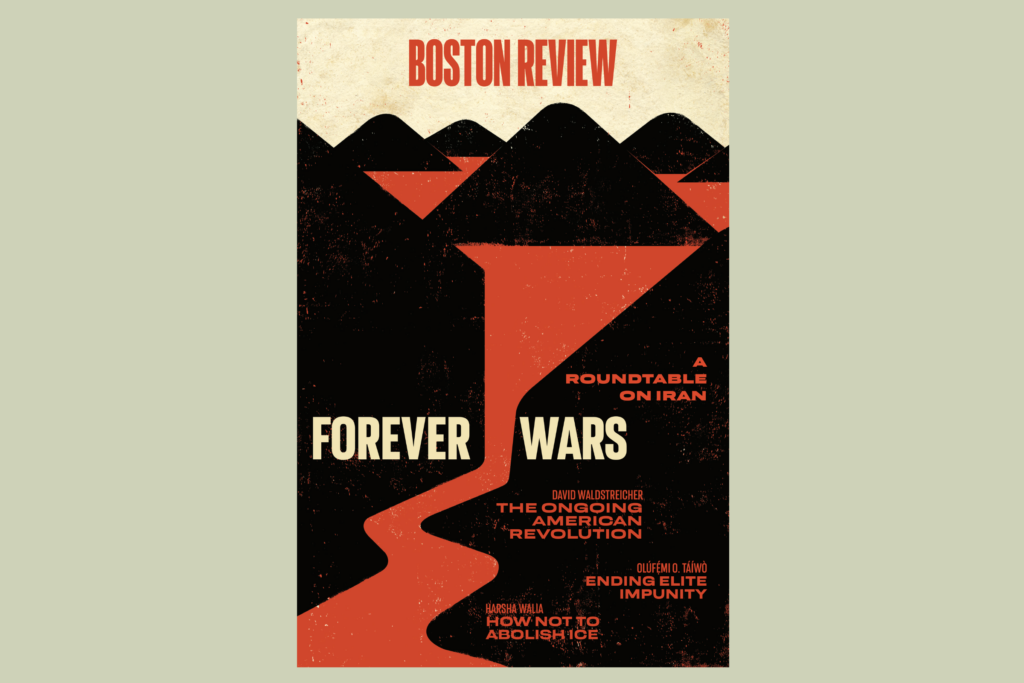
This February, the United States and Israel started a war with Iran, massively destabilizing the Middle East. In a roundtable discussion in this issue, four scholars of Iranian history and politics assess the shifting justifications, obvious miscalculations, and growing geopolitical, economic, and human toll. “We have seen different rationales,” Peyman Jafari argues, “because making the real reason explicit would have been unhinged, even for Netanyahu and Trump.” At bottom are “imperial anxieties” in the face of a changing global order. According to Manijeh Moradian, the United States and Israel “want the world to accept that this is the way it is, that they can do whatever they want.” The Iranian people, already the targets of brutal repression by their own government, are caught in between.
The human face of war runs throughout the issue. In a diary from March, an art director in Tehran bristles with hatred as a Basiji guard approaches her car. She had always viewed the Basij as the oppressive face of the Islamic Republic, yet the young man warns her that parking too close to their checkpoint is risky: it’s a likely target for drone strikes. The gesture startles her. “It was as if in a brief moment our relationship changed,” she writes. Other essays in the issue—dispatches from Lebanon, Iraq, and the West Bank, as well as a photo essay from Ukraine—further illuminate how a sense of common humanity can emerge in unlikely circumstances, and the powerful forces that can shatter it.
What can be done? As columnist Olúfémi O. Táíwò argues, the U.S. ruling class seems captivated by the fantasy that it can hide from the destruction it unleashes, whether in apocalypse bunkers or White House ballrooms. When consequences do catch up with elites, their shock reveals they are “appalled . . . to live in the same world as the rest of us.” We need to end their reign of impunity by using the power of the law to hold them to account.
Elsewhere, Harsha Walia urges that calls for “abolishing ICE” get something fundamentally wrong: to end the violence at the heart of today’s fascist politics, we need to reject borders themselves. Farah Bakaari draws lessons from Somaliland’s anticolonial struggles, which she argues have been betrayed by conflating self-determination with statehood. Two essays about novelists explore the role of imagination in a world increasingly hostile to it (Holter and Dunne), and two others challenge tech’s grip on our ideas about human creativity and the good life (Rubin and Grue).
Finally, on the 250th anniversary of the Declaration of Independence, David Waldstreicher revisits the long debate over the meaning of the American Revolution. Is it defined by its most undemocratic features, closing the nation off to change? Waldstreicher thinks not: the nationalist and capitalist compromises—on behalf of conquest and slavery—“were never the only legacies on offer.” They “don’t negate the radical claim on what else happened” and “what else was dreamed.” Those dreams are ahead of us.