Reviewed:
The American Revolution
directed by Ken Burns, Sarah Botstein, and David Schmidt
Florentine Films and WETA, 2025
We the People: A History of the U.S. Constitution
Jill Lepore
Liveright, 2025
Money and the Making of the American Revolution
Andrew David Edwards
Princeton, 2025
The American Revolution and the Fate of the World
Richard Bell
Riverhead Books, 2025
Freedom Round the Globe: A World History of the American Revolution
Sarah M. S. Pearsall
Doubleday, 2026
The Unfinished Business of 1776: Why the American Revolution Never Ended
Thomas Richards Jr.
The New Press, 2026
The Long Revolution: Creating a United States After 1776
Nathan Perl-Rosenthal
Basic Books, 2026
“What, to the American slave, is your Fourth of July?” Frederick Douglass asked in 1852, fourteen years after escaping bondage in Maryland, in a speech before the Rochester Ladies’ Anti-Slavery Society. “Whether we turn to the declarations of the past, or to the professions of the present, the conduct of the nation seems equally hideous and revolting,” he avowed.
Two hundred and fifty years after the Declaration of Independence was adopted by a few dozen men in Philadelphia, new forms of Douglass’s question cry out for an answer. How should we remember the American Revolution when millions march in the streets and shout “No Kings!”? When squads of masked thugs invade homes without warrant, kangaroo immigration “courts” deport hundreds of thousands without due process, and an executive agency buys up warehouses to use as internment camps? When agents of the state shoot and kill protesters but don’t come to trial, unlike the British soldiers who fired on demonstrators during the Boston Massacre? When the Supreme Court, invoking the “original public meaning” of the words of the king-dethroning revolutionaries, rubber-stamps absolute executive supremacy? When a Congress-spurning president, more callow and depraved than George III appeared in the propaganda of 1776, commands the largest military in the world to drop bombs and decapitate heads of state in furtherance of a rapacious empire, as the Patriots said the British had become?
If the right took possession of the American Revolution for a while, it is utterly failing to hold onto it now.
The situation is so bleak that professional historians of the early United States, generally as wary of partisanship as of presentism, are drawing the grimmest of comparisons. We are in “a much more serious situation than many politicians or journalists will admit: the scale of Trump’s crimes against American liberties rival those of king and Parliament in the 1770s,” Johann Neem, editor of the Journal of the Early Republic, wrote last year. The alarm extends beyond the so-called “resistance historians” who won large public profiles for liberal commentary during Trump’s first term. In my decades as a historian, I have never seen so many colleagues make statements implying that the present so echoes the revolutionary past that something like another revolution might be thinkable or even justified. Frank Cogliano, former director of the International Center for Jefferson Studies and editor of a new collection, The American Revolution at 250: Twenty-Four Historians Reflect on the Founding, has likewise compared Trump’s actions to the tyrannical acts of the British crown enumerated in the Declaration.
There is something old and something new in these warnings. The main theme Cogliano identifies in his assembled reflections is “uncertainty about whether the principles of the Revolution bind Americans together and whether its legacy speaks to the experiences of all Americans.” Where some essays stress religious freedoms, civil control of the military, and the peaceful transfer of power as enduring legacies, others lament a “founding in white supremacy” of “another settler colony born of European conquest and unchecked imperialism.” This “divergence” seems to be a far cry from the cross-partisan appeal of the Revolution during the Bicentennial. Over the last half century, with the fracturing of Cold War–era consensus, the right has embraced a “simplistic version” of the Revolution “for partisan ends,” Cogliano concedes, but the left has “largely abandoned the Revolution altogether,” a trend he sees culminating in the New York Times’s 1619 Project. The volume’s lead essay from Brendan McConville is more directly reproachful: our latter-day “repudiators of 1776,” with their “denunciations of nationalism,” miss the “universal implications” of the Revolution—its “suspicion of power” and “unique utopianism” that wisely rejected the “social leveling” promoted by “revolutionaries in other societies.” (This last claim got perhaps its most famous defense by Hannah Arendt in her 1963 book On Revolution.)
In fact, sharp disagreement over the Revolution’s legacy is older than these writers let on—far older than McConville’s predictable scapegoats, “progressives of both the neo-Marxist and identity politics types.” Before Warren G. Harding preceded Trump in presiding over one of the most corrupt administrations in U.S. history, he coined the phrase “Founding Fathers” to attack Charles Beard, the Progressive historian who dared to suggest the Constitution had something to do with interests and not just ideals, which in practice hardly seemed universal anyway. The hypocrisy question predated the war and independence; so did attempts to push further. “Remember the Ladies,” Abigail Adams abortively implored her husband in March 1776, as “all Men would be tyrants if they could.” It’s less well known that in the beginning of that famous letter she pivoted from worrying about the patriotism of Virginians “duped by a Dunmore” (the royal governor who had armed slaves) to observe that “the passion for Liberty cannot be Eaquelly Strong in the Breasts of those who had been accustomed to deprive their fellow Creatures of theirs.” She was not alone. “How well the Cry for Liberty, and the reverse Disposition for the exercise of oppressive Power over others agree, I humbly think it does not require the Penetration of a Philosopher to determine,” Phillis Wheatley wrote archly to her indigenous mentor Samson Occom two years earlier, a few months after being emancipated from slavery.
Harding’s language stuck, but he represents a general phenomenon. As a rule, elites tend to convert order-disrupting revolutions into order-preserving “foundings,” whether they use the word or not. If society is to be stabilized, the revolutionary past can’t keep inspiring radicalism, which after all is rarely welcomed in the present. Revolution can thus easily become a conservative symbol in the dominant political culture of a nation: more a means of defining and venerating a legitimate tradition—and what is legitimacy but a plea for loyalty over rebellion?—than of completing, achieving, or truly universalizing the ideals associated with it. This is the uphill battle the latter orientation to the American Revolution has always faced, doggedly advanced though it has been by Douglass (“notwithstanding the dark picture I have this day presented of the state of the nation, I do not despair of this country”) and by later left figures as various as Martin Luther King Jr., Richard Rorty, and members of the Black Panther Party. The specter of un-American radicalism apparently remains so menacing that neither Cogliano nor McConville, mourning the left’s abandonment of the Revolution, can point out, in service of their own argument, that the Panthers’ founding Ten Point Program ends with a lengthy quotation from the Declaration of Independence.
But if the right took possession of the Revolution for a while, it is utterly failing to hold onto it now. Among Americans elected to high office, Donald J. Trump appears singularly incapable of comprehending or even alluding to events before his own lifetime. MAGA’s efforts to commemorate independence have fallen flat, achieving none of the popularity or even gravitas that conservatives once could be expected to muster on this front. Last year’s military parade in Washington, a clumsy conflation of Trump’s birthday with the founding of the U.S. Army, drew sparse crowds. Ventures like the 1776 Commission, eager to censor national museums and historical landmarks in the name of “patriotic education,” are being impeded by legal challenges. As part of its Freedom 250 initiative, the White House outsourced an online exhibit to the right-wing nonprofit PragerU, which delivered a gallery of AI-generated videos as cartoonish as they are loaded. Cultural hegemony this is not.
Given the way that evocations of the rebellious parts of the American Revolution have migrated from the Tea Party of the Obama years to No Kings in the Trump regency, the revolutionary past appears less stable, much less frozen or dead or white, than some would have us believe. How are others remembering it, and what can we still learn from their memory?
Ken Burns has offered a much more popular treatment than MAGA with his six-part series The American Revolution, aired in November on PBS and codirected with Sarah Botstein and David Schmidt. Endorsed and promoted months in advance by leaders of the American Historical Association, the series features a few of the usual best-selling talking heads—Joseph J. Ellis, Stacy Schiff—but also a bevy of real experts whose commentaries broaden the cast and the geography of the Revolution itself. The familiar melodrama and jingoism are here, but they are meaningfully and constructively toned down. We’re reminded repeatedly to think of the Revolution as a civil war and yet also an imperial and world war. Women, indigenous people, and people of African descent are shown as both embracing and rejecting the Patriot struggle for independence and, whichever side they choose, suffering consequences as grave as soldiers did.
Yet the cast of thousands and the complicating what-abouts never quite make this production into something more than a war story, traced in maps by journalist-turned–military historian Rick Atkinson. The cumulative effect is a more fact-based and liberal version of the kind of narrative that Shelby Foote provided in Burns’s career-making series on the Civil War thirty-five years ago. Since then, Burns’s famous panning technique has done a lot more with period photographs and better footage, of baseball and jazz and New York City, but his Sumter-to-Appomattox documentary evidently remains the model, however accommodating of changing sensitivities. His American Revolution is nation-making not because it remade the polity or the culture but because it was, tragically, that kind of war.
Politics emerged from the Revolution as a dialectic of legal order and popular protest: a far cry from the easy consensus evoked by much later talk of a “founding.”
Indeed the war itself, the battles and strategy and arms and suffering on the home front, gets more than four two-hour segments. The run-up to Lexington and Concord is over in one episode; at the end of the series, the convoluted path to the ratification of the Constitution in 1788, with its social and economic questions, goes by in ten minutes. Over the middle ten hours, we hear in detail about thirty-five battles, as often as not with shots of muskets, muddy boots, and bloody clothes. Tactical errors and flanking maneuvers abound. You likely have never heard of Chadds Ford, Oriskany, or Bemis Heights, but they’re here, along with extreme close-ups of generals from John Burgoyne to Baron von Steuben. A pronounced vagueness sets in: Is our subject the overthrow of British authority, the creation of the United States, or the ultimate triumph of mostly unsuccessful military operations? Questions about the nation are explained by the war, and questions about the war are explained by facts about America—its demography and its landscape, looked at and lingered over like a painting. In the introduction to the show’s companion book, cowritten with Geoffrey Ward, Burns lays out his method of making landscape the main character. It’s the oldest romantic device in the history of art, and like all romance, especially when it involves death, it can be hard to resist.
What’s missing is the politics—which is to say, why the Revolution happened at all and how to make sense of its impact and lessons. Instead we get the messy facts of the war, some folks’ articulate descriptions of their experiences, and the sheer surge of people, in armies and in and out of occupied cities and indigenous towns and household bondage: the displacements and mileage and diversity that made the war last as long as it did. With all the maps in motion, it feels more like geography, or surveillance, than history. Except for a brief interlude on new state constitutions, one gets the impression the Revolution was over when the battles stopped.
In short, Burns dodges the making of a revolutionary movement, its evolution, strategies, and divisions, precisely at a time in U.S. history when some of its legacies might prove most useful. Apparently the choice was deliberate. Burns has said he wants the series to be “unifying” at this “supposedly existentially threatening moment.” We were “much more divided” then; he wants to “put the us back in the U.S.” now. The papering-over of real and lasting divisions is just as revealing as the conceit that balancing diversity with battle reenactments is the way back to consensus.
More compelling guides to what might be useful in the memory of the Revolution can be found in a mini-renaissance of well-researched, well-written tomes appearing over the last year. Much like the debunking exercises that sparred with neo-Whig narratives during the Bicentennial fifty years ago, the new work finds many ways to remind us of the revolution’s radicalism, its limits, and its implications today.
Back in 2010, Jill Lepore reported on the politics of revolutionary memory in The Whites of Their Eyes: The Tea Party’s Revolution and the Battle over American History. After Trump’s first election, while continuing to specialize in a unique brand of artful debunkery, she began to complain that her fellow historians had ceded the national story out of embarrassment, stating in This America: The Case for the Nation (2019) that the loss of a liberal hold on the narrative contributed to MAGA’s ascendancy. She emerges with more optimism in a recent New Yorker essay about the Bicentennial—ending on notes of “courage” and “resolve” despite our “long national nightmare”—and the sentiment shows too, though perhaps unexpectedly, in her latest book. We the People: A History of the U.S. Constitution is a lengthy history of something that hasn’t happened very often since revolutionary energies were channeled into devising a legal order for the new nation, and not at all since 1992: amending the supreme law of the land.
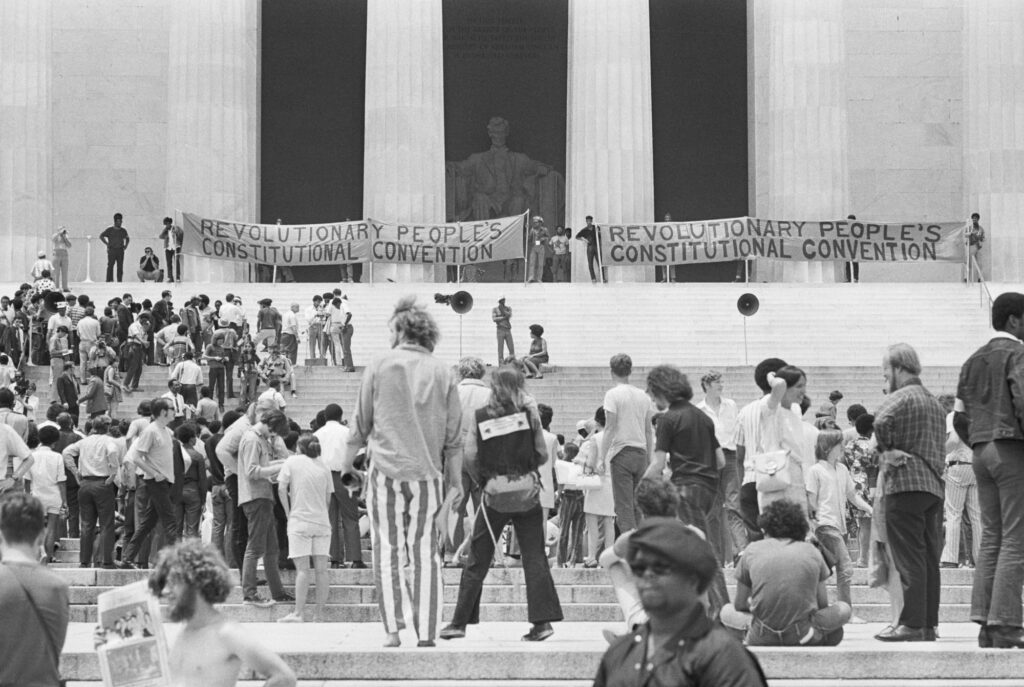
The process for amendment gets its own Article in the Constitution, following the first three delineating the branches of the federal government and the fourth on the states. But if amendment is as important as that prominence suggests, Lepore asks, why have there been only seventeen amendments in the last 235 years, following the burst of ten codified in 1791 and now known as the Bill of Rights? What does this have to do with the sense that the Constitution is “broken,” as more and more constitutional scholars seem willing, if not eager, to admit? If the American Revolution was about the people and their representatives forging self-government in a federal republic, why have Americans seemed to rely, increasingly, on the Supreme Court to tell us what is and is not possible, and why does so much now depend on the partisan gaming of lifetime appointments to the bench? Lepore argues that the struggle to amend refracts the legacies of the Revolution at their most potentially democratic as well as their most actually sclerotic.
The process for amending is certainly difficult. To succeed, an amendment must first be proposed either by two-thirds of both houses of Congress or by a convention called for by two-thirds of state legislatures; ratification then requires three-quarters of the states. These rules magnified the built-in inequalities of the Constitution—especially the Three-Fifths Clause, which advantaged Southern states. Only two more amendments, relatively inconsequential and procedural, were ratified before the Civil War. The three crucial (and still deeply contested) Reconstruction amendments—abolishing slavery, guaranteeing the right to vote and equal protection under the law, and establishing birthright citizenship—passed only because the slavocracies were required to pass them as a condition of their return to the union.
Failed attempts to amend make a surprisingly good story in We the People, with impressive villains (like Phyllis Schlafly, enemy of the Equal Rights Amendment) and flawed heroes (like Birch Bayh, champion of an amendment to abolish the Electoral College). Lepore illustrates how the “spirit” of amendment—“restless and unruly”—was the spirit of those “left out” of the design of the Constitution, especially women. No wonder, then, that it has so often been frustrated. The only thing that tends to break the logjam is war: eleven of the seventeen amendments that have succeeded since the Bill of Rights were ratified in the run-up to, during, or in the aftermath of the Civil War, World War I, and the Vietnam War.
Beard thus called the Constitution the “bulwark of every great national sin.” Yet Progressives made their peace with the judiciary during the 1930s when the Supreme Court stopped striking down newly fashioned parts of the New Deal administrative state. Lepore casts modern originalist jurisprudence, cemented in the 1980s under the Reagan administration, as a conservative response to the long failure of white Southerners and their allies to get a constitutional amendment to overturn Brown v. Board of Education in the wake of the civil rights movement. Subsequently, she argues, “liberals abandoned both constitutional amendment and democratic deliberation”—the kinds of massive popular campaigns it took to actually get amendments passed. If originalism ultimately derives from, as well as produces, the inability to change the Constitution by democratic means, then amendment is “a plant that seems to have withered almost as soon as it sprouted, choked by the weed of slavery.” The potted history proffered by originalists, with its prelapsarian imagination of a nation before race and gender and sex (but not religion), appears more unreal all the time.
There’s no shortage of lament in Lepore’s narrative, but it’s not all gloom, either: she sees useful precedents. It’s striking how consequential the Revolution is in her telling. She often grounds a devastating critique of our present political malaise in what might seem to be basic, if neglected, facts of the Constitution’s early evolution. The outcomes were double-edged: revolution produced a government responsive to the people, but it also produced a written federal constitution difficult for even a mass consensus to alter. Originally both radical and conservative, the balance has swung. The implication is that we are living in a period much more like the rebels faced in 1776—ruled by old-fashioned laws serving entrenched elites rather than through the creative self-governance that amendment, at its best, represents—than we may recognize. Unless, that is, we are in an unconstitutional war, in which case all historical bets are off.
What we remember about the rest of the long revolutionary process is at least as important as the legacies of the Constitution itself. In Money and the Making of the American Revolution, Andrew David Edwards recaptures another dimension with striking parallels to the present: the radical potential of colonists’ revolt against imperial fiscal policy.
In Edwards’s hands, the colonial protests about stamps and other taxes that lit the revolutionary fuse during the 1760s and early 1770s were really about the means of payment. Chronically short of hard coin, colonists had experimented with paper and book credit for more than a century, all the more so during trade booms and busts punctuated by Atlantic wars. But after the Seven Years’ War (1756–1763), the Currency Act forbade the colonies to issue their own money backed by sinking taxes or anything else, which meant that new imperial import duties would have to be paid in scarce silver. The inability of policymakers to understand the results alienated rich and poor alike. If those supposedly light taxes had to be paid in coin, they were not so light at all, and they might get worse depending on the fluctuating money supply. Settlers saw a colonial debt crisis on the horizon in the empire’s postwar austerity measures.
All this cuts against the neo-Whig narrative of historians like Bernard Bailyn, Edmund Morgan, and Gordon Wood, who reasoned from the relative wealth of colonists (compared to landless white Europeans) to the ultimate insignificance of taxes—and thus money or the economy writ large—as factors in the coming of Revolution. Instead, they argued, the Revolution was mainly an ideological and constitutional conflict over ideas like liberty and sovereignty. Beginning in the 1970s and 1980s, neo-Progressive historians countered by stressing how the declining availability of land, and falling wages in towns, created discontent that could be and was mobilized against the crown. T. H. Breen tried to split the difference with The Marketplace of Revolution (2004), an influential study of how consumption in an Atlantic economy became first a unifying and then a divisive force, from tea-drinking to boycotts. This account captured something of the modernity of colonial protest, depicting revolutionary energies as riding on rising expectations. But Breen ended his story in 1774, and in retrospect his interpretation of the market can look like not much more than a culturalist rewrite of Richard Hofstadter’s lament about the United States being a “democracy of cupidity” resigned to making the best of it.
Edwards manages to show the common interest among colonial debtors that made money supply an engine of provincial, then state-level, politics, and ultimately a driver of constitutional debates. He follows the story and the money through the war years as well as the 1780s, when the Continental Congress applied some of the lessons of debt-financing experience to the war. It did so with just enough success to sustain fledgling nationhood but not enough to keep rampant inflation, new divisions of interest between debtors and creditors, and pressures from foreign capital at bay. Edwards contrasts the capitalist, monied takeover of state and national policy by the likes of Alexander Hamilton with the more grounded, flexible, local approach to regulation and tax payments that many towns and states adopted under pressure from indebted farmers. And he terms the latter anticapitalist in essence—or at least in comparison to the world-system of credit that U.S. financiers eagerly rejoined after breaking from Britain, in order to fund larger settler-colonial projects on their own terms.
The characterization is debatable, given that wartime capitalists—what Beard called the “monied aristocracy”—ultimately dominated policy. Clearer are the Revolution’s origins in protest of a particular colonial relationship, not just an abstract idea of political liberty. As Edwards observes, some colonists, like John Dickinson, reached for Lockean theories of natural rights to condemn existing political arrangements that shaped their political economies. (They also had reason to not discuss certain aspects of their unevenly regulated bottom line, like smuggling and slavery and land speculation.) The upshot is that both the neo-Progressives’ search for resistance from the masses and the neo-Whigs’ focus on eighteenth-century ideas have made the American Revolution look less modern, less economic, and less specifically anticolonial than it was.
Though vexing in Virginia and Massachusetts, British fiscal policy was more explicable in the metropole given the increasing scale of empire. Extending the international frame, engaging new narrative histories by Richard Bell and Sarah M. S. Pearsall further illuminate the geopolitical stakes of the American Revolution, emphasizing its Atlantic, continental, imperial, even global dimensions without erasing its most human, experiential scale. Unbothered by old methodological divides between “top-down” political histories and “bottom-up” social histories, they feature ordinary people and leaders, Patriots and Loyalists, and especially women, indigenous, and Black people, in a civil war that became a world war.
As Bell argues in the portentously titled The American Revolution and the Fate of the World, the cardinal error is to think about the American Revolution in “simple, narrow, and nationalist terms.” The British East India Company was too big to fail, which set the backdrop for the 1773 Tea Act tax and the Boston Tea Party. Meanwhile, slave-trade profits inspired demands for free trade. When war broke out, it starved the British Caribbean, scrambled trading relationships, sped British abolition, and became a hinge in England’s century of conflict with France. Loyalists came in all shapes and sizes, and the sun never set on the war’s refugees. Native Americans and Africans fought on both sides but more often with the British. Bell musters seven broad themes and spies far-flung collateral damage. There was “mass migration” and tremendous “human cost.” The war’s outcomes were “highly contingent,” dependent on “naval power,” and included world-changing effects on trade. Imperial officials responded to “the call for liberty” that resonated “around the world” by further rationalizing—that is, by cracking down on colonial autonomy. All this is farseeing, even cosmopolitan, and hard to argue with.
That is, until one realizes that the American Revolution has been reduced (or inflated?) to World War 0. These are basically the classic themes of British imperial history; the giveaway is the relentless focus on the war, not unlike Burns’s treatment. Yet neo-Whig and neo-Progressive historians had good reasons for downplaying the war. It isn’t just that wars are hells that involve good people in evil, overspill national bounds, and last longer than anyone ever expects. It’s that war, being politics by other means, obscures the politics that animate flesh-and-blood actors to go to war—all the more so when war starts involving the whole world. There’s a cost to reducing revolutions to wartime contingencies and mocking provincial or national perspectives: we lose any sense of how men and women make history, even if they do not make it as they please. Bell’s version is curiously bereft of the British officers, smug MPs, London wags, and imperial reformers who inferred from the Seven Years’ War that Americans were not equal tax-paying Britons but rather selfish semi-citizens—genuine colonial subjects who needed to be taught a lesson, even if that meant reminding them that their lands and slaves and inexpensive tea were held at the sufferance of the king. Not much else could have made a revolutionary out of so successful, worldly, and well-connected a man as Benjamin Franklin.
Pearsall’s Freedom Round the Globe likewise sees the revolution as “a Russian doll of a war, with wars nested in other wars,” but it avoids the problem by emphasizing widely held ideals and meanings put to different uses in different places by different people. In her remarkably successful telling, Whig and imperial means are often put to Progressive ends. Each chapter commences outside the recognized boundaries of the thirteen rebelling colonies in places such as St. Kitts, Edinburgh, Quebec, and Anomabu as counterparts to the usual scenes, showing that these places too saw judicial murders, crowd actions, tax revolts, and debates about oppression and their causes. Like Bell, Pearsall sees another European imperial war, a civil war, and wars of conquest in North America. She begins, indeed, with Pontiac’s War in 1763, which began with a controversy over the hanging of an indigenous woman and her people’s fears that it portended their loss of power, and even future enslavement at the hands of the British:
Some have wondered: did Indigenous Americans belong to a larger Age of Revolutions? Yes—in fact, they helped to launch it. This moment shaped profoundly all that was to follow. All kinds of people forged unity out of noble ideas (community, sovereignty, freedom) and also out of less noble ones (racial and other exclusions and fierce anti-British sentiments). In a culture of resistance to encroachments and violence, Indigenous women and men were among the first North Americans to push back hard against the British empire.
Pearsall understands that slavery was getting bigger and worse in the third quarter of the eighteenth century, in part because of Britain’s imperial successes, and that everyone was responding to that empire- and war-inflected reality. Talk of freedom wasn’t just cant for power plays. Here the “world” view does not obscure the real and material grounds of politics, or the causes of dissent; rather it illuminates the sense of possibility that made the period revolutionary, even for those who did not win its battles. The 1780s are thus “a period of remarkable ambition and optimism, even amid economic uncertainty and rising inequalities,” an American hustle as well as backlash—for which Native people and the enslaved paid the highest price.
This season’s most compelling remembrances convey this open-endedness of the Revolution by stretching the story of political opportunity through the Civil War.
In The Unfinished Business of 1776: Why the American Revolution Never Ended, Thomas Richards Jr. finds a continued struggle over the Revolution’s meanings in various parts of the country between the Constitution’s ratification in 1788 and the end of Reconstruction a century later. Even the Bill of Rights—a touchstone of the reverent traditionalism that pervades conservative memory of the Revolution—was a direct product of antifederalist “popular pushback” against the secret handiwork of the Framers. “The First Amendment protected the boisterous communal radicalism of American public life as it existed at the tail end of the American Revolution,” Richards writes. In other words, politics emerged from the Revolution as an evolving dialectic of legal order and popular protest: a far cry from the easy consensus and authority evoked by twentieth-century talk of a “founding.”
Similarly, the Whiskey Rebellion in the early 1790s, prompted by a tax on whiskey production imposed by the new national government, suggested continued elite cluelessness about the relationship between money supply and taxes. The revolt was crushed, exhibiting federal supremacy; but it also demonstrated compromise with popular demands in the wake of resistance (the taxes didn’t really get paid, suggesting a de facto right to rebel). The relatively brief period of propertied women’s voting in New Jersey, up to 1807, had its roots in the revolutionary expansion of suffrage to more property holders: an example of early women’s rights arguments. Demands for debt relief and economic equality in Kentucky’s “Relief War” of the 1820s reveal that frontier farmers perceived no inherent conflict between “the absolute protection of private property and a society that was (relatively) more economically egalitarian.” In the murderous suppression of Gabriel’s Rebellion in Virginia in 1800 and in Northern emancipation, we see both backlash and advance as Black people “co-opted revolutionary rhetoric and made it their own.” And in emergent party politics, the Revolution justified calls for both unity and cutting-edge partisanship. Whether the revolution meant order or more people in the streets remained up for grabs.
Unfinished Business doesn’t hide from the more double-edged implications of post-revolutionary populism. On the one hand, colonizers in the 1830s and ’40s—Mormons, some Texans and Californians—claimed the right to cross borders and declare independence. On the other hand, Cherokees fought for the right to remain by reminding the nation of its revolutionary forefathers’ treaty commitments, shaming Americans so effectively that the Removal Act only barely passed Congress in 1830. Their movement lost, but it inspired abolitionists who saw how far the “slave power” would go once they controlled the executive branch. Richards defines the open-endedness of the American Revolution as a function of its limits or hypocrisies: the gaps between revolutionary promise and post-revolutionary reality provided compelling grounds for challenging the evolving order, precisely in order to close them. In carefully demonstrating how such claims took shape in a multitude of contexts, he threads a needle between the idealized, egalitarian, nationalist, world-inspiring, too-often-exceptionalist version of the American Revolution and the necessarily disillusioned, debunking rebuttals.
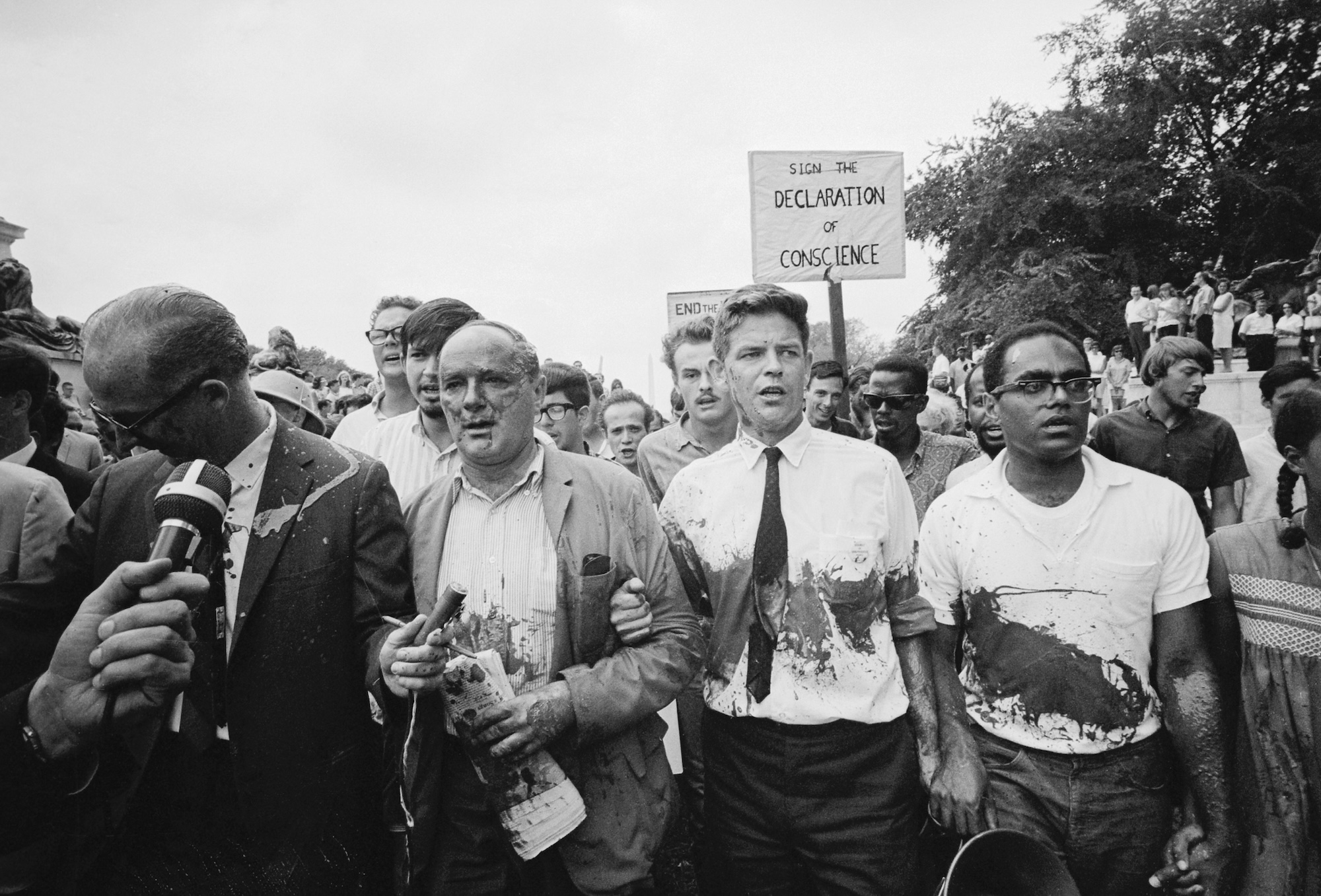
The argument finds further substantiation in Nathan Perl-Rosenthal’s The Long Revolution: Creating a United States After 1776, which examines a hundred years of Fourth of July orations—Douglass’s among them—and finds that unlike conservatives’ sense of the Revolution as closed and defined, post-revolutionary Americans spoke of and heard about an unfinished event: “their revolution was one still in progress,” an ongoing experiment, and sometimes one facing imminent dangers. In the early republic, the Fourth of July was a highly politicized ritual of public culture, engaged through newspapering and beyond, that enabled more and more people to connect local and national politics, not least by spawning parallel holidays like George Washington’s birthday, the anniversary of Thomas Jefferson’s election, and the end of the international slave trade. By focusing on the annual orations, The Long Revolution misses some of the dynamism of this new participatory partisanship, but it reminds us that major questions about a changing world were addressed in forums that only later became quaint.
Perl-Rosenthal is a leading comparative and transnational historian of the period. His previous book, The Age of Revolutions (2024), offered a lively and panoramic narrative of revolutionary upheaval as a two-generation and continent-spanning travail, from North and South America to Haiti and Europe. Now, with Long Revolution, he’s delighted to find full-throated American nationalists looking abroad for the meaning of what they had done and inherited. By the 1820s, he shows, the memory of the Revolution also served as a site of national introspection: Did social changes, and especially the further spread of slavery, mean that the Revolution’s projects had been resolved, obviated—or never completed? Perl-Rosenthal is especially good on the way abolitionists made effective and inspiring use of the revolutionary legacy, whether they made Patriots out to have preserved slavery (as William Lloyd Garrison contended) or to have intended it to end (as Douglass maintained).
The discussion provides a fresh window into the politicizing possibilities of revolutionary memory. Only after the Civil War and the failures of Reconstruction was the Revolution denuded of political potential—except for Black Americans and for radicals of all stripes, who “continued to cast themselves as actors in an unfinished American Revolution.” Perl-Rosenthal sees the “happy, festive void”—celebration of the nation shorn of its critical edge, the sort of thing MAGA imagines when it says America was great, and which some on the left take to be the essence of nationalism—as a late corruption, the image of a non-revolutionary revolution eventually being codified by intellectuals like Arendt and Louis Hartz at the height of the Cold War. The “living revolution,” not the “beautiful mummy” frozen in time by the likes of Calvin Coolidge, is the authentic legacy.
American revolutionaries gathered in the streets against armed oppressors, and they scaled up their dissent with innovative use of committees and the new media of the day. In all this, they mobilized past struggles—a sense of historic freedoms as well as British imperial glories—to proclaim and create something new. Elite leaders caught up with them and tamped down on the anger of crowds as well as the most egalitarian possibilities advanced by Patriots, for which the establishment will never cease to congratulate them as “The Founders.” Compromises shaped the revolutionary settlement in ways that served capital, conquest, and the spread of slavery; the engines and outcomes of the Revolution include settler-colonial lawlessness and cynical racial nationalism. Still, those were never the only legacies on offer. They don’t negate the radical claim on what else happened and how it happened, what else was dreamed and uttered.
“Any critic of the American present must have profoundly mixed feelings about our country’s past,” the late historian Staughton Lynd admitted in his neglected classic, Intellectual Origins of American Radicalism (1968). He wrote these words in the midst of his own vigorous activism against the Vietnam war:
On the one hand, he will feel shame and distrust toward Founding Fathers who tolerated slavery, exterminated Indians, and blandly assumed that a good society must be based on private property. On the other hand, he is likely to find himself articulating his own demands in the Revolutionary language of inalienable rights, a natural higher law, and the right to revolution.
In full acknowledgment of these “ambiguities,” Lynd traced a throughline of conscientious resistance from the English civil wars through the Revolution to the abolitionists, Eugene Debs and W. E. B. Du Bois, and the young radicals of his own day. “Without significant exception,” he concluded, “subsequent variants of American radicalism have taken the Declaration of Independence as their point of departure and claimed to be the true heirs of the spirit of ’76.” In this tradition, there’s civil disobedience, openings for new actors and new sensitivities, faith and universalism. Debs said “my country is the world” while he waved the flag and claimed Jefferson and Abraham Lincoln for the rights of workers.
The obstacle to reclaiming this heritage may have less to do with the impurities of the Revolution itself than with what Douglass called a “quailing sensation”: the fear we sense at the right’s ghostly grip on American political traditions. If that grip is loosening, in massive “No Kings” protests in Minneapolis and beyond, radical expressions of our revolutionary inheritance—those that believe it “remains relevant as an instrument of social transformation,” as Lynd put it—stand to flourish once again. After all, “the process of revolution begins when . . . the way a society makes its decisions is forced to change,” and nothing could be more necessary today.
Independent and nonprofit, Boston Review relies on reader funding. To support work like this, please donate here.