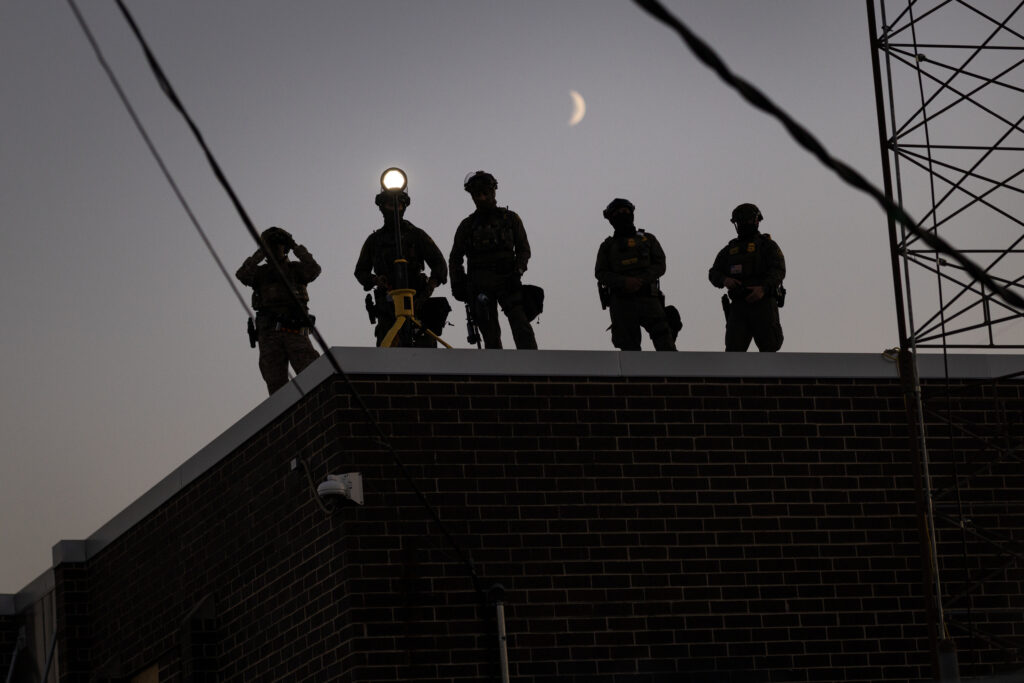
Calls to abolish ICE are as old as the agency itself. When it was established in 2003 by President George W. Bush with bipartisan support, ICE was meant to serve as the domestic arm of the U.S.-led global war on terror, the at-home counterpart to the merciless military operations in Iraq and Afghanistan. Community organizers, in turn, saw their demands to dismantle ICE as part of resisting “the war at home,” the post-9/11 attacks on immigrants and those deemed “national security threats” through mass surveillance, racial profiling, incarceration in detention centers and black sites, expanded enforcement powers, and border securitization. Organizations like Desis Rising Up and Moving fought for, and subsequently won, an end to the “Muslim Registrations” of over 84,000 Muslim men and boys through the infamous National Security Entry-Exit Registration System, and launched community defense programs to free people from ICE detention.
Most people, however, likely first encountered the idea of abolishing ICE more than a decade later, during Donald Trump’s first term. In 2018, when the Department of Justice implemented a “zero-tolerance” policy toward irregular border crossers that resulted in the criminal prosecution of adults and the separation of thousands of children from their families, some activists created a social media hashtag—#AbolishICE—that swelled into a viral campaign, making the idea familiar among a broader swath of the American left. In the process, though, some of the original idea’s nuance got stripped away. For one thing, the agency tasked with enforcing the family separation at the border was not ICE but Customs and Border Protection (CBP), one of almost two dozen agencies within the behemoth Department of Homeland Security (DHS) created in the wake of 9/11. And ICE and CBP are not the only agencies with the power to police immigration: through various policing and detention agreements, more than 1,000 local and state law enforcement agencies throughout the country also have jurisdiction over migrants.
Certain calls to abolish ICE are in reality a means to stabilize, not dismantle, the violence of immigration enforcement.
Today, as Trump’s high-visibility deportation regime has cast ICE’s abuses back into public view, calls to abolish ICE are back. And while most in the party have stuck to calculated bromides about reining in the agency’s power, some Democrats have joined the chorus of voices calling to dismantle it. But what the past decades of immigration struggles have taught us is that we must learn to resist a singular focus on ICE as a rogue agency, looking instead to how the sprawling border policing apparatus has been built up over years as a bipartisan effort. We certainly do need to abolish ICE, but that cannot be the only goal. The agency’s abuses are not new, not created by Republicans alone, and not distinct from other enforcement agencies: they are tethered to otherwise normalized carceral and militarized infrastructures that will persist even without it. Abolish ICE is part of a broader political project that strikes at the heart of the border.
Public outrage at ICE has peaked during each Trump term, yet without the Democratic presidents who helped cement an immigration apparatus bent on expanding mass detention and deportation, criminalizing migration through prosecutions, and militarizing the border, Trump would not be presiding over an agency with such vast power and deep pockets. Every day ICE, which commands a budget larger than all other federal law enforcement agencies combined and most of the world’s militaries, spends millions of dollars to surveil, separate, and incarcerate over one thousand families. Those capacities were not only already part of immigration enforcement before the creation of ICE—they had also long been deployed within the web of policing.
In the 1990s, Bill Clinton’s “tough on immigration” strategy converged with “tough on crime” policies, widening the net for detention and deportation for those with minor convictions stemming from stop-and-frisk policing and the war on drugs. New laws fast-tracked deportation, expanded the list of deportable offenses, mandated detention in many instances, and imposed criminal penalties for unauthorized border crossings by entangling the criminal legal and immigration systems (commonly referred to as “crimmigration”). Deportation and detention expansion aided the rise of the prison-industrial complex, too, with criminalization, illegalization, and policies of austerity acting as conjoined forces. Clinton’s administration also created the notorious 287(g) agreements, which deputized local law enforcement as immigration authorities to check immigration status and authorize administrative warrants, collapsing the material distinction between these different agencies and opening the doors to the modern-day police state.
Ever since then, rhetoric embracing “legal” immigrants, with the simultaneous vilification of “criminal” and “illegal” immigrants, has remained a Democratic policy pillar. By the first year of Obama’s presidency, about half of the people ICE detained came through the “Criminal Alien Program,” which uses collaborations between local law enforcement and federal immigration enforcement as a pipeline for expulsion. Obama also turbocharged the Secure Communities initiative, which linked over 1,000 local law enforcement jurisdictions with ICE and FBI databases, nearly doubling deportation rates. By 2014, about half of all federal criminal arrests were immigration-related. By the end of Obama’s second term, the three million deportations he had overseen earned him the moniker of “deporter-in-chief.”
In his first term, Trump increased funding for ICE, further militarized the border, authorized the deportation of immigrants convicted or accused of minor crimes, and implemented the internationally condemned zero tolerance policy at the border. Despite promises to the contrary, Biden increased deportations and detention still further: in his administration’s first year, the number of immigrants jailed by ICE increased by 70 percent over the last year of Trump’s first term. Then, amid the U.S.-Israeli genocide of Palestine, the 2024 Biden-Harris campaign harkened back to Bush-era rhetoric by emphasizing immigration as a domestic security issue.
So today, when more and more Democrats voice support for eliminating ICE, we should be wary. Certain calls for abolition are in reality a means to stabilize, not dismantle, the violence of immigration enforcement. A case in point is Michigan representative Shri Thanedar’s Abolish ICE Act. Introduced to some fanfare in the media, the bill simply reassigns most ICE duties and funding to DHS—hardly true abolition. Other Democrats opt for rhetorical sleight of hand, opposing “Trump’s ICE” or, as summed up by Congressman Troy Carter, seeking to “abolish ICE as we know it today.” For them, ICE’s most spectacular excesses are epitomized in the image of former DHS secretary Kristi Noem slandering two white citizens, Renée Good and Alex Pretti, as “domestic terrorists” after they were fatally shot by officers for acting as legal observers. Many of the Democrats’ proposed reforms, such as body cameras and increased training (the latter paraded as a response to police abuses of power since the days of the Kerner Commission in the 1960s), are the same failed police reforms weaponized to quell generations of Black-led movements, including the 2020 uprisings.
Immigration enforcement is an ever-expanding architecture that collapses the local and global, seamlessly merging with both policing and military power.
In the case of body cameras, for example, studies show that police departments frequently control footage release, and there is no statistical evidence proving body cameras reduce officer force or increase officer accountability. Four CBP officers on the scene of Pretti’s shooting already had body cameras (though the footage has still not been released). And yet, to appease widespread outrage, DHS announced body cameras would be issued to all agents in Minneapolis, and then nationwide once funding was available. Put simply, body cameras don’t work and become a pretense for bloating enforcement budgets.
As political scientist Naomi Murakawa documents, the unprecedented number of legal reforms passed in the months following the murder of George Floyd gave the veneer of addressing police accountability but, in actuality, only shored up police legitimacy. Data from Mapping Police Violence shows that police-perpetrated killings have increased, not decreased, since 2020. Liberal conceit thus maintains the war of the carceral system, while ensuring capital flows for corporate giants like Geo Group, L3, Palantir, Axon, and Lockheed Martin. As journalists Maya Schenwar and Victoria Law describe, reform “is the re-forming of the system in its own image, using the same raw materials: white supremacy, a history of oppression, and a toolkit whose main contents are confinement, isolation, surveillance, and punishment.”
Liberal reformism also perpetuates the erroneous assumption that police can be allies in the fight against ICE. Over the last year, there have been countless pleas for police officers to protect people from ICE, and many cities are reporting increases in 911 calls to report ICE activity. But ICE surges are often accompanied by local police or involve police information sharing and surveillance cooperation as force multipliers. Similarly, ICE detention capacity is largely expanding through existing Bureau of Prison facilities, the carceral carousel that just cycles prisons for different uses at different times. The binary between “good cop” and “bad ICE” launders the everyday carnage of police and prisons. Even further, there is no material or ideological distinction between ICE and police; both are an extension of the anti-Black warfare waged since the country’s founding. The attempts to rein in irregular migration stem from the longue durée of the policing of Black mobility, which Benjamin Ndugga-Kabuye and Tia Oso describe as the United States’s central “pre-occupation with Black movement.” Contemporary immigration enforcement draws heavily on the Fugitive Slave Acts of 1793 and 1850; in fact, one of the first operations of ICE in 2003 was called the “Fugitive Operations Program” to capture noncitizens who had gone underground.
Immigration enforcement is thus not in contrast to, or even parallel to, police; it is a method of policing. As far back as the 1980s, Ronald Reagan’s administration identified the Immigration and Naturalization Service, the predecessor of DHS, as “a criminal justice agency.” Today, there are over 1,400 federal 287(g) agreements with tens of thousands of local officers in a capillary network of immigration policing crossing forty states, and—even without high-profile ICE occupations in their cities—hundreds of local jails are ballooning with migrants snatched from their families through existing state-level agreements for immigration incarceration. At the same time, Trump has transferred stretches of borderlands to military jurisdiction with a deployment of over 20,000 troops. Immigration enforcement is an ever-expanding architecture that continuously collapses the local and global, seamlessly merging with both policing and military power.
It is not enough, then, to focus on the governance and oversight of ICE because the agency is not an anomaly. Instead, we must question all carceral systems that capture an expanding web of subjugated people. As abolitionist Mariame Kaba insists, the abolition of policing goes beyond the police, recognizing that child welfare reporting, drug courts, mandatory psychiatric treatment, and immigration detention are also forms of criminalization and control that are counter to providing meaningful safety. Abolishing ICE, then, is the floor towards abolishing all policing and carceral systems. Abolishing ICE also means permanent, full rights for migrants and abolishing the border itself—a structuring force for all immigration, policing, and military violence.
The terror of ICE home invasions, racially motivated man hunts by law enforcement, car chases at traffic stops, abandoned children in abandoned cars: these displays of naked brutality expose how the border can follow migrants anywhere. The infrastructure and ecosystem of entire towns are being reshaped by this moving border, which has ordered people, disappeared immigrants, paramilitarized neighborhoods, and turned cities into the borderlands. Today’s border is elastic—at once domestic and global, internal and external.
For one, border policing extends well within the nation-state. Immigration agents, for instance, can be authorized to demand tenant information from landlords, healthcare and social workers are being conscripted into information sharing programs, and local policing agencies routinely enforce immigration warrants and detention. Even when migrants are released from detention, they are often forced to wear electronic ankle bracelets, the border mapped onto their bodies. The internalization of the border is perhaps most apparent with the 100-mile rule, in which CBP claims extended authority for warrantless searches and internal checkpoints within a 100-mile zone of any border, which includes the entire U.S. coast—multiplying the border into a radius where nearly two-thirds of the population resides.
Border internalization also affects the workplace. Despite the fact that immigrant workers labor alongside citizen workers, their immigration status makes them more vulnerable to employer exploitation. While the most visible consequence of ICE raids is the terror of expulsion, border enforcement is not actually intended to deport everyone. Every politician understands that deporting all undocumented immigrants would cause much of the economy to collapse. In a 2025 interview about farmworker deportations, Trump stated: “We can’t let our farmers not have anybody.” Borders create conditions of deportability, which produces labor precarity and keeps immigrant workers compliant. Following ICE raids last year, many undocumented workers in construction reported unscrupulous employers taking advantage of the climate of fear to reduce their wages and increase their workloads. The border is thus animated in the workplace, segmenting the labor force and acting as a spatial fix for capital accumulation. By shaping the state and capital’s ability to deflate labor power and manage citizenship, the border always serves capital. Investors, diplomats, tourists, and soldiers move freely across borders while migrant labor is made precarious, preserving the long-standing distinction between propertied settler citizenship and exploited racialized subjugation.
Join our newsletter
New pieces, archive selections, and more straight to your inbox
The border is also externalized. Last year, in a $4.67 million detention outsourcing deal, the Trump administration paid Nayib Bukele’s government in El Salvador to accept Venezuelan deportees, many of whom were then incarcerated in the infamous CECOT gulag. For years, the United States has funded immigration enforcement in El Salvador, Guatemala, Honduras, Mexico, Panama, Dominican Republic, Haiti, Colombia, Venezuela, Costa Rica, and elsewhere, with the aim of preventing migrants from ever reaching a U.S. border. Now, Trump is extending border outsourcing to third country deportations, making agreements with at least twenty-seven countries. Most recently, in April, a group of Colombians, Peruvians, and Ecuadorians were deported from the United States to the Democratic Republic of Congo. Not coincidentally, just a few months prior, the United States signed a partnership granting it preferential access to Congo’s minerals. Many present-day bilateral agreements revolve around the same model: trade, investment, resource extraction, security partnerships, and migration prevention.
Much like the impacts of increased interior enforcement, the archipelago of outsourced borders has transformed the political economy —as well as the physical landscapes—of many Latin American and Caribbean countries. In Mexico, for example, migration policies are securitized with a sprawling carceral infrastructure, and over 100,000 officers deployed to apprehend, detain, and repatriate migrants. Known as the containment strategy and dictated by the United States through a series of bilateral and multilateral agreements, a battery of migration checkpoints manned by the army, police, and National Guard runs from the southern to northern border. The country also has one of the world’s largest immigration detention systems. Migrants from across the hemisphere face arbitrary detentions, gendered violence, and illegal pushbacks. Parallel to the war on drugs, the agreements couple militarization with forced neoliberal restructuring by also imposing trade and investment policies serving elite interests.
It is not just that white nationalism is ideological fodder for fascist forces. Fascism itself is constituted through the border.
Border outsourcing thus serves a myriad of functions: blockading irregular migration into the United States; circumventing legal obligations by claiming violations are outside U.S. jurisdiction; further cracking open countries for capitalist trade and extraction; and expanding the Monroe Doctrine by compelling governments to accept migrant interception checkpoints and offshore detention. Imperialism—through a long arc of dirty wars, coups, unfair trade agreements, and resource extraction—is already a root cause of migration. Now, border outsourcing is becoming a means of imperial management; it both globalizes border violence and maintains a colonial present.
This process is not entirely new. The most recent outsourcing of borders was pioneered by Europe thirty years ago: the EU spends billions on its sweeping externalization infrastructure across Europe, Africa, and Asia that not only creates a killing field for migrants but also props up authoritarianism, the global arms trade, and vast geographies of paramilitarization. In Sudan, for example, the EU-funded Khartoum Process began militarizing the Sahel and Horn border regions and financially backed the genocidal Rapid Support Forces to become EU border guards to stop migrants from crossing between Darfur and Libya and across the Mediterranean. In Libya today, the EU-backed Libyan Coastguard are notorious for widespread torture, forced labor, slavery, and sexual violence. Yet, the EU has allocated another €52 million for the next two years to support Libyan border securitization. Across Africa, there are some 400 different EU migration prevention projects resourcing surveillance, military equipment, detention centers, border enforcement trainings, and interdiction. A similar pattern is repeating across West Asia and Eastern Europe. Turkey receives billions in EU aid and the possibility of accession into the EU in exchange for buffering against migrants passing through it into Greece. In Ukraine, the EU Eastern Partnership Program has paid for three new EU-funded detention centers and, similar to Libya, turned the country into EU’s border guards to fortify Europe as a “white enclosure.” Since the proclamation of a global refugee crisis in 2015, at least 27,000 migrants have drowned in the Mediterranean. (Aimé Césaire haunts: “Europe is indefensible.”)
If the border is everywhere, then what exactly is the border? It is best understood not as a fixed line, but as an ordering regime of human immobility and labor discipline thickening across space and time to reproduce a global colonial order and stabilize racial capitalism. Abolishing ICE, then, necessitates abolishing the border wherever it proliferates, and dismantling the conditions spawning both the global crisis of displacement and a global empire of borders.
Fascism is an outgrowth of capitalist liberal democracies. The far right virulently demonizes criminalized and illegalized others, feeding off what most liberals believe to be the otherwise reasonable institution of borders—what Democrats call the “lawful administration of immigration” in contrast to the paramilitary violence of ICE. Yet there is nothing coherent about the definition of “criminal alien,” “illegal,” or “unauthorized arrival,” discursive categories that are always shifted and policed to maintain cheapened labor and racial citizenship. In this way, the recent accounts of Indigenous people being apprehended by ICE are not ironic: in fact, some of the earliest political battles against immigration enforcement were launched by Crees, Chippewas, and Yaquis who, in the nineteenth century, were considered “illegal” by an expansionist settler state. Today, “illegal migrants” are scapegoated to deflect responsibility for austerity agendas and billionaire profits generating mass inequality.
It is not just that anti-immigration sentiment and white nationalism are the current ideological fodder for fascist forces. Rather, fascism itself—which relies on the idea of a homogeneous, exclusionary body politic—is constituted through the quotidian violence of the border, the perfect breeding ground for fantasies of ethnonationalism, cultural supremacy, racial purity, and Darwinian lifeboat survivalism. Simply put, because borders provide the ideological basis for fascism, being an antifascist means being a border abolitionist.
Today, displacement and the constriction of mobility has reached unprecedented levels; in the course of my lifetime, the global number of migrants has doubled. We are living through genocides from Palestine to Sudan, imperialist aggression and forever wars from Latin America to West Asia, unmitigated resource extraction on Indigenous lands amid climate catastrophe, and authoritarian attacks on diverse communities and on the very right to dissent. The linchpin in these concurrent wars normalizing mass death and disposability is border imperialism: a system of global apartheid upholding racialized class control within empire.
Witnessing these daily horrors, residents from Los Angeles to Chicago to Minneapolis are fighting the logic and materiality of borders, refusing to succumb to the multibillion-dollar industry of fascist propaganda and rejecting state violence that categorizes and brutalizes migrants. Whether through direct action, rapid response teams, care networks, mass coalition-building, national days of action, or mutual aid, these constellations of resistance push back against bordering and its dehumanizing differentiations between the state-constructed categories of migrant and citizen. Organizing allows us to see each other as coworkers and neighbors who share kinship and belonging, having more in common with each other and our siblings around the world than those who drew borders to rule us.
Already, the fascist agenda has suffered magnificent defeats. Organizers have compelled contractors Avelo Airlines, Pattison Group, Prairie Band Potawatomi Nation, and Oneida-Stantec to end partnerships with ICE and DHS; forced DHS to postpone plans for mass immigrant warehousing; gotten detention center construction and expansion banned in cities like Seattle; and undertaken many acts of defiance to prevent, delay, and otherwise hinder ICE enforcement and kidnappings in neighborhoods across the country. As abstract as it may sound, anti-border organizing is not simply a utopian horizon. Guided by an internationalist framework, it is an everyday presence working to render borders, and the violence they uphold, obsolete.
This moment is our compass. In the face of anti-migrant terror, our responses cannot be confined to diversity ethics, or platitudes about “good” or “innocent” immigrants; instead, we must reverse the gaze to confront the animating logic of bordering regimes. To abolish ICE, we must oppose bipartisan immigration enforcement as a key method of state violence, refuse the lure of reforms that preserve immigration and policing power, and dismantle bordering regimes that are a principal structuring force of racial capitalism and global empire. The abolition of borders is a necessary pillar to defeating fascism today, and an expansive vision for our collective liberation.
Independent and nonprofit, Boston Review relies on reader funding. To support work like this, please donate here.