
This essay is featured in our Summer 2026 issue. Subscribe to get a copy.
An anecdote at the end of Ta-Nehisi Coates’s We Were Eight Years in Power (2017) neatly condenses the felt contradictions of Barack Obama’s legacy. In early 2016, as Black Lives Matter was growing rapidly, Ayọ Tometi, one of the movement’s founders, relayed the group’s decision to refuse a meeting with Obama. Without the “space to have a real heart-to-heart,” she said, a meeting would be “a disservice to the movement.” Obama responded by scolding BLM’s leaders, insisting the goal of activism is “to get you at the table” and “prepare an agenda that is achievable.” In an interview with Coates, he expressed a more personal frustration: “You feel like saying to these folks, ‘Don’t you think if I could do it, I [would] have just done it? Do you think that the only problem is that I don’t care enough about the plight of poor people, or gay people, or immigrants?’”
The building is not all that different from what many feel about Obama himself: gravity defying, seemingly impossible, yet also a real, apparently indomitable force in American liberalism.
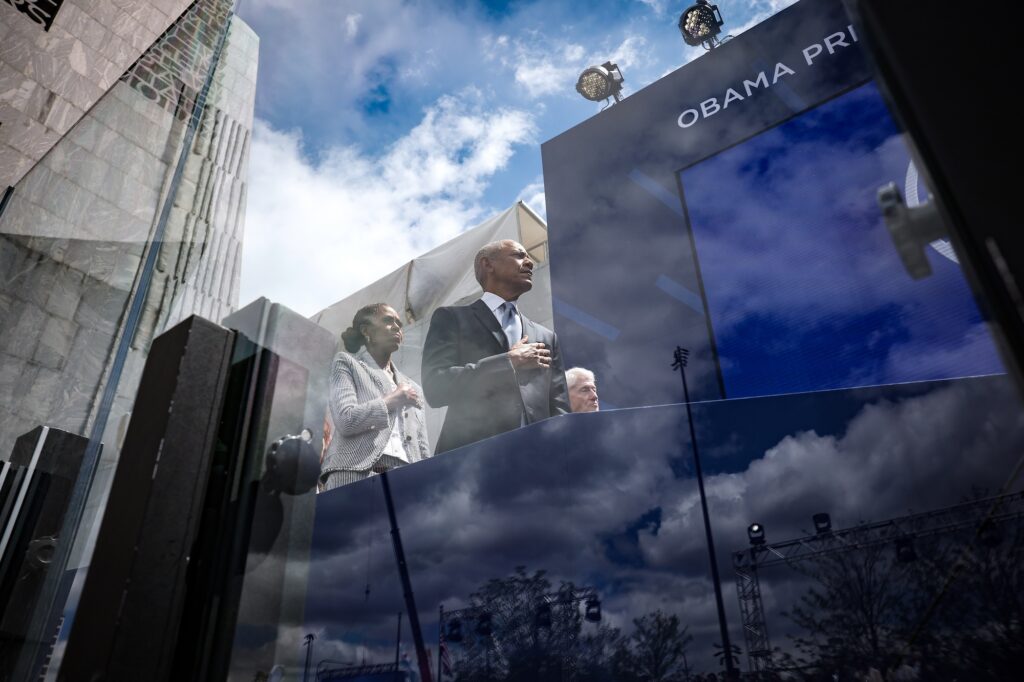
The tension between a presidency bound simultaneously by the half-imposed, half-embraced strictures of neoliberalism—an “achievable” agenda, given the limits of office—and the mantle of representation not only of the left, but specifically a Black left, is one that I carried with me as I visited the Barack Obama Presidential Center a week before its official opening in June. By now the photographs have made the rounds: an imposing obelisk, windowless, washed stone gray, eight stories and nearly 250 feet tall, towers over Hyde Park and Woodlawn in Chicago’s South Side. It’s not all that different from what many feel about Obama himself: gravity defying, singular, seemingly impossible, yet also a real, apparently indomitable force in American liberalism. The building reflects both power and isolation, anchoring the historically underdeveloped and redlined neighborhoods it looms over while clearly standing apart from them. One can see it as a testament to “defying history,” as Coates puts it, in all the ambivalence of that phrase.
The building’s architects explained the obelisk was meant to represent “cupped hands,” while an architecture critic notes the blunt tower of stone epitomizes University of Chicago brutalism. As I approached the Center with advance tickets a friend received by virtue of being in Obama’s graduating class at Occidental, I wasn’t sure what to expect. I had been walking by the construction site for years as a resident of Chicago’s Hyde Park; it didn’t seem possible that I could stroll over and just walk inside. Tometi’s remark about proximity to power suddenly seemed a portentous warning.
It was hard to know what I’d walked into. Past the security desk I turned a corner and was greeted by a concrete wall, on which black, unadorned letters spell out Hope and Change Lobby. The name is doubly strange: not only are we still waiting on hope and change, but there is also nowhere to sit. In lieu of wraparound couches or ferns, the space hosts a bending staircase down to the gift shop and diner and a corridor off to the left. My friend and I stood for a minute, a bit lost and adrift, until we saw a museum docent directing another group toward an escalator on the other side of the wall.
It’s on the second floor that the exhibit opens, with twin narratives: of Obama’s parents meeting as students at the University of Hawai’i in 1960, and of the social movements that defined the decade. There are original posters from the 1980s anti-apartheid movement—a Black man opening a door of Africa and out into the world—along with a banner from the United Farm Workers, a campaign poster for Shirley Chisholm, a Malcolm X poster, an original copy of Rachel Carson’s Silent Spring, anti–Vietnam War fliers, fliers printed by the National Organization for Women, a pair of boxing gloves signed by Muhammad Ali. Protest buttons are hung on a black velvet mount. All of these are intertwined with the stories of a young Obama and photos of his parents as a good-looking couple and of his grandparents in Kansas.
As I wound through the signs and photos, I saw images of Obama in Chicago teaching law and sitting in meetings with a clipboard, of Harold Washington, the Black Panther Party’s Rainbow Coalition, and Jesse Jackson’s later iteration of it. As you move through the floors, you hear the disembodied voice of Obama narrating his story on a video montage looping through his life and his odes to the possibility of progress through democratic struggle. But the presidency itself, it seemed, barely registers. As one ascends, narrative storytelling gives way to ceremonial objects: Michelle Obama’s inaugural red-and-black dress, Obama’s Air Force One leather jacket, a life-sized model of the Resolute Desk, a basketball, a seder plate, White House Christmas tree ornaments. About Obama’s policy accomplishments, such as they were—even the Affordable Care Act—relatively little is said.
The final floor, six levels up, had the first window I saw, overlooking the entire South Side. It was breathtaking: the lines of trees and dense neighborhoods fading into prairie, haze and vista. Above, wrapped into a skylight, hangs an abstract painting of Obama’s speeches, scrambled into select phrases—freedom, rights, responsibilities, Trayvon Martin, all wending their way to heaven.
I asked my friend to sit down. I was feeling amazed, in both the common and the old sense of the word. Climbing up this narrative staircase felt like wandering through a maze of passageways only to arrive at a cul-de-sac of light. Obama, it struck me, told the story of a liberal, progressive America through his own personal rise as president. It is a narrative as compelling as it is chilling in its grandiose simplicity. I was reminded how much narrative and national force was invested in the personal fortunes of Obama as redemption for this nation’s many crimes and inequities. Rather than broad social movements that might undo structures of racialized capitalism, we were offered a single person’s ascent to leadership—a fable in which his rise, and the moral and political redemption of the nation, became one and the same. The imposition of Obama’s voice over images of Malcolm X and the Panthers and Harold Washington tells exactly this story: Obama as compensation, culmination, deliverance.
I was suddenly brought back to election night in 2008. For a brief moment there was, I remember, a national euphoria, or at least a liberal euphoria. America elected a Black president. The thought was electric. In San Diego, where I lived at the time, there was a wild joy in the streets: people hugged, shared drinks, joints, danced on tables in bars. In this segregated city whose downtown had always been reserved for tourists and Navy officers, the city center was flooded with Black men and women, young and old, waving American flags, singing, and lighting firecrackers. Even I, who had doorknocked for Obama in New Hampshire but very privately voted the Green Party in California, felt swept up in the joy. Maybe this grumpy Marxist was wrong about America for once?
Of course, the presidency proved as far from those euphoric crowds that fall night in Southern California as the killing fields of Afghanistan are from Hyde Park, Chicago. Obama governed precisely as he said he would: as a believer in “markets” and in compromise with the GOP.
In many ways, Donald Trump is the ghost haunting the Center—the emblem of political realities that Obama still refuses to name.
He followed the neoliberal restraints of previous decades, despite winning a mandate for “change” amid the greatest economic crisis since the Depression. His appointment of Larry Summers, Rahm Emanuel, and Timothy Geithner signaled continuity rather than rupture, reassuring anxious business and party leadership there would be no “violence to the social order,” no “wrenching of political and economic norms,” as Obama would go on to write in his post-presidential memoir. The “stimulus” he oversaw was far smaller than progressive economists called for, doing little to bail out underwater homeowners and next to nothing for the largest loss of Black wealth since Reconstruction. Like Dodd-Frank, the Affordable Care Act was designed to shore up chaotic markets with subsidies and regulation. These limited economic reforms were combined with a draconian deportation machine—the Obama administration still has deported more people than any other administration, including Trump’s—and Obama’s “surge” in Afghanistan only transferred American-led death squads from Iraq to Central Asia.
Of course, all this conservatism—in personal style and politics—did not prevent the vicious backlash after a “skinny Black guy with a funny name” (as Obama described himself in 2008) won an office that had been exclusively held by white, mostly Anglo-Protestant men since the nation’s founding. Racist cartoons of Obama were distributed by GOP clubs and GOP-leaning conventions; Sarah Palin referred to Obama’s “shuck-and-jive schtick”; Newt Gingrich called Obama a “food-stamp president”; Tea Party activists waved Confederate flags and signs saying “Go back to Kenya.” Perhaps most insidious of all was the “birther” conspiracy peddled by Donald Trump, claiming that Obama was not born in the United States and thus ineligible to run for president.
In many ways, Trump is the ghost haunting the Obama Center—the emblem of political realities that Obama still refuses to name. The exhibit’s total silence about the current president may not be surprising, but it’s not possible to understand Obama’s legacy without considering the rise of white nationalism in his wake. Coates’s argument in Eight Years is simple: Obama was “one of the greatest presidents” the United States ever had, and in response, a country founded on white entitlement mobilized a race riot in the form of a chief executive. There is no denying the counterrevolution; as former Fox News host–turned-podcaster Megyn Kelly put it last September, “We haven’t felt like ourselves since Barack Obama,” and Trump “was the antidote.” But Obama’s presidency was hardly revolutionary in the first place. Coates’s encomiums amount to a cultural argument for a president whose achievements were primarily cultural: his invocation that Trayvon Martin “could be my son,” his singing of “Amazing Grace” in Charleston’s Mother Emanuel AME Church, the small Black child touching Obama’s hair in the Oval Office.
And yet it is part of the mystification and reality of race—even for Coates—that it can transcend politics, indeed is perhaps the only stable referent in American political life. As much as Obama articulated his own life as a symbol of a changed America, he is merely one of many centrist candidates to be swallowed whole by the rising tide of the far right in the wake of the Great Recession, decades of market orthodoxy, and the hegemony of a tepid liberalism hostile, at its core, to social transformation. From the AfD in Germany to the Independence Party in the UK, the near victory of Marine Le Pen in France, and beyond, a xenophobic, nationalist populism has gained steam where progressive parties promised to end neoliberalism but in the end were buried by it.
Coates himself seems to have come around to the notion that not all is well in the party of trickle-down multiculturalism. In a recent essay for Vanity Fair, he suggests that Kamala Harris’s political failures are perhaps the greater symbol of the crisis of liberalism. If the ascent of Obama and Harris was supposed to represent the fulfillment of 1960s Black politics, the party’s stance on Palestine represents its moral bankruptcy. Coates’s widely quoted line from a conversation at the University of Michigan last year—if Democrats “can’t draw the line at genocide,” they “probably can’t draw the line at democracy”—could be said of many things the Democrats can’t seem to draw lines at, from obscene wealth inequality to the civil rights of trans people. But nothing says it more clearly than holding a convention showcasing the diversity of America (in Chicago, no less) while blocking a Palestinian American lawmaker from speaking about a genocide being carried out with direct funding and support from the United States.
Still, not all of Obama’s legacy should be considered lost. His win and reelection (albeit while losing Congress) demonstrated two vital things: that a multiracial coalition can win national elections by mobilizing working-class voters and voters of color, and, as important, that a progressive coalition does not need to wait for a white man to lead it.
As much as Obama articulated his own life as a symbol of a changed America, he is merely one of many centrist candidates to be swallowed whole by the rising tide of the far right.
The organization that has most fully embraced these two facts has been the Democratic Party’s sharpest critic on the left, the Democratic Socialists of America (DSA). Rather than reduce Obama’s legacy to a cynical branding campaign, it recognizes a real contradiction: Obama mobilized millions of new voters and formidably challenged white racism, yet deference to the structures and strictures of neoliberalism meant these new voters were left with no meaningful material improvement to their lives, and no organization to mobilize them to resist the reactionary backlash.
After decades as just another marginal organization on the socialist left, DSA was reborn in 2016 with a surge of new activists, becoming a far more radical organization in the process as it broke with its historical support for moderate Democrats and liberal Zionism. Its fundamental message was that the Democratic Party’s claim to fulfill the promise of an inclusive democracy was broken—fatally captured by a Washington consensus insistent on tinkering at the edges of problems in order to uphold “political and economic norms,” both in the United States and abroad. Today DSA’s membership rolls have exploded to more than 100,000, while Zohran Mamdani, Rashida Tlaib, Darializa Avila Chevalier, and others form the largest elected body of socialists since the days of Eugene Debs, coming to power on a platform of proposals Obama and his heirs have scorned: Medicare for All, Palestine solidarity, a Green New Deal, the abolition of ICE.
People believe in this program because it clearly seeks to dismantle imperial neoliberalism, not to rescue and stabilize it. While they may have walked out from the obelisk of Obama’s party, they are, in another sense, the true heirs of his promise.
Independent and nonprofit, Boston Review relies on reader funding. To support work like this, please donate here.