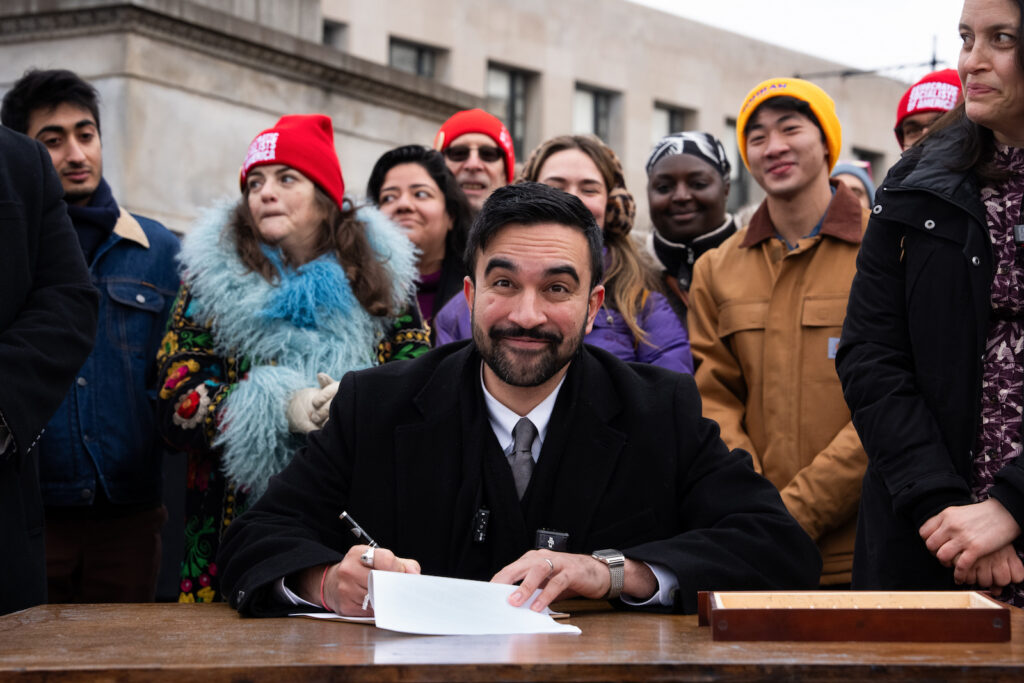
Zohran Mamdani is now the mayor of New York City. Amid the chaos unleashed by Trump in the first weeks of 2026, it can be easy to lose sight of the truly seismic shift in politics his mayoralty represents.
To recap: an obscure, thirty-four-year-old state assemblyman and member of the Democratic Socialists of America, who a year ago could barely fill a seminar room at New York University, beat both incumbent mayor Eric Adams and former governor Andrew Cuomo by running on an unapologetically progressive ticket, critical of ICE and Israel as much as rents being too damn high. India Walton came close to a similar upset in Buffalo four years ago, but this time the socialists prevailed. In his inaugural address on New Year’s Day, sworn in by Bernie Sanders and quoting Fiorello La Guardia, Mamdani spoke of building a city “‘far greater and more beautiful’ for the hungry and the poor.” Handing out free tickets to a theater festival earlier this month, he spoke of his vision of a city “where we make it possible for working people to afford lives of joy, of art, of rest, of expression.” When’s the last time you heard a politician talk like this?
The sneering haters of all political stripes are right about one thing: the stakes of Mamdani’s mayorship are very high.
To the establishment it sounds like so much juvenile poetry. Real governing, the self-styled adults in the room insist, happens in prose. Many of them aren’t just predicting a rude awakening; they are actively seeking to tank Mamdani’s time in office. But the forces of reaction are right about one thing: the stakes are very high. The U.S. left needs Mamdani’s mayorship to be successful—not because it will resolve intraleft fights over electoralism once and for all but because, in the eyes of a watchful public, it will determine whether social democracy can become politically legitimate in the United States.
The ultimate test is governance. On this point, the Mamdani administration and the more mainstream “abundance” liberals of the Democratic Party are agreed: a viable left-liberal politics needs to be able to point to a track record of success. Chicago mayor Brandon Johnson offers a cautionary tale. Like Mamdani, Johnson won a hard-fought campaign in 2023 against an incumbent mayor and a Republican-backed protest candidate. And like Mamdani’s victory, his was made possible through mass grassroots mobilization of supporters and progressive allies. But Johnson’s popularity plummeted almost immediately after his election, dragged down by perceptions of cronyism and incompetence, and while his poll numbers have recovered somewhat since the depths of 2024, he is still almost twenty points underwater.
Implementing a truly transformative agenda in the country’s largest city—which also just happens to be the center of global finance—could reset the narrative. The “public good” and the “commons,” alien phrases in the kleptocratic hellscape of neoliberal America, might prove closer in reach than ever before.
Trotsky famously rejected the possibility of socialism in one country. What about in one city? Successful social democratic politics at the municipal level really can work, but it requires rethinking decades of received wisdom about political economy.
The starting point is reconsidering elite-driven growth as the lodestone of urban planning and development. As historian Daniel Wortel-London chronicles in his recent book The Menace of Prosperity, urban policymakers assumed for much of the twentieth century that economic development is directly downstream of “enticing and retaining the wealthy.”
This was not always the case. New York City used to be dominated by real estate, services, and then light manufacturing. The latter industry fueled social mobility after it was organized, making the International Ladies Garment Workers Union one of the most influential unions in the country in the 1920s and 1930s. But this model of political economy, grounded in the high wages of union labor, began to collapse by midcentury as suburbanization, white flight, and the decline of domestic manufacturing hollowed out the tax base of American cities.
One response was to attract and consolidate businesses in urban cores. Chicago achieved some success with this approach under Richard J. Daley in the 1960s and 1970s, with Sears Tower a lasting testament. Another was revenue sharing—basically, pooling the growing suburban tax base into a metropolitan area-wide fund. Minneapolis and St. Paul took this approach in the 1970s, creating a Metropolitan Council backed by the state government.
Will threats of capital flight from hedge fund manager Bill Ackman and his billionaire friends get in the way?
But each approach had limits. Corporate offices in the Chicago Loop didn’t reverse population decline, nor did they dismantle the prevailing racial order. In 1966 Martin Luther King Jr. went head to head with Daley’s liberal machine, speaking before an audience in the tens of thousands gathered in Soldier Field: “Let us be dissatisfied until every socially oppressive ghetto and rat-infested slum is plunged into the junk heaps of our nation and Negroes and whites live side by side in decent, safe, and sanitary housing.” The Twin Cities, for their part, were utterly dependent on a supportive state government and urban cores that were still overwhelmingly white. Facing its own massive financial crisis in the 1970s, New York City opted for a hybrid approach. Like Chicago, it would try to keep as many corporate offices as possible within city limits, but it would also court the mega-rich to inflate the tax base and attract the service industries that cater to them.
The result has been a deeply inequitable city, one leading the national affordability crisis. Wortel-London is refreshingly blunt: rampant inequality, in and of itself, carries a massive social cost. It distorts the body politic and reorients society around servicing wealth. It distorts politics too, because it makes catering to the wealthy the guiding principle of municipal governance. A city comprised primarily of extraordinarily wealthy people and their professional-class courtiers means more taxable income but also fewer people making claims on social services—which, among other things, can mean a tax reduction. As the problematic poor get pushed out, the city effectively becomes another gated community. Dylan Gottlieb’s forthcoming history of the yuppies—that Reagan-era neologism for young urban professionals—makes clear they weren’t simply the shock troops of gentrification; they were policymakers’ pawns, recruited to achieve just this.
Ironically, the project seems to have worked too well. Mamdani haters sneer that he owes the election to the so-called “Commie Corridor,” a strip of neighborhoods running from Astoria in Queens to Prospect Park in Brooklyn and consisting primarily of well-educated professionals fretting about their downward mobility. The observation is meant to delegitimize—look at these entitled rich kids cosplaying at communism!—but support for the old paradigm really has collapsed. The yuppies, at least in New York, are now the socialists, and reform is the watchword of the day. Will threats of capital flight from hedge fund manager Bill Ackman and his billionaire friends get in the way?
Mamdani is hardly the first socialist mayor to navigate these challenges. He’s not even the first DSA member to become mayor of New York—that was David Dinkins, elected in 1989, though with much less reliance on the organization than Mamdani.
But it’s another mayoralty that may hold the clearest lessons for today. Before beginning his long and steady march to technocratic Cold War liberalism, Walter Lippmann was a card-carrying member of the Socialist Party of America and served as a deputy to fellow Socialist George Lunn, who was elected mayor of Schenectady, New York, in 1911. Lippmann only lasted a few months in the role, disillusioned by what he felt were Lunn’s compromises and political opportunism. But the experience prompted reflections worth revisiting now.
Join our newsletter
New pieces, archive selections, and more straight to your inbox
In a letter to another Socialist comrade, Carl D. Thompson, two years later, Lippmann harshly criticized Lunn but also noted the bind he faced. “Where is the allegiance of Socialists elected by non-Socialists?” he asked. Lunn refused to raise taxes to pay for municipal services out of fear it would “alienate the property-holders whose votes decided the election.” But “it is quite clearly the business of a Socialist administration,” Lippmann wrote, “to cut into the returns of property, take as much of them as possible to be spent for social purposes.” This is precisely the vision that Wortel-London lays out: economic development and growth as social goods, not ends in themselves.
The ends—and the broader vision of society underpinning them—really do matter. “Take the municipal ownership and operation of subways,” Lippmann went on. Both progressive reformers and socialists across the country supported public ownership of mass transit systems, at the time owned and operated by private companies. But the goals were different. “The profits on a socialistically conducted subway would be a direct transfer from private dividends to the people,” Lippmann explained. “The profits on a reformist subway would be a transfer from stockholders to taxpayers.”
In other words, there is a big difference between a public good administered as a public good and one that exists primarily for the benefit of the middle classes. The distinction also implies a difference in messaging and moral leadership, as many contemporary writers have observed. Even the New York Times’s David Leonhardt, hardly a Sanders-Mamdani partisan, has stressed the “perils of invisible government,” criticizing Obama and Biden for aspiring to do public good as quietly as possible. Routing policy through Cass Sunstein–style “nudges,” or what political scientist Suzanne Mettler has deemed the “submerged state,” is a recipe for political disaster. The whole point of socialist politics is to make state power and state capacity explicit in a way that liberals have long eschewed.
There’s a big difference between a public good administered as a public good and one that exists primarily for the benefit of the middle classes.
Lippmann concluded his letter on an ambiguous note, at once rejecting electoralism—he believed Lunn’s compromises dashed any chance of genuine socialist power—while affirming the importance of governance in building socialist credibility. For Lippmann, socialists needed practical political and administrative experience, in part to overcome their reputation, deserved or not, for political incompetence. “I have watched a local of two hundred Socialists trying to audit fifty-cent bills by majority vote,” he lamented. The solution, he thought, was to build experience and credibility through unions and cooperatives.
Unfortunately, in the twenty-first century, that is simply not a viable alternative. One result of the decline of these traditional training grounds for socialist governance, as Ned Resnikoff recently pointed out in Dissent, is that too much of the left remains in thrall to what could be called David Graeberism: an anarchist, anti-system outlook that flourished with Occupy Wall Street, resolutely hostile to working within the state. Mamdani and his political allies, above all Alexandria Ocasio-Cortez, represent a very different tradition, invested in using bureaucracy to achieve democratic socialist ends. For better or worse, now that Mamdani is the most powerful socialist in the country, they have to show they have the chops to actually govern.
So far, at least, things are looking good. The specter of capital flight hasn’t materialized. And in policy terms, Mamdani spent his first weeks issuing a blitz of executive orders making good on campaign promises.
He revived the Mayor’s Office to Protect Tenants and installed tenant organizer Cea Weaver to lead it. He brought former Federal Trade Commission chair Lina Khan aboard as his affordability czar. In a genuinely shocking moment, at least for those who remember the infamously terrible relationship between Mayor Bill de Blasio and Governor Andrew Cuomo, Mamdani and Governor Kathy Hochul jointly announced a plan for universal child care for all New Yorkers between the ages of two and four. Legislation was introduced in December to advance Mamdani’s vision of a new Department of Community Safety that would work to “prevent violence before it happens by taking a public health approach to safety.” And perhaps most significantly, his Executive Order 7 set up an Office of Mass Engagement, superseding an older civic engagement program, to promote democratic governance.
Critics on the left say these are hardly revolutionary transformations. They are right, but they could stand to recall Lippmann’s point about ends. These are good, solid initiatives that liberals and progressives—and even erstwhile centrists like Hochul—can get behind. Even more important, they are being deployed to achieve democratic socialist political goals, without sacrificing an internationalist vision to boot. There certainly are limits to what the Mamdani administration can accomplish. New York has a strong mayor system, but he faces a relatively conservative city council, and while Hochul is certainly a more reliable partner than Cuomo, Albany always looms ominously in the background. But the mayor does have considerable authority he can exercise through executive orders and staffing decisions, and Mamdani has been aggressive in using it thus far.
Of course, using power effectively requires weathering scurrilous political attacks. Ironically, on this score, the over-the-top anticommunist and Islamophobic fearmongering about Mamdani seems to have functioned as a kind of battle testing. Who can forget the gutter racist AI-generated ads the Cuomo campaign tweeted claiming that Mamdani would release violent criminals back onto the streets, legalize sex trafficking, and globalize the intifada? Bari Weiss’s The Free Press has run at least half a dozen articles since the election about Mamdani’s alleged antisemitism, one depicting him as a Third Worldist working to bring the Algerian revolution to our shores. Liberal blogger Noah Smith intimated that Mamdani represents “the growth of Islamoleftism in America.” The smear campaign seems to go beyond time-honored reflex; it looks more like they understand Mamdani’s generational talent—on par with AOC as Sanders’s successor—and are desperate to contain it. But the old slanders aren’t working, and the insecurity is driving them mad.
At bottom, the reason for these ridiculous and racist slurs is the same as the reason for the relentless conspiracizing about Barack Obama. Like Obama, Mamdani is a very popular, charming, and telegenic politician with an “exotic” name and brown skin. Unlike Obama, Mamdani actually is a Muslim and isn’t beholden to compromise and consensus. The fact that he isn’t afraid of conflict—isn’t, as Obama described himself in his post-presidential memoir, “conservative in temperament”—makes his success even more dangerous to the center-right mainstream. Yet even Trump, who for years demanded that Obama release his birth certificate, clearly relished being in the new mayor’s presence at their Oval Office meeting in November. Most of all Mamdani has charisma, and Trump knows better than most just how far you can go with it. An important segment of Mamdani’s electoral coalition was South Asian voters in the outer boroughs who broke for Trump in 2024.
If the administration succeeds, the “public good” and the “commons”—alien phrases in our kleptocratic neoliberal hellscape—might prove closer in reach than ever before.
All this seems to have helped Mamdani not cave to anxieties over optics. He has successfully resisted bad-faith attacks from the Times and allies of Eric Adams over failing to appoint a Black deputy mayor, a transparent ploy by the Democratic establishment to deploy identity politics against Mamdani and perpetuate a form of ethnic patronage politics that should have long been left in the dust. Mamdani has also refused to throw the Palestinian solidarity movement under the bus despite endless goading by the Democratic establishment. As his recent condemnation of a pro-Hamas demonstration in front of a Queens synagogue demonstrates, his approach has been pragmatic and strategic.
And to return to the urban development front, the new mayor has also stood by Weaver, his housing appointee, after the New York Post reported on tweets she made during the 2010s supposedly demonstrating her hatred of white people. (Weaver herself is white.) Vaguely tongue-in-cheek posting during Peak Woke, the administration seems to recognize, should not lead to political self-immolation in 2026. Weaver is a well-respected policy expert who has a stellar track record in policy and organizing circles. Writing for Phenomenal World last October, she concluded that a rent freeze—a plank of Mamdani’s platform—was essentially inevitable given that New Yorkers simply cannot afford more rent increases but that it needed to be paired with code enforcement, and more importantly public investment, where the City of New York acts as a “quasi-community land trust.” In essence, Weaver wants to use the power of the state to suppress the rampant real estate speculation that is undermining affordability in New York City, and invest that money in public housing.
This, too, would warm the young Lippmann’s socialist heart. The point is not to freeze rents simply to deliver to constituents—although that is certainly an added benefit—but to begin to reimagine an urban political economy not based around the principle of constantly inflating real estate prices for the benefit of investors and property owners. One of Weaver’s tweets cited by the Post says that “private property including and kind of ESPECIALLY homeownership is a weapon of white supremacy masquerading as ‘wealth building’ public policy.” That may not be winning campaign language (as Weaver no doubt understands), especially as the movement tries to grow and build power in white-majority districts it will need to take back Congress. But there is a fundamental truth to the analysis that isn’t rebutted by the fact that some people of color own their homes in New York’s outer boroughs.
For decades policymakers have assumed that rising property values are an unquestioned good for development and tax purposes and should be the goal of urban public policy, and thanks to a staggering (and growing) racial wealth gap, any institution that facilitates the reproduction of this model—including the prevailing system of homeownership and home loans and everything tied to it—really does perpetuate white supremacy. It would do so even in the absence of redlining and racist real estate agents, but these things are very real too and only compound the problem.
Weaver and Mamdani are rightly challenging this paradigm, not out of vengeful malice—which is how every dominant class experiences any egalitarian movement anyway—but in the name and spirit of genuine universalism. This shift in political imagination is long overdue, and the power it has won shows just how much the U.S. left has matured politically. In the past ten years we’ve gone from tweets and articles in little magazines decrying racial capitalism to developing a thoughtful and granular theory of politics that can win despite the decades-long collapse of labor and that seeks to use the power of the state for the public good, mobilized by a multiethnic coalition of downwardly mobile professionals and working-class people. If it works, we have a model for the nation.
Independent and nonprofit, Boston Review relies on reader funding. To support work like this, please donate here.