
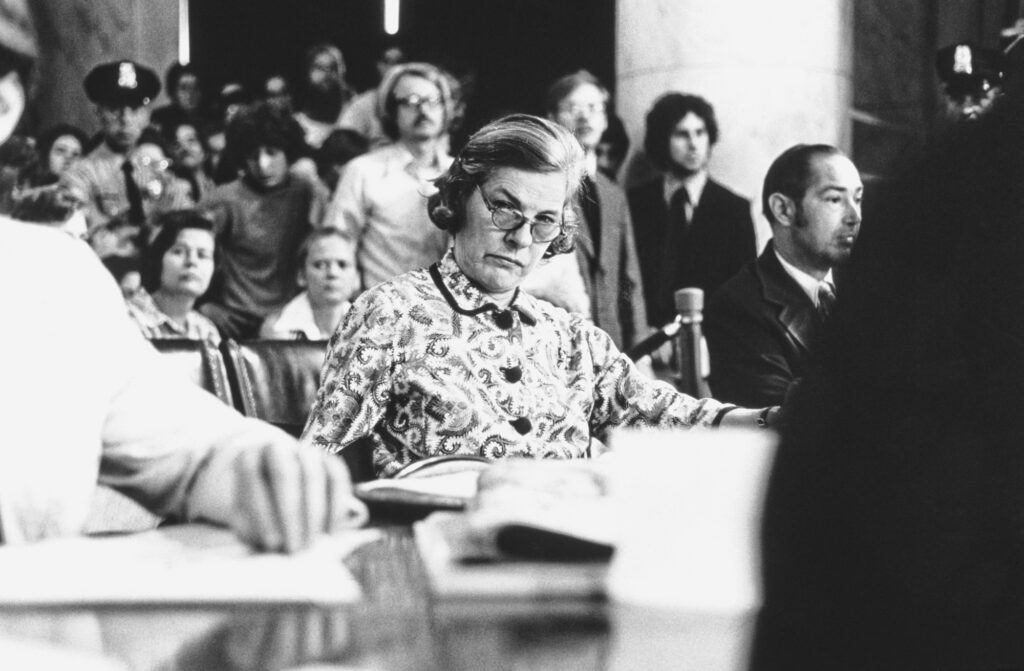
“I confess that when I went to Vietnam early in February I was looking for material damaging to the American interest, and that I found it, though often by accident or in the process of being briefed by an official.”
So begins the first of the novelist and critic Mary McCarthy’s extraordinary dispatches from the Vietnam War filed for the New York Review of Books between the spring of 1967 and the summer of 1968. Quickly collected and published as two books, Vietnam and Hanoi, McCarthy’s reporting on Vietnam proved some of the most controversial American journalism to emerge from the war. It was not that she exposed one of the many war crimes perpetrated by U.S. forces in Vietnam, as Seymour Hersh documented the My Lai massacre or Jonathan Schell wrote of the destruction of Bến Súc. Rather, her reporting depicted the war as something perhaps even more painful for many Americans to confront: a psychodrama of vanity and hubris that indicted the values of the “Greatest Generation” to which she belonged.
Her reporting depicted the war as a psychodrama of vanity and hubris that indicted the values of the “Greatest Generation” to which she belonged.
Descriptions of combat were hardly necessary to illustrate this, and in fact McCarthy—curiously for a war reporter—passed up opportunities to accompany U.S. soldiers on patrol. Soon after she arrived in South Vietnam, the revered correspondent Bernard Fall encouraged her to tag along with the Air Force on a bombing mission. The experience would help train her to “feel nothing” as a war reporter, he said. “Be completely detached.” The idea revulsed her. “For a person like me, a natural civilian,” she wrote, “insentience should be the last thing to strive for; detachment would equal indifference.” McCarthy’s biographer, Frances Kiernan, notes that only a few days after their conversation, Fall died after tripping a landmine—one of over sixty journalists killed during the war.
More than fifty years after the fall of Saigon, Vietnam and Hanoi are worth reading as much for what they suggest about the possibilities and liabilities of war correspondence as what they say about Vietnam. History and public opinion have validated McCarthy’s assessment of U.S. involvement as a sordid imperial endeavor many times over; that much is settled. What writers can say or do about a war to end it, though, remains a worthy question. Few literary figures living in the West today are willing to confront it as directly as McCarthy did, and they, like her, are typically rewarded with the condescension of a loud and powerful segment of their peers. Sally Rooney’s defense of Palestine Action—and the subsequent backlash—is a case in point.
The New Journalism of the 1960s enlivened reporting with techniques of autobiography and literary fiction: Tom Wolfe did it with hot rod enthusiasts; George Plimpton with professional football; Truman Capote and Joan Didion even covered murders. But war, as it was unfolding? McCarthy’s decision to go to Vietnam was a much greater test of New Journalism’s premise, one that many critics would judge as a failure. Writing in Washington Monthly in 1974, future White House speechwriter James Fallows agreed that novelists had earned their keep in American journalism. But “Mary McCarthy’s political writing shows the other side of the story,” he averred: “the damage that can be done by a novelist with insufficient care for the facts.”
One reporter who had seen it all saw it differently. Murray Kempton, a long-running columnist of the New York press and veteran of World War II, thought McCarthy’s eye as a novelist had done exactly what it was supposed to in Vietnam. Here, also, her gender had prevailed: after decades of being patronized as a “lady writer” and worse by contemporaries like Norman Mailer and Norman Podhoretz, McCarthy’s fine-tuned perception of her male interlocutors, military and civilian, allowed her to draw out insights that no one else had.
To Kempton, it was an epiphany. “McCarthy gave me a general formula for understanding the war which I had never had before,” he said. “She did that war as if it were a failed marriage.” The marriage, in this case, was not between the government of the United States and its client South Vietnam so much as the men responsible for planning and directing the war and the rest of the country to whom they sold it as a high-minded enterprise.
Vietnam was an enterprise all right, McCarthy discovered as soon as she touched down. The American presence had brought so much consumerism and speculation to Saigon that it was coming to resemble not just the United States but urban California, she thought; the city was “like a stewing Los Angeles, shading into Hollywood, Venice Beach, and Watts.” Profiteering wafted through the air no less than the smell of napalm in the morning. While traveling by military cargo plane to Huế, she listened as two pilots discussed the real estate development they would pursue once Ho Chi Minh threw in the towel: “From the air, while they kept an eye out for [Viet Cong], they had surveyed the possibilities and had decided on Nha Trang—‘beautiful sand beaches’—better than Cam Ranh Bay—a ‘desert.’”
Join our newsletter
New pieces, archive selections, and more straight to your inbox
Camouflaging this baser vulgarity were the pretensions of professional expertise. Military and civilian intellectuals, not businessmen, were responsible for elevating the work of the war into something systematic and scientific. McCarthy detected dubious thought everywhere. There were the unscrupulous local contractors of the CIA’s anticommunist indoctrination efforts, some of them trained at Michigan State. There was the Marine colonel pondering his “scale model, like a crèche, in papier-mâché of an ideal Vietnamese hamlet,” complete with a miniature bronze statue of a dollar sign, like the golden calf. And there was the alleged political science—about as empirical as alchemy—behind the disastrous “strategic hamlet” initiative to win over rural villages from the Viet Cong. In Vietnam, McCarthy reported, the can-do and know-how of the idealistic Kennedy era had dead-ended in futility and moral corruption.
Camouflaging the baser vulgarity were the pretensions of professional expertise: McCarthy detected dubious thought everywhere.
Certainly, as some critics charged, McCarthy was a snob. She made no attempt to hide or soften her disdain for almost every American she met in South Vietnam—the language she alleged they debased, the junk they left behind as opposed to the things they carried. If she focused so much on the aesthetics of the war, as it were—on words and surfaces—it was because she had given serious thought to the conclusions of her closest friend, Hannah Arendt, about the banality of evil and its accessories of euphemism and cliché.
Technocrats, academics, and other experts—the “new mandarins” scrutinized by Noam Chomsky in the New York Review—played an essential role in this obfuscation, McCarthy stressed. Consider the following passage in light of the endless whine of self-pitying, self-exculpatory sophistry we hear today from the Israeli establishment and its defenders:
To political scientists . . . the word “genocide” is quite unsuitable to describe what is happening. Genocide is deliberate. . . . If the Viet Cong plants a bomb in a theater, that is an atrocity, but if the Americans bomb a village that is “different.” When you ask how it is different, the answer is that the VC action was deliberate, while the U.S. action was accidental. But in what way accidental if the fliers saw the village and could assume there were people in it and knew from experience that the bombs could go off? Well, the fliers were really aiming at the Viet Cong; if they hit some civilians, that was unintentional—it just happened. But it happens all the time, doesn’t it? Yes, but each time it is an accident. In the American view, no area bombing implies premeditation of the results that follow, while every grenade hurled by a Viet Cong is launched in conformance with a theory and therefore possesses will and consciousness.
To observe that these lines simply “hold up” is to risk a shameful minimization in itself. I hasten to add that as I write this, the satanic idea of building luxury waterfront property on the Gaza Strip is not the pipe dream of IDF soldiers but the expressed interest of the White House and its chillingly named “Board of Peace.”
Of course, McCarthy didn’t need to go to Vietnam to draw these particular conclusions, but the fact that she did—that she could—underscores the enormous disadvantage of war writers and resisters in the present. In Rooney’s case of support for Palestine Action, the risk and legal jeopardy the author bravely assumed lay in an expression of solidarity, not in what she could testify to having seen or heard in Gaza herself, firsthand. So it is with Omar El Akkad, Isabella Hammad, Pankaj Mishra, and Ta-Nehisi Coates, to name a few of the novelists who have written with probity and lucidity about Gaza for an international audience. (The Message, Coates’s latest book of nonfiction, includes an essay describing his experience in the West Bank and East Jerusalem in the spring of 2023.)
The point is, none of these figures could have made a trip like McCarthy’s had they wanted to. Israel has forbidden even the staidest, establishment-credentialed reporters from visiting Gaza for over two years now, never mind critics and novelists. Palestinian journalists have had to report the nightmare on their own, with targets on their backs all the while; scores have been killed. Only a small, select group of media outlets—CNN, NBC, ABC—has been admitted, on the condition their reporters embed with the IDF. Speaking recently about this price of admission on NPR, a network reporter broadcasting from Tel Aviv was ambivalent. “Some access is better than no access,” she claimed. That is a debatable proposition, though not debated nearly enough.
Israel’s media blackout is not just a tacit admission that its actions in Gaza are unspeakable; it’s evidence that governments have learned from Washington’s sentimental attitude toward press freedom in Vietnam. With a little more censorship or secrecy, some might insist, American leaders might have managed to bomb Hanoi in peace. The same line is now being taken more or less explicitly about Gaza, updated for the age of TikTok to boot. “When I’m trying to make arguments in favor of, you know, for Israel, I realize I’m talking through a wall of dead children,” former Obama speechwriter Sarah Hurwitz complained at a conference in November, referring to social media footage of Israeli atrocities.
McCarthy’s critics condemned her refusal to separate polemic from reportage, but as New Journalism her portrait of South Vietnam is lively in the manner of Gore Vidal’s treatment of the Republican National Convention in the fall of ’68: we get a series of tawdry set pieces in which the author’s superior intelligence and wit—and, in McCarthy’s case, moral indignation—triumph over all comers. The approach, as her subjects might have said, was to kill them all and let readers of the New York Review sort them out.
Her account of North Vietnam is a different story—the prose loses some of its quicksilver as polemic gives way to introspection, possibly to the point of solipsism. By her own admission, she confused herself there. Her reports ended up providing more material to her critics and biographers than to the antiwar movement, much less to the North Vietnamese whom she believed were basically in the right.
To be sure, it was brave of her to go in the first place. Almost no American journalists had reported from Hanoi before her, and the threat of aerial bombardment was ever present. Again she didn’t see combat—North Vietnamese officials never offered to take her—and again, no matter. “The meaning of a war, if it has one,” she wrote, “ought to be discernible in the rear, where the values being defended are situated.”
At the level of theory, at least, North Vietnamese communist values, aligned with the Soviet Union and Maoist China, had long disturbed McCarthy. In the 1930s and ’40s she had been a partisan of the anti-Stalinist left, the origin of her longstanding enmity with playwright Lillian Hellman. (Truth-telling was again the issue: “every word she writes is a lie,” McCarthy said of Hellman on The Dick Cavett Show in 1980—“including ‘and’ and ‘the.’”) On the ground, though, McCarthy found herself rather charmed by the beleaguered, hospitable people she met in Hanoi. Under the circumstances it must have been hard not to be. The only way for her to access North Vietnam was as a member of one of the “Peace Committees,” international delegations wined, dined, and closely supervised for the sake of good public relations. She did rather less than she might have to inconvenience her hosts with questions.
Notably, she missed the torture. McCarthy’s account of her meeting with two American prisoners of war at Hoa Lo Prison (the “Hanoi Hilton,” POWs called it) is astonishingly hasty and unilluminating. One of them just rubbed her the wrong way. He seemed dopey and “servile,” she wrote in her notes, and had voted for Barry Goldwater. He spoke of his fondness for Vietnamese candy. Lieutenant Colonel James Robinson “Robbie” Risner was a conservative, but he was no idiot; he had been tortured. McCarthy was watching a performance. When Risner wrote his own version of their meeting following seven years of imprisonment, he was nowhere near as discourteous to McCarthy as she had been to him. What’s more, she took to the New York Review to write a self-exculpatory rebuttal, much longer than her original account.
To put this episode in perspective, McCarthy’s fellow New York Review contributor Susan Sontag was so disturbed and confused by her own meeting with American POWs in Hanoi in May 1968—recounted in “Trip to Hanoi,” published first in Esquire and then as a book—that she chose not to write about the episode at all. “I was really dumb in those days,” Sontag said many years later. “But I still had my instincts and I thought, This is a terrible situation. I don’t understand it and I don’t know what’s right. So I didn’t deal with it in my book.”
McCarthy could hardly be faulted for not having recognized the signs of Risner’s torture, as even young Fallows, her most perceptive critic, had to concede. Little was known about this subject in 1968, and there was some complexity to the way servicemen handled the ordeal of Hoa Lo, making the “terrible situation” opaque even from close up. McCarthy might have staked the politically coherent position that captured U.S. airmen were simply beyond the reach of her sympathy, responsible as they were for the millions of tons’ worth of bombs dropped on civilian populations in Southeast Asia. However one sees it, the crucial missing element in McCarthy’s account of Hoa Lo seems to have been curiosity about the facts. She let America get too much in her way.
Here we have a perfect illustration of how novelists, acting as reporters, can apprehend the essence of things even in confusion and ignorance.
Or did she? Just months before McCarthy first went to Vietnam, John Steinbeck had gone to write a series of pro-war columns for Newsday. They turned out to be the last of his writings to be published before his death in 1968. The Nobel Prize winner, tales of fruit-pickers long behind him, had made “a fool of himself” there, McCarthy thought. Still earlier, though, in February 1966, Steinbeck had written an even less well-remembered string of reports from Israel. He was enamored with the nation but admitted that his powers as an observer had failed him in a crucial respect: everywhere he looked, America overlaid itself like a double image. In the Negev he couldn’t help but think of the Texas panhandle, or Nevada, or Death Valley. He knew “the shadings, the nuance” of the place were passing him by. He’d traveled all that way just to be left wondering: “Did I see only America?”
Here we have a perfect illustration of how novelists, acting as reporters, can apprehend the essence of things even in confusion and ignorance. Hadn’t Steinbeck actually conveyed an important historical and political truth about Israel and its affinity with the United States? About mutual identification with the “frontier” and the prerogative of manifest destiny?
McCarthy, we could say, likewise succeeded through failure in Vietnam. There was much about the country, the people, and the war that she did not see and made limited effort to understand. Clearer to her were the terribly dangerous “fantasies and illusions of American men,” as Kempton put it, and her own hope against hope that a novelist could help stop the war by piercing them. Show me the writer, then or now, credible enough to insist she was wrong for trying.
Independent and nonprofit, Boston Review relies on reader funding. To support work like this, please donate here.