OUR SPONSORS


Books After Amazon

The man sitting next to me takes out his new Kindle. “How do you like that thing?” I ask. He instantly becomes animated, angling the Kindle toward me so that I can better see its face. “It’s great,” he says. “I can download tons of different books and magazines.” Then, eyeing my hefty, hardback of John Dos Passos’s USA trilogy, he adds, “Cheaper than that, too. $9.99.” There, our conversation ends. I am unsure of where I fall on the Luddite spectrum, but I’ll admit to inhaling the odor of leather-bound volumes. Having moved over a dozen times, though, I’ve also found occasion to curse their weight.

So, too, has Jeff Bezos. Bezos calls the Kindle a response to “the failings of a physical book.” He told attendees of a technology conference in New York: “I’m grumpy when I’m forced to read a physical book because it’s not as convenient. Turning the pages . . . the book is always flopping itself shut at the wrong moment.” His conclusion? “It’s had a great five-hundred-year run . . . but it’s time to change.”

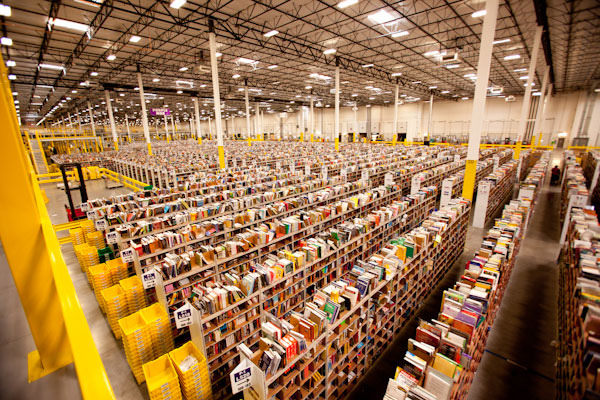
That Bezos is unencumbered by reverence for the physical entity should be no surprise. The book has always been an object of convenience to Bezos, whose principal interest is capturing market share. In 1994 Bezos set out to create a new kind of online business. The specific product was irrelevant; what was important was how it would be marketed, sold, stocked, and shipped. He made a list of the items he could carry, including CDs, videos, computer software and hardware, and books. Books won out because there were so many, and demand was steady. The International Standard Book Number (ISBN) also allowed him to organize and index the millions of books in print. No catalogue or bookstore could possibly have it all, Bezos reasoned, but he could.

Amazon’s ascendance no doubt is a function of its nontraditional ways. Though neither a publisher nor strictly-speaking a bookseller, it has become the world’s largest retailer of books in any form. And it has done so as a software company that offers great deals on Vienna sausages as well as hardbacks. Bezos’s customers come for the low prices, not to fondle, sniff, or otherwise interact with the product. The most one can do is “browse” some pages electronically. Bezos thinks pleasing the customer is all that matters, and his strategy—nearly endless inventory at rock-bottom prices—is working.

Today an estimated 75 percent of online book purchases in the United States are made through Amazon, and its overall market share in book sales is astonishingly high. Some publishers make more than half of their sales through Amazon. So when Bezos rang the death knell for the physical book, people paid attention. Even before the Kindle, Amazon wielded enormous influence in the industry. Now it is positioned to control the e-book market and thereby the future of the publishing industry.

What happens when an industry concerned with the production of culture is beholden to a company with the sole goal of underselling competitors? Amazon is indisputably the king of books, but the issue remains, as Charlie Winton, CEO of the independent publisher Counterpoint Press puts it, “what kind of king they’re going to be.” A vital publishing industry must be able take chances with new authors and with books that don’t have obvious mass-market appeal. When mega-retailers have all the power in the industry, consumers benefit from low prices, but the effect on the future of literature—on what books can be published successfully—is far more in doubt.


• • •


For decades the publishing world has been anxious about the end of books. Industry consolidation has led to a much-lamented shift to a business-oriented ethos, particularly at some of the larger conglomerates. With corporate ownership came a demand for profit margins that the book-publishing world had never seen. Yet even if new management is nothing like that of the past—gentlemen with large fortunes who became gentlemen with small fortunes—publishing remains an intensely people-driven business, the kind where folks meet face-to-face. Even today most people involved in publishing are there because they love good books.

For most of their modern history, the primary goal of publishers was to find brilliant writers and produce books. Publishers left it to other book lovers—independent bookstores across the country—to sell the fruits of their labors. Booksellers not only carried books tailored to their local audiences, but also promoted their favorite new books through personal recommendations to their customers. All indies ordered books at a standard discount—somewhere around 40 percent off the list price. In the ’70s and ’80s the number of new book titles grew steadily, as did the number of independently owned bookstores.

Where once a publisher had to worry about competing for shelf space, now its entire list of books could be available to customers.

But this trend came to a halt when chain superstores such as Barnes & Noble and Borders began taking over in the late ’80s. They set up shop down the street from successful independents, lured customers with a broader array of books and lower prices, and put their competitors out of business. In the early ’90s there were roughly 6,000 independent bookstores across the country. Today, that number is closer to 2,200.

There is not a whole lot of mystery behind these stores’ runaway success. Barnes & Noble wasn’t getting rich by offering caffeine with the classics; it was negotiating better discounts from publishers.

In 1994 the American Booksellers Association (ABA), a group that represents independent bookstores nationwide, filed suit against five major publishing companies for offering discriminatory discounts that weren’t justified by costs. One large publisher, for instance, was requiring that bookstores order 3,000 of their books in order to get a 48 percent discount. A smaller order would net a 40 percent discount. That meant that smaller stores, making smaller orders, could not afford to meet larger retailers’ prices. With even the higher-volume indies unable to compete, small bookstores across the nation were forced to close their doors.

While publishers were guilty of providing two-tiered discounts, there was reason to believe that the chain stores were using strong-arm tactics to demand these discounts of larger publishers. Bruce Spiva, one of the lawyers who brought the ABA’s case, recalls hearing that the chain stores had threatened to remove publishers’ books from stores if they didn’t cooperate.

The five publishers (Houghton Mifflin, Penguin USA, St. Martin’s, Rutledge Hill, and Hugh Lauter Levin) settled, but in 1997 the ABA found that the chain bookstores were still demanding and receiving discounts that weren’t being made available to independent bookstores. The ABA sued Barnes & Noble and Borders directly for leveraging discriminatory discounts. In 2001 this lawsuit, too, was settled, on the condition that a large amount of the evidence the ABA had collected against the chain stores be destroyed.

This era of publishing consolidation and chain growth also marked the rise of “promotional allowances” or “co-operative advertising” (co-op). Big chains pressured bookmakers to pay for top placement in outlets—$20,000 for two weeks in the front of the store, say—or to provide customers special in-store discounts. Such promotions are now standard, with roughly 4 percent of publishers’ net revenue devoted to them.

As the focus shifted to the bottom line throughout the industry, the ABA and many others in the publishing community worried about the effect of revenue-obsession on what would get published, and with good reason. It has become common practice for representatives of large retailers to weigh in on everything from book covers to sample chapters of manuscripts. In some cases, retailers even demand changes. One editor at a major publishing house, who agreed to speak on condition of anonymity for fear of employer sanctions, told me that agents of Barnes & Noble, Borders, and Target are frequent participants in meetings about potential books. Without their buy-in, the publisher is unlikely to go forward with a book. Ideas that excite independents might be scrapped if they don’t get a chain’s stamp of approval.

As a result of this pressure, major publishers have become less inclined to take a chance on new authors and more wary of published authors whose previous works were only moderate sellers. Jamie Raab, publisher of Grand Central Publishing (formerly Warner Books) for 24 years, says that without the independent bookstores to help in the process of “discovery and nurturing,” it became riskier to invest in a talented but unknown writer. Although smaller houses often pick up promising new authors, they don’t always have the resources to pay for preferential status in mega-stores. A full range of new works and authors make it into print, but breakout books for smaller publishers are now rare. And the emergence of Amazon, the biggest of the big-box retailers, has exacerbated these effects while introducing a slew of new headaches for publishers of every size.


• • •


In 1995 Bezos’s new online model had the book world atwitter.

Where once a publisher had to worry about competing for limited shelf space, now its entire list of books—old and new alike—could always be available to customers. This was a godsend for small publishers as well as self-publishers, who otherwise had few ways of finding a retail audience. “It’s because of them that our backlist lives,” explains Margo Baldwin, president of Vermont-based Chelsea Green Publishing. “Amazon has been hugely important to us. If you go in as a small publisher and sell to Barnes & Noble or Borders, you have a set of buyers who may or may not take your books. [Amazon has] made the marketplace accessible to everyone in a pretty equal way.”

When Ten Speed Books refused to give Amazon a higher discount, its books disappeared from the Web site.

Publishers were also excited about not having to take so many returns. Bookstores typically order stock from publishers on consignment and return unsold copies, but most of the books Amazon ordered from publishers were non-returnable.

Yet, before long, the mood soured. Over the course of the next decade, Amazon pushed standard discounts to 52–55 percent, with some as high as 60 percent. In contrast, bookstores—even the chains—get discounts that usually top out around 50 percent. That small margin can mean the difference between surviving another day or folding, particularly for a publisher doing modest print runs.

In addition to pushing discounts up explicitly, Amazon began to get creative about what constituted co-op. In 2004 Publishers Weekly reported that publishers were being asked to pay higher co-op rates to Amazon, and those who didn’t sign up would be subject to “such changes as Amazon not selling their books at a discount and not having their titles ‘surface’ in various merchandizing and advertising programs.” There was more: “Amazon also may turn off the search options to publishers’ books, making it possible to find a title only when the correct name of the book or the ISBN is entered.” What publishers were supposed to get in exchange for this co-op, was, essentially, not being made to disappear from the Web site. Winton calls the tactic “a discount grab in the guise of getting co-op”—in other words, a way of getting around antitrust laws that put a cap on the discount a retailer can demand.

Dennis Loy Johnson, head of Melville House Publishing, was one of the publishers approached by Amazon and encouraged to “sign on” to the new program. He refused and two weeks later received a visit from a cadre of Amazon employees at a book convention. “It was one team of guys one day and then another team of guys the next,” he recalled, when we spoke in May of 2009. “They kept saying, ‘Why aren’t you participating in the program?’ in this really heated, aggressive way. I told them we couldn’t afford it.” They countered that Johnson “couldn’t afford not to.”

When Johnson returned from the convention, he discovered that the entire catalogue of Melville House books had disappeared from Amazon.com. “I just didn’t believe they were going to play hardball like that,” he told me. Even a search for ISBNs failed to bring up Melville House’s books. Johnson gave in and agreed to the new plan. Soon after, his books reappeared. In a recent article in The Nation, Johnson says that when he refused to sign onto the new program, Amazon reps told him they were keeping an eye on him and advised him to “get in line.”

Johnson’s story is familiar to Phil Wood, former publisher of Ten Speed Press in Berkeley. Wood received a phone call from Amazon around the same time as Johnson. “What it amounted to,” Wood says, “is that they wanted more discount.” When Wood refused, the “Amazon flunky”—as Wood puts it—threatened to delist all of Ten Speed’s books. “I didn’t even know what that meant,” Wood says. “I told him to go fly a kite.”

Ten Speed’s books then disappeared from the Web site. For about a week, Wood fielded panicked calls from his authors, wondering where their books had gone. Never a fan of computers or email, Wood sat down to pen a letter to Bezos. “I described what his company had done, and I said this was not the way gentlemen treat gentlemen,” Wood told me. He informed Bezos that his next letter would be to The New York Times. After a week Wood received another call from Amazon, further pressuring him to agree to the new terms. When Wood again refused, Amazon relented, and agreed to continue doing business with Ten Speed on the original terms.

High co-op fees allow Amazon to claim higher discounts without asking for them, but sometimes the company doesn’t bother with pretense. Two years ago an Amazon buyer told Kristen Frantz, vice president of sales and marketing at Berrett-Koehler, a San Francisco–based publisher of business titles, that her company’s discounts weren’t high enough. Frantz checked around and found that Berrett-Koehler’s discount to Amazon was about average. She brought her concerns to her distributor, Ingram Publishing Services, and her representative there was able to go to bat on her behalf, arguing to Amazon that Ingram, as Berrett-Koehler’s distributor, should be handling the terms and that the discount should stay as-is. “Once we made that clear to them, they left us alone,” Frantz says. “I think they just try to squeeze everything they can out of publishers, and if you’re small or on your own, you’re going to be much more vulnerable.”

Frantz might be right. Scale seems to matter to Amazon. Ten Speed—responsible for bestsellers such as What Color Is Your Parachute and the Moosewood Cookbook—was doing at least three million dollars in annual business with Amazon. Melville House was doing less than a hundred thousand. But Amazon’s punitive tactics may be more arbitrary than that. A number of publishers have said “no” to Amazon and lived to tell the tale, suggesting that publishers ought to push back harder.

Of the 20,000 employees at Amazon, just one is a full-time liason between the company and publishers.

Nonetheless, cases of disappearance continue. Amazon doesn’t always go as far as delisting books entirely. Sometimes it just makes them impossible to purchase by taking the “buy” button off a title’s page. In 2008 two huge British publishers—Bloomsbury and Hachette—had their buttons pulled. That same year, Amazon also removed buy buttons from any printon-demand publisher that didn’t use Amazon’s on demand printer, Book-Surge, a move that led to an antitrust lawsuit in which Amazon agreed to pay a settlement to a competitor, though it admitted no wrongdoing. The Author’s Guild recently launched WhoMovedMyBuyButton.com in order to keep track of buy buttons. On the front page of the site is a note greeting visitors:

See, the folks at Amazon have a headlock on the online book world, and they tend to get carried away. That’s why we developed WhoMovedMy-BuyButton.com. We’ll keep an eye on your Buy Buttons, checking daily to make sure they’re safe. If they’re AWOL, we’ll let you know by e-mail. We’ll also let you know when they return.


• • •


Buy-button disappearances are just one of the tensions that have emerged between publishers and Amazon. Publishers accustomed to the more bibliophilic operators of independent stores and even Barnes & Noble find it jarring to deal with Amazon’s lawyers. Wood’s frustration at Amazon’s lack of “gentlemanliness” is echoed by many other publishers who wonder why Amazon keeps putting the screws to them. (The majority of publishers contacted for this article chose not to speak on the record, citing their fear of retribution for divulging Amazon’s tactics, which one publisher described as a “You do this, or we’ll fuck you over” approach.) In a July 2009 interview, Mike Shatzkin, a publishing consultant and author of the popular publishing blog The Shatzkin Files, put it this way: Amazon “sell[s] all kinds of things besides books; they sell their technology. They have a lot of fish to fry besides the fish that the people in the publishing business think about.” And as Amazon has grown in clout, these differing priorities have caused more and more anxiety. “They’re not quite family to the same extent that the retailers have always been in the business,” Shatzkin says.

Publishers who once met directly with Amazon representatives find they can no longer reach anyone at the company, even by phone. Many publishers with distributors don’t even know the name of the person who buys their books at Amazon. The relationship is almost exclusively handled by the distributor. Indeed, of the 20,000 employees at Amazon, just one is tasked full-time with working as a liaison between the company and publishers.

Jeffrey Lependorf, Executive Director of the Council of Literary Magazines and Presses and of Small Press Distribution, suggests that the difference between Amazon and brick-and-mortar bookstores is most evident in how they market books: “I think even people at Amazon would say that it’s essentially a widget seller that happens to have begun by focusing on books. Many people, like me, will say you can’t sell a book the same way you sell a can of soup.”

At the heart of the soup-can analogy are the algorithms that Amazon uses to “recommend” books to customers. Most customers aren’t aware that the personalized book recommendations they receive are a result of paid promotions, not just purchase-derived data. This is frustrating for publishers who want their books to be judged on their merits. “I think their twisted algorithms that point you toward bestsellers instead of books that you might actually like [are] a shame,” Gavin Grant, cofounder of Small Beer Press, laments.

Algorithms can also affect how much customers pay for books. Individual customers may get different discounts on the same book depending on their purchase history. The practice is euphemistically called “dynamic pricing.” According to Roger Williams—the former sales director at Simon & Schuster, and one of the first salespeople to deal directly with Amazon—the complexity of the algorithms is such that, Amazon’s employees “sometimes don’t know themselves what is going to show up in some of the pages that appear.”

In addition to selective pricing and sponsored recommendations, Amazon uses its sales rankings to sell books. One might think that at least these are sacrosanct, generated exclusively from hard numbers. But last year Amazon de-ranked hundreds of gay- and lesbian-themed books. Without a sales rank, the visibility of the titles plummeted. Initially, Amazon claimed this was the result of books being tagged as “adult material,” even though many of the books did not contain content any more explicit than other books that remained ranked. Soon after, the company changed its tack and denied that it had any such adult-material policy. In the end Amazon called it a “glitch” but did not explain what the glitch was, or how it could be prevented in the future.

Amazon had to cede pricing control to Macmillan because the publisher “has a monopoly over their own titles.”

Amazon’s handling of e-book pricing—and publishers’ response—will have perhaps the most far-reaching effects on the industry. The situation thus far is not encouraging. To create a new market and generate demand for the Kindle, Amazon set the e-book’s price at $9.99. Publishers were not consulted.

If Amazon had asked publishers what they thought about locking in e-book prices at $9.99, it would have been subjected to a chorus of outrage. That’s because the math behind publishing is seldom in a publishers’ favor. The sale of a twenty-dollar hardcover nets a large publisher about ten dollars. Royalties run the publisher about three dollars, and the costs of printing, binding, and paper are a further two dollars (more for low-volume titles). Take $1.20 for distribution, two dollars for marketing, and that leaves a publisher with roughly $1.80 to cover rent, editing, and any other costs. A smaller publisher might keep closer to a dollar per book.

E-books reduce the cost of printing, binding, and paper, but royalties tend to run higher, and all other costs are largely unchanged. Publishers account for these costs when they slap a price tag on a book, so Amazon’s decision to set the price irrespective of them set off a wave of anxiety.

Amazon, hardly oblivious to these economics, chose to absorb the loss, paying publishers for the price of the equivalent printed book in order to make the deal more appealing. But Amazon has successfully established customer expectations at an impossibly low rate, and publishers worry that at some point the retailer will no longer take on losses to sustain it.

“There’s no way they can continue to sell . . . at a loss,” says Johanna Vondeling, vice president of business and development at Berrett-Koehler. “Eventually, they’re going to change their minds on this, and I think all publishers should be worried about what happens when they do. They’re going to keep that e-book price where it is. They’re going to turn around and say to the publishers, ‘Tough. All we’re going to pay you on is the split of $9.99.’”

While the $9.99 price has evolved, it is still the most popular e-book rate on Amazon. And even with elastic pricing, Amazon remains in control, using its algorithms to set the price of e-books.

This past January John Sargent, CEO of the publisher Macmillan, met with Amazon executives in hopes that he might regain control over the pricing of Macmillan’s books. If anyone could sway Amazon, it was Macmillan, a huge bookmaker with imprints such as Farrar, Straus, and Giroux; Henry Holt; Picador; and Times Books. Sargent flew to Seattle and laid out his terms. By the time he stepped off the plane in New York, Amazon had removed the buy button from every Macmillan book on the Web site.

Negotiations between retailers and publishers have historically been behind closed doors, so it was that much more dramatic when an irate Sargent wrote a blog on the Macmillan Web site chronicling the messy details. Before long, Amazon announced that it had no choice but to cede pricing control to Macmillan because the publisher “has a monopoly over their own titles.”

Macmillan’s success is a heartening development. It and a handful of other large publishers have taken over pricing of their own e-books. But smaller houses have not been so lucky. Johnny Temple, founder of the independent press Akashic Books, is not sure whether he will eventually be able to negotiate the same terms that the big publishers have with Amazon. “If we had a room full of lawyers, maybe we would be working with them and thinking about the future terms,” Temple says. “But we’re just busy trying to stay in business.” As is the case with most large retailers, those publishers with a lower sales volume are simply treated differently.

The conceit is that the market demands the $9.99 price tag. But in the case of e-books, Amazon is the market.

For small publishers Amazon provides unprecedented access to a larger audience of customers. The costs of reaching this audience can, however, outweigh the benefits. For Gavin Grant, keeping Small Beer Press afloat without slashing already-modest author royalties means making cuts in advertising and marketing budgets. Grant isn’t shy about Amazon’s role in keeping him in this tight spot: “If I meet a reader and they say, ‘I buy all your books through Amazon,’ I often say to them, ‘That’s great for Amazon, that’s great for the shipper. It does nothing for me, and it doesn’t do much for the author.’”


• • •


Many in the publishing community mock Amazon as the “Wal-Mart of books,” but it’s important to remember that Wal-Mart is also the Wal-Mart of books. Last year, Target, Amazon, and Wal-Mart fought a price war over a handful of new hardcover bestsellers. Books with $25 and $35 retail prices were being offered for nine dollars or less.

In response to the price war, the ABA wrote a letter to the Department of Justice (DOJ), requesting that it investigate possible “illegal predatory pricing.” David Gernert, a literary agent who represents the novelist John Grisham and was quoted in the ABA letter, told The New York Times: “If readers come to believe that the value of a new book is $10, publishing as we know it is over. If you can buy Stephen King’s new novel or John Grisham’s Ford County, for $10, why would you buy a brilliant first novel for $25?” People who tend to read Grisham and King aren’t necessarily reaching for a brilliant first novel, but Gernert’s point still has some force: devaluing the books produced by an industry already squeezed to the brink is not likely to benefit the reader in the end.

The DOJ made no formal reply to the ABA, nor is it likely to (when contacted for this article, a DOJ representative had “no comment” on the letter). Enforcing anti-trust statutes, particularly in the publishing world, has always been a difficult endeavor. The relevant laws (part of the Robinson-Patman Act) have their roots in the 1930s, an era in which healthy competition was measured not only in low prices but also according to the diversity of retailers. A portion of the Robinson-Patman Act states, for instance, that it is illegal to charge different prices in different geographic areas simply to undersell local stores, a practice critical to the business strategies of large companies such as Wal-Mart.

But the DOJ doesn’t bring Robinson-Patman cases anymore, and the Federal Trade Commission (FTC) does so only rarely. John Kirkwood, a former FTC lawyer, explains that the Robinson-Patman Act is thought to be anti-consumer, “so courts are skeptical if not hostile.” The thinking is that, if prices are getting lower, the consumer must be benefiting.


• • •


In July Bezos told the press: “Amazon.com customers now purchase more Kindle books than hardcover books—astonishing when you consider that we’ve been selling hardcover books for 15 years, and Kindle books for 33 months.” The company refuses to release exact figures, so there’s nothing to back this claim, but with Amazon cutting the price of the Kindle in order to remain competitive with Apple’s iPad, there can be little doubt that Kindle sales—and e-book sales—are up. Though that part about being astonished probably isn’t true. Amazon’s quest is market control, and it goes to great lengths to ensure it.

“At the end of the day,” an Amazon source explained, “the market is going to determine what the right price for this content is.” The conceit is that that $9.99 price tag is what the market demands. But in this case Amazon is the market, having—with no input from its suppliers—already dictated the price and preempted the standard fluctuations that competition and improved efficiency impose on prices. It was only through Macmillan’s negotiating that a new e-book-pricing model emerged, and then only for certain, privileged publishers.

Cheap books are easy on our wallets, but behind the scenes publishers large and small have been deeply undercut by the rise of large retailers and predatory pricing schemes. Unless publishers push back, Amazon will take the logic of the chains to its conclusion. Then publishers and readers will finally know what happens when you sell a book like it’s a can of soup.

Research support for this article was provided by The Investigative Fund at The Nation Institute.

Post this page to: del.icio.us Yahoo! MyWeb Digg reddit Furl Blinklist Spurl

Comments

1 |
The Future of Publishing
what will happen is that the number of self published books you actually get to see goes up.

production costs continue to decline for creative pursuits, distribution costs are slowly becoming lower as well.

gatekeepers and middle men are lo...sing ground.

there will always be a large scale mainstream, amazon or otherwise, but the independent authors will gain more traction more easily(and likely outside of those channels, only to later be moved into them at some critical mass).

I say this as a true lover of books and more specifically I love physical books, but even this is helped. In the future having solid copies with properly chosen fonts nice paper etc will be some of the many value adds that short runs can have.

someday solid physical books will be like buying collectors editions of video games, which come with maps posters, notes form the developers. Or special order versions of free works(as trent reznor did with one of his double albums)

we may of course see a resurgence of some of the less grand tactics of moneymaking from the early era of publishing. for instance having people pay for chapters, serializing novels. only writing what people pre-pay for(Stephen King experimented with bringing this back)

Overall I think it is to the good, I detest the modern shitty paperback that is flimsy and printed on the crappiest paper, I already willingly pay extra for beautiful well done editions of books. examples being, my complete works of Poe complete with gold leaf, my red hardcover single volume edition of the lord of the rings, etc.

one major major major service middlemen will continue to be asked to provide though is editorial service, authors need sounding boards people who are unafraid of being critical and people who can keep horrible typos from ruining otherwise fine stories. I think this will end up divorced from publishing itself. in recent years I have noticed a sharp decline in the importance place don editors, which I believe is a major mistake of the publishing industry.
— posted 11/30/2010 at 19:22 by Jeff
2 |
Waah, waah, waah.
The world is changing and some people are stuck in the past, refusing to move on. This same kind of whiny protesting happened when digital music replaced CDs and yet somehow the world kept turning. I used to carry around a folder full of CDs and a bulky portable CD player - now I have an iPod. I used to carry around a bunch of physical books and magazines, now I have a Kindle. See, that's the thing about technology - it advances if consumers buy into it regardless of whether or not that's good for certain segments of the population. Like indie booksellers.

As for this comment: "Booksellers not only carried books tailored to their local audiences, but also promoted their favorite new books through personal recommendations to their customers."

That's awesome if your bookseller shares your taste and your interests and is willing to stock things you want to read even if he or she doesn't like them. A lot of indie bookstores went down (or are going down) because they are too elitist, too focused on handselling what they consider to be "great literature" instead of great reads. If I get on Amazon and want to buy a beach read, I don't get sneered at by some indie bookstore clerk with an eyebrow ring and a condescending attitude. Amazon makes suggestions, but no judgments. I have been in way too many indie bookstores where the staff was unwelcoming, unfriendly, ill-informed and frankly unpleasant. No wonder people prefer to buy online.

In any case - all this hand-twisting over Amazon doesn't matter. Whether it's Amazon, iTunes, Wal-Mart or Bob's Online e-Book Emporium, people are moving away from paper books and the indie bookstores are going to be done, pretty soon. It will be a loss - the same way losing music stores was a loss - but people will get over it. You know, you used to get milk delivered to your house in glass bottles by a man wearing a white cap. Anyone do that any more? No, because that model of commerce became outmoded. Progress marches on, sometimes whether we want it to or not.
— posted 11/30/2010 at 20:00 by Gil
3 |
The solution
Go to the library.
— posted 11/30/2010 at 21:40 by Ben
4 |
informative article, and good insight into why it's about more than just publishers trying to get greedy.

There's no doubt publishing and technology need to align more, but that hopefully will happen as ebooks become more the norm.

Off-topic, but I personally like seeing some form of 'gatekeepers' and the self pubbed author can get irritated over that if they choose, but at least with having gatekeepers, we can find quality books easier.

I'd rather not wade through the 600,000 titles pubbed on the kindle platform for my reading material-many of those are self pubbed and many, many, many are poorly written. There are, no doubt, a number of well written self published books, but they are by far the minority. I don't want to waste my reading time look through the chaff.
— posted 11/30/2010 at 22:07 by Shiloh Walker
5 |
@ Shiloh. It's not just having a 'gatekeeper' to help one find quality books, though. It is very true that editors at publishing houses read the slush so you don't have to.

Self publishing is all well and good if you have no problem doing it, but I know of a number of (published) writers who have spoken about feeling that having to do all the publishing side of their books is, to them, taking precious time away from writing, which they'd rather be doing. That the reason they have an agent and a publisher is so they can concentrate on writing. To many writers, such is like a business man having a tax accountant to take care of that side of his business. A necessity, and not something he has the time, or inclination, to do.

— posted 11/30/2010 at 23:37 by Wrenn
6 |
Writer
The agonies of the publishing community leave me cold.

It is the creative writer who should be at the center of the digital revolution.

The oft cited critique by the caring reader that he/she must trawl through millions of books to find something of 'worth', shows that to date she/he has been happy to allow the traditional publishing house act as editor/censor/critic/filter over the choice available in our bookstores and libraries.
— posted 11/30/2010 at 23:49 by Des Greene
7 |
Problems, but...
As the publisher of a small press, I have to say thanks to amazon. I have been giving them 55% plus shipping since I started publishing 15 years ago. Other distributors have demanded 60%. One, in fact, demands 55% of what THEY sell for. So if they sell to a bookstore at a 40% discount, they pay me 55% of THAT. Amazon is bloody generous next to them. As for ebooks: My dream. I get 70% for every kindle book of mine sold. Yes, I pay half of that to the author (who deserves it), but I also pocket the other half without spending anything on production or shipping. I like it.
— posted 12/01/2010 at 01:47 by jacko
8 |
the best minds of our generation
I think it will be a long time, maybe a generation or two, before we know what happens when you \"sell a book like a can of soup,\" or something with much less mass than a can of soup. What will a living room look like when there are no more bookshelves? Will teenage shoulders be stronger without backpacks to carry heavy textbooks to school? Will old ladies like me need reading glasses when you can adjust the font size? Will anybody write a poem a la Ginsberg that says the best minds of our generation were destroyed by madness? What will the best minds be doing in the post-book era? Will it be okay or won\'t it? I don\'t think we know yet. But this is a great article to start thinking about a future without books as we knew them.
— posted 12/01/2010 at 04:10 by Ann Matranga
9 |
Gimme Shelter
Print books will be abandoned in cardboard boxes after failed garage sales, rescued by bleeding heart bibliophiles and brought to local book-shelters....
— posted 12/01/2010 at 05:32 by Lisa D
10 |
Kindle
I love books, I love the feel, weight and smell of them. I always have, I have never been happy with paperbacks and would rather spend the money on hardbacks. I keep them forever. In the past few years my eyesight has deteriorated..no matter how strong my glasses are, I cannot get involved with a book, it affects my concentration. I have tried large print books to no avail. I recently was introduced to Kindle and another kind of book reading 'thing' eye pad"
I hope to get one for Christmas as I love reading and haven't been able to for several years. I'm not crazy about the idea, but look forward to reading again.
(I'm just speaking for the people with Older Eyes here...
— posted 12/01/2010 at 06:32 by Jody Stickney
11 |
It\'s not the future...
I read (what I could) of this article. While I agree Indies will flock to the new venues, I don\'t think it\'s the death of book stores other than the big elephants like B/N.

Smaller shops will adjust. Indies will go to the kindles of the future only because they do not sell enough for the publishers or stores to bother with in the short run. I do enjoy much of it,but face it. The writers/smaller publishers do not have the cash flow or marketing ability they did decades ago. aka The traveling salesman or catalogs of books to order.

So, if the catalogs have dropped out of site, what makes you think you\'ll really want to wade through 88 lines per page on your screen to find that gem to read.

As well as, how will you even know of it\'s contents or if it exists?. Will you be watching for the smoke signal communique? News is homogenized, so who will spread the word of the small publishers? Don\'t wait for the buzz online from the next reviewer. They likely won\'t be getting paid either unless you advertise and pay them....

— posted 12/01/2010 at 06:54 by Not A Fan
12 |
Used books are cheaper...
As a teacher, I am happy to say good riddance to paper-bound texts and expensive school editions. I'm also glad to see the back of phone books, repair manuals, bound genre fiction and other clutter. For such ephemera, cheap is good.

But Amazon and Apple have another impact on the market. As people get rid of their books and CDs, they're flooding the market with used (but perfectly usable) copies.

Why pay $10 to Apple for an MP3 file stripped of its liner notes and lyrics when I can pay $3-$8 for the same work from Amoeba, Second Spin, or Oldies.com? Why pay $10 to Amazon for a book published just a year or two ago - a book whose survival in my collection requires me to update Kindle hardware every few years - when I can buy it used for half that price? Finally, why take notes in a format that doesn't yet integrate with my own databases?


— posted 12/01/2010 at 08:31 by Tom L
13 |
everyone seems to be forgetting
Although most of us writers write for the joy of it, be prepared to read those who want to be writers, but can\'t write.

HOW DO you expect writers to make a living if no one wants to pay for good writing?
— posted 12/01/2010 at 10:04 by sharon
14 |
plus ca change
comme ci, comme ca - some stuff is great on a kindle - I've read the Larsson trilogy kindled on a phone but authors I rate, I buy in first ed hardbacks - some music is ok on ipods (in the car, on a holiday house boombox) but vinyl on a good deck with a valve amp kicks ass - you can't hold back the river, so learn to swim with a variety of strokes...
— posted 12/01/2010 at 11:20 by Ian
15 |
Amazon Really?
Will you be just as happy when they censor your writing> Amazon is a giant who doesn't always play by the rules, unless they made them.

http://www.youtube.com/watch?v=dlzrNKN3rZI&feature=related
— posted 12/01/2010 at 12:08 by GiggleMeThis
16 |
On Libraries
As to the 'library' solution, I recently visited my local library, and took along my Amazon Wish List of books, and every book was either checked out, 'On Order', 'Being Shelved', or listed as being on the shelf and not there. I walked out with only one book: a book about Dorothea Lange from 1970. Since I like the book, I ordered a used copy of it for $7, and downloaded several other e-books and e-book samples. Going to the library as of late has been mostly a waste of time.
— posted 12/01/2010 at 12:17 by Lee
17 |
What utter nonsense
Amazon has not had the effect of reducing the number of books available to readers. To the contrary, it has expanded them dramatically. I can find incredibly obscure books on Amazon i would never find in either my local independent or the big box book store. New, used, hardcover, softcover, large print, electronic books are all at my fingerprint. Amazon and e-books are not bringing about the death of books, but may in fact kill off a few of the oligopolistic dinosaurs who have been seeking consolidation and control of all publishing in recent years. Small publishers who could never get their books on the shelf at Barnes and Noble or even their local independent have no trouble getting their books on the Amazon "shelf." These developments are good for readers, and good for aspiring authors. They are only bad for the big publishers who can't or won't adapt to them.
— posted 12/01/2010 at 12:18 by Bil
18 |
Lomax two cent/bits micro payments, Google Free World Library
WastingtonDC:
Publishing physical content and broadcasting hidden bias television are failed business models! That said, we repeat the mantra that I fervently hope will convince Sir Rupert Murdoch to destroy the failed business model of physical publishing, as he has destroyed the failed business model of network television, at least in the soul destroying bundled, biased, butchery form in which it has been practiced, all our lives, before Sir Rupert. Those proudly selling their conservative positions, as part and parcel of their exceptional American media product will draw ratings that equal all hidden bias outlets combined, as does Fox, and those selling American decline, and killing and maiming our troops, whilst secretly serving as campaign staff for liberal politicians intent on socialist democratic agendas will lose money, until the rich liberals paying for their bias run out of money, or Carlos Slim harvests the last of their stockholder’s wealth.

Google, PayPal, and Sir Rupert must formulate and execute my Lomax two cent/two bits solution, to the multi-billion dollar problem that is destroying the Lame Stream Media in particular, and the physical publishing industry, in general. Consumers of content must be enabled to pay their two cents for each article, or twenty five cents, for each book/movie they consume, directly to the producer of their chosen content, with none of the collected millions of pennies paid to read the perfection of Charles Krauthammer’s 800 word article diverted to paying for union employees destroying trees, or hauling them to mill, press, news stand, home and then our landfills. The same goes for the world’s books, movies, television and other content, all made available in my oft suggested Google Free World Library, at no cost, for all the children who will never see more than a few printed books. The content will be presented for pay, on a trust but verify honor system, for those folks who have the where withal necessary to click on the author’s payment line, after the standard teaser allowance, or where ever the best authors choose to put their “click to pay me now”, line.

Billions of consumers/readers of a dozen or a few online media outlets daily, are ready to pay in a PayPal Google deposit, of $100, $500, or more, as necessary, for the float to allow Google to maintain their World Free Library, the day their geeks get the “how to do it securely” bits worked out. Gates and Buffet will help us provide free internet devices for the poor.
Sir Rupert must make another bold step change to his industry, as with Fox and the WSJ, albeit it means the immediate destruction of billions of dollars of his family owned monopoly infrastructure. Since that union driven waste of resources was devised, the day the press was invented, for controlling writers, artists, and their fans, or herding cats, if you will, and is doomed to extinction in any event, being the first adapter is sure to save and make Sir Rupert’s family even more money, in the long run.

We will pay our writers directly, with the free market shaping the systems that deliver us content, and we will not abide any approach that limits the honest anarchy apparent in Sir Rupert Murdoch’s Market Watch commentary approach. That is: with 5000 characters allowed per comment, with it all archived to embarrass either writers or their detractors, non-censored, and only mildly refereed. Basically it is bare knuckle combat, politely stated, and encouraged as commentary. Fair and balanced, open commentary began, and has been refined, in Market Watch. It has been increasingly emulated, albeit poorly executed in some outlets. I have repeatedly called for this free for all approach, in NYT, WP, Fox News too (only sound bite comments allowed by Fox, now), by media outlets hoping for survival, in any form.

Producers refusing to allow Google to provide their content free, to all the world's poorest oppressed peoples, can allow themselves to be chosen, or forced to kiss physical publisher's rings, or biased broadcaster's nether regions, executing their bias, whilst paying their unions to destroy the planet’s lungs, and consumer's minds. The rest of us will gladly join the schools recently giving away their physical collections, and pay a beloved professor/text author, $0.25 for his newest digital book, eagerly sought after, if it's any good. Of course, less useful works will find no place on our go anywhere devices with phone, camera, apps, TV, et al.

I will deposit a $500 Google Free World Library premium membership today, and authorize PayPal to draft $100 from my account, each time I have bought that much unbiased, or proudly biased and honestly sold content, at market prices. At first, millions, then billions of paying members deposits will allow GFWL to lift every oppressed human on earth up to Free World education, and thus, to Liberty and Justice for all humans, everywhere, obeying my Mother's rule, right now.
— posted 12/01/2010 at 15:16 by Franklin D. Lomax
19 |
Level playing field?
Don't forget that Amazon has an additional edge over bricks-and-mortars stores: it doesn't pay taxes on book sales. Combined with its predatory practices, this gives Amazon a position of strength in the industry that is virtually unassailable. As former director of a university press, I have mixed feelings about Amazon: along with Google, it made the "long tail" possible; but its heavy-handed tactics are deplorable and will make transitioning to the ebook environment financially very difficult. Perhaps, if traditional publishers die off, Amazon will become THE publisher for everyone? It already has put a toe in this water. Will it provide the kind of services regular publishers have? Or will we all have to put up with essentially self-published books as the norm and rely on "crowd" review to sift the wheat from the chaff?
— posted 12/01/2010 at 15:25 by Sandy Thatcher
20 |
Miss them...
For my part, as a calligrapher, I miss the curving expanse of scrolls. Unwinding them on a good read led to a motion of letters...an ancient animation of wisdom. Books? Sure, they were an improvement in random access...but lost the feeling of the hidden word...revealed only by unscrolling. It was a lot easier for publishers of books to adopt the short cut of pagination. It saved them production costs and many packaging difficulties. In the end their modern flimsies prevailed...much to our loss.
— posted 12/01/2010 at 15:33 by JSSSTUDIO
21 |
Google enters the market too..
And Apple pays a higher dividend.

http://www.pcmag.com/article2/0,2817,2373654,00.asp
— posted 12/01/2010 at 16:43 by GiggleMeThis
22 |
need competition
I think the point here is Amazon's monopolistic practices, not the move to digital. So, competition from Apple and now Google on this front should help. If Amazon actually has to worry about market share and publishers have other viable digital venues, the impact of being delisted could be more hurtful to Amazon (smaller selection) than to the publisher. Though that's a big if when Amazon is currently crushing it with their market share.
— posted 12/01/2010 at 16:49 by Andy
23 |
Diversification
As someone more interested in text than in books, there's only one thing of value to me that publishers do better than Amazon, which is acting as a filter for worthwhile content.... And frankly, you're pretty lousy at that, too. My favorite book of the past year was self-published, quite successfully, after publisher after publisher turned it down for being unmarketable.

If publishers want to survive the decline of print, they've got to find ways to leverage their true resource: editors.
— posted 12/01/2010 at 16:58 by Mark
24 |
@Gil - Waah, waah
The comparison of CDs and digital music to the physical book and the digital book is forced and inaccurate. The source of recorded music is, by nature, artificial. It always has been. A more accurate comparison would have been attending a concert/listening to your iPod. The difference there is significant. So, too, is the difference between the book and the digital book. The digital book can be glossed, highlighted and reread -- but the actual presence is missing. And That presence is a reminder, a companion, an unspoken thought when the eye falls upon it.There is a loss. And though I do use my Kindle much while traveling, the digital information stored there is but information.
— posted 12/01/2010 at 17:05 by James
25 |
Amazon makes sense
The vast majority of consumers get products they want at cheaper prices because they buy from companies who in turn influence what gets published (books that sell, aka books that people would want to buy) and what the supply costs are.

Only an elitist would think that millions of "low brow" buyers should be forced to subsidize the production of the so-called "real works of literary art".

Each book consumer should have the *freedom to choose* which books they want produced by voting at the cash register with their dollars. They shouldn't be made to pay more so that someone else can get their more expensive and less popular book made.
— posted 12/01/2010 at 17:39 by Kathleen
26 |
nice article
Very well researched article with one quibble: Regarding Ten Speed's stand against Amazon. Sorry, nope, Ten Speed caved to Amazon's demand, although it was structured in a way that Phil could save a bit of face, but as the Borg would say "Resistance is futile."
— posted 12/01/2010 at 18:16 by Gator Bitten
27 |
Jeff Bezos
His "principle interest," huh?

Doth pot call kettle black?
— posted 12/01/2010 at 20:23 by robert F. Dorr
28 |
Bookseller/Blogger
Sadly, the library is not the answer for most book needs. Reagan era budget cuts have never been restored. Unless you love the same top-selling authors who publish every year you're unlikely to find the titles you want at your local library. BTW: Barnes & Noble sells more physical hardcover and paperback books than Amazon. And in consumer and industry surveys nook has consistently outscored the Kindle. nook has more content available (2,000,000 titles and counting) and is easier to use & less costly than an i-Pad.
— posted 12/01/2010 at 22:37 by captaincurt81
29 |
Tons of self-published "books" not a good thing
"what will happen is that the number of self published books you actually get to see goes up."

It is going up because people think having a computer means you can be a writer. It does not. I'm a published author of two books and I have spend YEARS getting my writing in professional form, and understand that writing is rewriting. Having the market flooded by narcissists who can merely type is not a good thing.
— posted 12/02/2010 at 01:57 by A writer
30 |
the new world of self publishing.
i used to be the programming director of a well known independent film festival, self publishing is the equivalent to independent filmmaking. it IS possible to make money self-publishing in certain genre's, (mostly specialized non-fiction such as cook books etc. and you have to develop a following before going out on this limb) but the stigma of "self publishing" is a thing of the past, and btw, it's called INDEPENDENT PUBLISHING.

I don't want publishers, amazon, or anyone else deciding what books will make it to the marketplace and put in front of my face. I can't wait to stand in line for my first Independent Publishing Festival.
— posted 12/02/2010 at 05:40 by tilda linville
31 |
local book stores
There is an independent bookstore in my neighborhood. We want to keep it healthy. I buy 95% of my books from them, even if they have to order it and the rest come from used books stores or websites. Rarely do I use Amazon.

Who in heaven's name wants to spend even more time with an electronic device?
— posted 12/02/2010 at 05:57 by Tom Coughlin
32 |
some books will survive
When reading about the death of the book I'm always amazed at the way people discount the book as artefact. I love books as objects: the feel, smell etc. Certainly e-books will see some books disappear (the textbook being made electronic will be a godsend!) in much the same way as tv and movies led to the decline of pulp fiction magazines in the 1950's. But books and book sellers will continue in some shape or form. Yes there will be less of them or the indies will carve a niche on-line but gradually Amazon will be challenged. The change may be unpleasant for older publishers who don't adapt but as another poster observed it is not the fact that Amazon sells books but its monopoly position.
— posted 12/02/2010 at 05:59 by bilbo
33 |
Questionable Numbers
"Take $1.20 for distribution, two dollars for marketing, and that leaves a publisher with roughly $1.80 to cover rent, editing, and any other costs.

E-books reduce the cost of printing, binding, and paper, but royalties tend to run higher, and all other costs are largely unchanged."

$1.20 to distribute 1 ebook? I think not. Factor in that there are no ebook "remainders" and they are always in print and you have a very different pricing for an ebook.
— posted 12/02/2010 at 10:08 by Andy Jenkinson
34 |
A lifetime of reading
A Kindle capacity of 3,500 books equates to 67 years of reading (at 1 book a week).

Once "the classics" have been discounted one possibly has 2,500 or 47 years worth left.

If those 2,500 are all to be self published trivia and detritus that Amazon are currently punting out to the consumer then I guess we will all find far better things to do with our time :)
— posted 12/02/2010 at 10:28 by Roger Allerton
35 |
ignores the benefits to publishers
What about the 2nd hand market being totally killed by ebooks? Surely that's a huge benefit!
You cant give away or lend your copy of an ebook either so thats another huge plus for publishers.
The back catalog also lives forever now - very different to the old model so thats another plus for publishers.
Its also a lot easier for publishers to build a direct link to their customers with ebook formats.
The whole dynamic is changing and as an ebook buyer I know that I am being ripped off when the electronic version is not the cheapest option for a book I want to buy - prices need to drop drastically if the industry wants to avoid a culture of piracy from taking hold.
— posted 12/02/2010 at 10:50 by marco
36 |
The real killer feature - reviews
At a bookstore, I will pull out my phone and look up a book on Amazon to find the reviews. Yes, I could go through the book there and then - and for fiction, it's those first few pages, but the reviews are what turns the giant catalogue of Amazon into something truly useful. Amazon's built in secondhand books for sale, and it's easy enough if you're already online to go look for a better price or sometimes go straight to the publisher - but the reviews are key. I'm surprised they're not mentioned above. Editors may be the first gatekeepers, but reviews by other readers are critical when I'm trying to narrow down a wishlist of books.

I buy more books each year, but increasingly, they're hardbacks because if I'm going to get a physical copy instead of the e-book, I really want the book for a long time and to read repeatedly.

I think soon we'll have very cheap digital ebooks, and it'll be normal to have 1,000+ books on your ebook device, and 100 beautiful hardcovers on your shelf, printed to spec or in short runs.
— posted 12/02/2010 at 12:02 by Dale Edmonds
37 |
@ #16 - On Libraries
Your library shelves are probably empty of the books you want to read because library use always goes up in a recession. It's a great way to save $$. If you can't wait for the book you want to read, then a Kindle provides instant gratification. If you don't mind waiting, the library is $9.99 cheaper per book than even a Kindle. I'm a librarian myself and I use both, depending on the situation.
— posted 12/02/2010 at 15:33 by Beth
38 |
Paper preserves writing
Say what you like, but if you want your words to last there is *nothing* to compare with paper.

Give it some years and your Kindle device will become obsolete - forcibly rendered so, perhaps.

And anyway, your book will be lost in a sea of computer files - utterly invisible to the eye. At least a paper book can be seen by the casually interested observer - if only at a garage sale.
— posted 12/02/2010 at 15:44 by Tim Carter
39 |
Indie bookseller sells on amazon but...
I sell on biblio.com and from my brick-and-mortar store (which generates sales taxes and jobs for my community.) The same book is $18 in my store, $21 on biblio.com and $25 on amazon. Amazon.com may be a necessary evil but I feel it's appropriate to 'tax' buyers on amazon in this way.
As for folks like the teacher above, from where does the money for your salary originate? Not amazon -- so if you don't choose to support a local business, please don't complain when your fellow citizens choose not to give you a better salary.
— posted 12/02/2010 at 16:42 by Russ
40 |
So many books....
Amazon's market share of ebooks will shrink once google editions gets going and people start using other ereaders as a result. It seems to me like Amazon is trying to squeeze the last bits they can out of the ebook market before this happens.

Still can't understand why so many people rhapsodize about the smell of books--I say if you can smell it, eeeww, something's wrong.

I love books don't think they will go away.
— posted 12/02/2010 at 16:50 by Cindy
41 |
Amazon is Evil..
So now that Amazon took down hosting the wiki properties, do you still think censorship won\'t happen to all hosted sites? Including your book?

Seriously, Think Again.
— posted 12/02/2010 at 17:17 by GiggleMeThis
42 |
so, what does the author have to say about books being sold at Dollar Tree
I would have liked to see the writer's analysis of how the sale of recently published fiction and non-fiction titles
(2005 - 2009,) at Dollar Tree stores figures in the demise of traditional publishing
— posted 12/02/2010 at 18:32 by Alicia
43 |
Am I the only person on the planet
Can I possibly be the only person on the planet who can't read the electronic copies I wrote on my first computer? I have piles of media filled with formats that died at the whim of a marketing manager, that I cannot even browse.

If you have an ebook you want to read again in a couple of years, print it out, or copy it to a papyrus scroll. that way, you'll still be able to read those when the ebook format goes bye-bye.
— posted 12/02/2010 at 22:15 by DinoSam
44 |
Hard to have sympathy for greedy publishers
It is amazing that the publishing industry has gouged students for years and years with astronomical textbook prices and now want sympathy when someone finds a way to bully them into lowering book costs. They must know the schadenfreude is killing us.

Smart authors will jump off this sinking ship immediately in favor of an editor/agent model that sells directly to amazon. In the digital world there\\\'s no such thing as having to beg a publishing house for a 500 copy first run.
— posted 12/02/2010 at 23:42 by Rob
45 |
@36 "killer reviews"? Indeed!
Dale,

It's great that those reviews help you out, but have you seen the Daily Mail article #1333885 about Amazon so-called "amateur reviews" done by publicists who charge $5,000 to write a good fake review to game the system on Amazon?

— posted 12/03/2010 at 01:23 by writer
46 |
Those Golden Days of Yesteryear
I'm suspecting there is some Golden Age reminiscence going on here in the beginning of the article. I operated a small bookshop in 1972. At that time, our jobber (distributor) reported that there were only something over 800 bookstores in the country selling only books. And I never sold, nor was in a bookshop that sold, books at a discount, other than remainders and novelty items. We all sold at list price, and the publishers allowed us 40% off that figure. (Maybe there were large independents who were able to forge better arrangements). There could not be much generosity in our community; we opened the shop because I loved books, and closed it because few others did.
— posted 12/03/2010 at 18:21 by Clovis Bowden
47 |
Where's the Objectivity?
I am not for or against Amazon, but after reading this article I have to ask, where is the objectivity? This is completely one-sided.

What about libraries? Why would someone buy a book when they can just go to the library and read it for free? Why are publishers not worried about that? Why are booksellers not worried? Is Amazon?

Here is a better question. Why is there not anything in this article about what authors think? They are the ones that write the books. Without them there would not be any books to worry about. They have to make enough money to live by. If they cannot survive with just their writing, they are not going to be able to continue writing. We would lose out on so many good books. What if Stephen King had only been able to make enough money to write his first two books? What if Tolkien had not made enough money on The Hobbit to be able to write The Lord of the Rings? I, for one, would miss all the Tad Williams, Robert Cormier and C.S. Lewis books I love. Where does the author fit into this?

Obviously they have been making enough money from publishers to live by, but if publishers disappear, how would that affect authors? Will they be able to make enough money from Amazon sales to live on? If not, then publishers can't go out of business. Amazon cannot sell books unless there are books to sell.
— posted 12/03/2010 at 18:31 by Ray Riddle
48 |
@Ray Riddle: Why are publishers not worried about libraries? Because libraries *buy* books. Libraries are the core market for hardcover editions, because they want durable copies that will last. And libraries serve as valuable promotional tools. How many folks do think might have discovered an author they like and whose books they now buy when they are released because they first read one free in their local library? Assume it\'s a fair number.
There have been specialty publishers specifically targeting the library market, and publishing imprints likewise. The old Doubleday SF hardcover line aimed at libraries, and sales to libraries covered their costs. But Doubleday\'s contract gave them half of whatever the paperback rights sold for, and that was where they made money.

Tolkien wasn\'t able to write the Lord of the Rings because he made enough money on The Hobbit. He wrote in his spare time. He had a day job as a university professor and a lecturer in Old English, and he lept that day job till the end. (His translation from Old English of \"Sir Gawain and the Green Knight\" may be the definitive version.) And language was the inspiration for LoTR: he created the languages used by the Elves, Dwarves, Orcs, Ents and Men first, then created the peoples who spoke them and the world they lived in.

But the question is a good one. Very few writers make real money writing, even when professionally published. But if you want to make any money, being professionally published is almost a necessity. Sure, you can self-publish, but that simply means the book will be *available*. Selling it is quite another matter. You can argue that they do it badly, but *selling* books is what publishers *do*.

— posted 12/04/2010 at 02:35 by DMcCunney
49 |
Reader Reviews are the innovation that underpins Amazon power
I'm sympathetic to people who lose when technology shifts, but publishers deserve less money because reader reviewers have taken away much of publishers' value. When I'm browsing online or in the store, I constantly refer to reader reviews to guide my decisions.

I love to visit a book store. When I am in a bookstore I scan a books isbn with my Android cellphone to instantly access Amazon reader reviews. Yes I am still am impressed by books released by my favorite publishers but the reader reviewers are much more important too me.
— posted 12/04/2010 at 11:45 by Steve Vaughn
50 |
What is a modern business model for the independent bookstore?
We have a local independent, and I have wondered what business model could help them survive in today's day and age?

The thing that independent bookstores have, or should have, is roots in the community. Perhaps bookstores can organize themselves as gathering places for people of common interests, where discussions could focus on key books of interest. This would be a bit more focused and organized than author signings, which can be sad affairs. Rather organize reading groups based on particular genres.

Obvious examples are particular crime genres. Science fiction, perhaps sharing love of old and finding out what's new and noteworthy. I would not discount horror genre, in the film community the fans of classic horror are amazingly well-informed and loyal.

A brave bookstore might try branching out into the political arena. There are a lot of books out there dissecting what is going on in the world. A lot of it trash written by hacks, some good historical books such as by Rick Perlstein. Also some great books dissecting what is going on in economics, such as Yves Smith, Barry Ritholz, etc. Organizing for local awareness of climate change? I realize there are dangers. I wouldn't be happy to hear about the local bookstore organizing a local reading group on creationism or some other anti-science discipline, but as long as it was balanced by other groups, I'd be big enough to recognize the right to free speech etc.

There's still the problem of price. Why don't the independents use the organizing power of the internet to form their own price negotiating block? There is the danger that it would become the tail that wags the dog, but they have to compete with Amazon somehow. And as long as Amazon doesn't pay sales tax, they are at a permanent price advantage.

I do think the advantage of Amazon is their vast and searchable inventory. Perhaps we need to re-imagine the modern bookstore, to be an internet cafe as well as a bookstore, where browsers can browse online as well as in the store, then order the book at the checkout, then have the store deliver the next day to the front door. This latter delivery model could compete with Amazon's use of UPS etc, leveraging existing supply chains for bookstores and maybe competing on price with the inefficient Amazon model. Browsing online in stores is already supported by B&N, could bookstores compete by assuming customers have e.g. iPads?

I just want my local bookstore to stay in business. Right now, I don't see what the business model is.
— posted 12/04/2010 at 16:02 by Taylor
51 |
BTW if you want to know where we end up when Amazon is the only game in town, look up "discriminating monopolist."

Short story: There will no longer be a single price for anything. Amazon will charge you what its algorithms, and its profile of you, say you can afford.
— posted 12/04/2010 at 16:13 by Taylor
52 |
Balle Balle
1. Great to read that the publishers and their parasite brokers called litter(ary) agents are being thorougly shown their place for the first time. This article derived satisfaction, though they dub it sadistic.
2. Other on-line booksellers shall also emerge equally powerful and shall maintain the equilibrium in due course. These are transitional times.
3. Time is going to be too author- friendly, for the first time in the history of publishing.
— posted 12/04/2010 at 19:01 by Kay C Badhok
53 |
Ms
amazone give readers a best chance to choose wisely and gain knowledge its just dream come true for readers and remove the overhead of publisher

Kitchen Cabinet Manufacturers
— posted 12/06/2010 at 10:12 by harrifol fenced
54 |
Magnifico
Did you ever see books in StarTrek? I guess not.....well that settles it....
— posted 12/07/2010 at 05:06 by Andras
55 |
Germany\'s Response
I spent a year in Germany, and noticed that university towns are still filled with independent chains - despite the presence of Thalia (the equivalent of B & N) and Amazon. The reason: the government has set the price of books. The cost the same no matter where one buys.
— posted 12/09/2010 at 18:19 by Brad
56 |
Libraries and snobs.
To the poster who wrote that their library never has any of the books they want, does your library not offer the ability the order books using your library card and/or a user name and password? It\'s how I get my books! Of course, it may mean you won\'t get the books right away, but if we teach our children to learn the benefits of delayed gratification, surely as adults we can follow suit, no? Also, if I can\'t get the books I want that way I get them via Interlibrary Loan. Additionally, I find it great fun to just browse the stacks and discover that (surprise, surprise) there are TONS, TONS of books I have not read which have never made it onto the bestseller list, much less found their way onto Amazon\'s rankings. Imagine that.

I have an iPod, but I can\'t see myself ever owning a Kindle. I understand how incredibly convenient they are for many and am not disparaging of that fact. But most of the books I read aren\'t even available on an Kindle anyway. I tend to prefer what many might describe as dry, specific, academic non-fiction. And well, I like snobby small-press fiction more than most of the stuff on the bestseller list. Sue me. You can keep your James Patterson. Plus, my books don\'t require electricity, can\'t be wiped out by anything outside of fire (Lord forbid) as was the case with that one instance when Amazon erased copies of 1984 from the Kindles of some, and they can be dropped without any fear of screwing up anything drastic.

I expect to be long dead by the time books truly, truly vanish from this world. But I hope that the deep curiosity, the love for engaging storytelling, and the even deeper love for great writing will endure because it is vital to our humanity, not because it makes someone rich.
— posted 12/13/2010 at 03:54 by Migustaloslibros
57 |
Much ado about nothing
It has never been easier to produce, market, locate, and buy books. This is a huge boon to anyone who loves to read and anyone who loves to write.

The publishers are merely complaining that their comfortable old niche is falling apart. They\'re so invested with the idea of their own usefulness that they can\'t see it is fading away. It is all nostalgia and self importance.

Come on publishers, get creative! There\'s more than one way to connect readers with good writing. Amazon is eating your lunch because they understand the new opportunities better than you.

The successful publishers of the future will be the ones that stop playing a game so stacked against them, and invent a new game.
— posted 12/19/2010 at 20:33 by Edward
58 |
Seen this all before...
This is how the death rattle started for the music industry, price pressure from consolidated retailers, then piracy built the coffin.

To those who still insist these are 'transitional times' and this will somehow be a paradise for writers, we already know that it doesn't work out that way.
— posted 12/31/2010 at 12:28 by Marduk
59 |
economics
>If they cannot survive with just
>their writing, they are not going
>to be able to continue writing.

MOST writers don't write full time, even the fairly prolific ones. That has been the case for a very long time now. The money a writer makes is a supplementary income for most of them.

In regards to the article in general, very little was said about print-on-demand publishing, either at the publisher's location or at physical locations via automatic printing and binding machines (which have started to appear in some cafes and universities). When books are printed on the spot, there is no need for returns, no shipping and storage costs, no inventory to deal with, etc.

- J
— posted 01/04/2011 at 00:40 by james
60 |
thank you, from an indie bookseller
It was a pleasure to read, and have this article to refer to in the future. I am consistently put in the position of needing to explain what Amazon does to the publishing world at large, not just our personal sales, and this article did a compelling job verbalizing it.
— posted 01/05/2011 at 22:17 by maggie
61 |
author, owner of Clearwater Publishing Company
This is a little misleading. I've been a tiny publisher for 20 years. Most bookstores won't buy from small publishers unless they go through a huge wholesaler. Those wholesalers charge a discount of 55 or 60 percent and even more. The better discounts were only available to the big publishers, so Amazon actually leveled the playing field a bit, paying us about what a wholesaler paid.

Independent bookstores have always been reluctant to carry my titles unless a customer requests them; they just can't afford to take the risk. Barnes and Noble had more flexibility and (at least while Marcella Smith was there) became champions of small presses along with Amazon.

At a recent regional meeting of independent bookstores, it became obvious that co-op advertising dollars influenced a lot of their buying decisions as well. In fact, many small bookstores stock books from smaller presses only if the publisher pays them to do so. Chains charge for product placement, but they don't charge small publishers for the chance to compete on the shelf. Neither does Amazon.

Now that small, very small, and microscopic publishing companies produce more than half the titles every year, it's no wonder that companies that supported them for years should grow as well. I don't see any bad guys here.

I love small bookstores, but I love Amazon and Barnes and Noble as well. They're not perfect but, as a tiny publisher, I could not have survived the last 20 years without their support.
— posted 01/22/2011 at 16:18 by Kenn Amdahl
62 |
the pal fox
i have no comment at this time.
— posted 10/12/2011 at 07:39 by mr.wallace arvinger
63 |
Indies and libraries win
Hey Taylor, what you are describing for indie bookstores is happening all over the country. I live in the Twin Cities (MN) and our bookstores have events constantly, most have coffee, they are hubs of the community. We have a GREAT indie bookstore collection here, you could practically plan a vacation around them.
And as far as libraries, don't walk in and complain that they don't have what you want. People are reading the books! Get a card and go online and request what you want. Even if your own branch doesn't have it, you can order it. I use requests and Inter Library Loan all the time, and I volunteer two hours a week just to compensate for the bother. I love our libraries!
PS A living room without bookshelves? Not in my lifetime. I love books. That's not going to stop.
— posted 10/25/2011 at 05:29 by Linda White
64 |
Kindle opened a new world for me!
I travel often woth my work. I used to carry 3-5 books on every trip to the detriment of my back. The kindle has allowed me to have nearly an unlimited number of books eith me when I travel. Amazon has made it possible for several friends of mine to deliver ebooks to the masses that were never picked up by a publisher after years of trying. I have gotten to the point that much of my reading is from these indie authors. B&N has jumped on the bandwagon and is now selling some indie work, but Amazon started it. My local bookstore obviously would not carry these titles since they are driven by what the publishing houses publish. I want to support my local bookstore, but they need to start working directly with new authors and get rid of the publishing conglomerates. I love my kindle and I love indie books!
— posted 11/29/2011 at 13:57 by Katy
Name
E-mail (Will not appear online)
Title
Comment
To prevent automated Bots from spamming, please enter the text you see in the image below in the appropriate input box. Your comment will only be submitted if the strings match. Please ensure that your browser supports and accepts cookies, or your comment cannot be verified correctly.


Powered by Comment Script
del.ici.ous  stumbleUpon  Reddit  Facebook    Digg   RSS Feed Icon

About the Author

Onnesha Roychoudhuri’s work has appeared in Salon, Mother Jones, and The American Prospect.

Neal Gabler, Embracing Defeat

M.G. Stephens, Conrad’s List


Boston Review Newsletter