One morning, when I was about four years old, I proudly announced from the back seat of my family’s car, “Mother, I want you to know that I am the first kid in my whole kindergarten to think inside my head rather than out loud.” The car slowed to a standstill as we waited for the light to change. My mother turned to me, smiled, and said softly, “How do you know you’re the first?”
I was speechless. With one brief question, she had made the world a stranger to me and made me a stranger in my own world. She unveiled a universe of goings-on, a whole new brand of human activity that everyone I knew—the friends I played with, my sisters, even my parents—was engaged in, which I could have no access to. I sat on the staircase that day in kindergarten, observing the other kids play. Using my recently acquired skill, I wondered silently, with unmistakable trepidation, “Who knows what they are thinking?”
I soon regained my trust and grew up believing in the people around me. I knew there were dangers, but I felt certain I was not alone and therefore not helpless in facing them.
Fourteen years after my big kindergarten discovery, I was conscripted into the Israel Defense Forces (IDF). At the West Bank checkpoints, the terror of other minds took over again. It occupied my soul.
PART 1: Job Description
As you stand at the checkpoint, you must constantly consider the various ways in which you may be attacked: Where are they going to come from? What will their strategy be? Is that child as innocent as he seems, or is he smuggling a weapon? Is that ambulance really rushing a woman to the hospital to give birth, or are there enemies hiding inside? Is that old man harmless, or is he deliberately diverting your attention from something that is happening behind your back? You have to get into their minds. They are creative, and they have already exploited our naivety and good will in the past. They can come up with anything, and you have to come up with it first.
These are the instructions soldiers receive before beginning their principle combat mission in the IDF: enforcement of military rule in the West Bank.
In the West Bank, the IDF is directed neither to conquer enemy territory nor to prevent an enemy from conquest. It is engaged in “low intensity conflict,” a phrase that encapsulates the indecisiveness of occupation. The enemy—the foreign people the military is charged with subduing—is within a territory that is already under the military’s control. Since the military occupies the land on which the enemy resides, it cannot conquer the enemy’s land any more than it already has. And insofar as the enemy has no land, it has no political independence, no real capacity for civic life. It is therefore impossible for Israel—logically impossible—to “go to war” with the Palestinians in the West Bank: Palestinian individuals may suffer to a greater or lesser degree, but the Palestinian people, as a people, cannot be further defeated.
At the same time, West Bank Palestinians are foreign to Israel. They are not Israeli citizens, and Israeli civil law does not apply to them. Israeli martial law—the law that, at least in principle, guides and constrains the IDF—also is not a law for the Palestinians, although it does affect their lives in profound ways. Law does not govern the relations between the State of Israel and Palestinian civilians in the West Bank. Unlike citizens, who obey the police not only because they are powerful but also because they are authoritative, Palestinians obey the orders of the IDF only because it is powerful. Military laws in the West Bank therefore are not laws at all, but merely what the legal philosopher H. L. A. Hart called “orders backed by threats”: the source and limit of their authority depends on the source and limit of particular threats.
Thus when a Palestinian disobeys Israel’s orders in the West Bank, the disobedience is, by its very occurrence, a lapse of occupation. All disobedience must be eliminated for the IDF to have firm control of the land and its people. Brute force cannot eliminate the possibility of Palestinian resistance, but, as long as resistance is possible, the military, whose only tool is brute force, cannot rest. Occupation, it might then be said, is about fighting the war before it begins, constantly postponing the next burst of resistance.
The idea is to demonstrate presence (le’hafgin nohehut), commanders tell their soldiers. We make them feel like we’re watching their every move and anticipating their every action. This is the occupier’s solution to the problem of preventing everything everywhere: the army has to make Palestinians believe that nothing escapes Israel’s fist. The soldiers demonstrate presence in order to make Palestinians fear that they are present even when they are not. Thus, the Israeli army’s unofficial yet unavoidable tactic is to instill constant fear through arbitrary acts of force.
The IDF demonstrates presence in a variety of ways. It peppers the West Bank with observation posts, foot patrols, Jeeps, Humvees, and tanks. It conducts random raids on houses and random inspections of cars and pedestrians. It enforces a curfew. However, the IDF’s most prominent and most notorious form of presence is the checkpoint.
Checkpoints and barriers line the pre-1967 border, but most are within the West Bank: between villages, on the outskirts of cities, on deserted mountain roads. Checkpoints may be in noticeable and strategic spots, or where they are least expected. Some are permanent and heavily staffed, while others are temporary and consist of only three soldiers and two stop signs. Some are unmanned barriers. As of last September, there were 522 checkpoints and barriers in the West Bank, according to the United Nations.
Officially, the checkpoints’ mission is to regulate the coming and going of Palestinians. Depending on the checkpoint, a Palestinian may need to present a permit in order to pass or may be allowed to pass after inspection even without a permit.
But the checkpoints’ primary mission is to demonstrate presence, to exhibit the army’s constant surveillance and its overwhelming force. Because the checkpoints are pervasive and involve intense interaction with the civilian population, they have become the clearest expression of the IDF’s dual message to West Bank Palestinians: you cannot hide and you cannot fight; Israel is both omnipresent and omnipotent.
“Soldiers should always obey orders and regulations,” the colonel says, opening his weekly talk to a hall filled with hundreds of rookies. He paces back and forth on the stage. His heavy army boots on the wooden floor measure the pause between his sentences.
“However,” he continues, coming to a halt, facing his audience and raising his finger in the air, “you must always use your clear-headed judgment (shikul-da’at). One can never know what they’ll try next. Orders and regulations are sacred but they cannot cover all possible scenarios. You must use your judgment to decide in any given case if it is an exception to the rule. There’s nothing as valuable as a soldier’s clear-headed judgment.”
The soldiers seated in the hall probably don’t give any special weight to this last instruction. First, dramatic announcements about the soldiers’ various responsibilities—to their nation, family, fellow soldiers, superiors—are common during basic training and with time lose their force. Second, in contrast to many pointless directives they have gotten so far, the clear headed–judgment order just sounds like common sense: How can orders and regulations cover all possible scenarios?
Only at the checkpoint will these soldiers appreciate the significance of clear-headed judgment. In testimony to Breaking the Silence—an organization run by Israeli veterans who collect anonymous testimonies of fellow soldiers, and the source of all soldiers’ statements here—one soldier who served in a Hebron checkpoint explains:
When someone suddenly says ‘No’ to you, what do you mean no? Where do you draw the chutzpah from, to say no to me? Forget for a moment that I actually think that all those Jews [who settled in the West Bank] are mad, and I actually want peace and believe we should leave the territories, how dare you say no to me? I am the Law! I am the Law here!
The soldier does not only have authority to make exceptions; the soldier has a responsibility to make exceptions. At the checkpoint, omnipotence is the power to create orders, not merely the power to enforce them. When a soldier’s order is defied, it is he, his judgment, that is defied, not merely a rule that he represents. Disobedience, therefore, is always personal at the checkpoint. So are the punishments that follow. A wrong move by a Palestinian can mean the difference between getting to work, school, or home to one’s family, and being humiliated, detained, or physically assaulted. It can mean the difference between waiting in the sun for a couple of hours and getting killed.
But there is more: the soldier’s responsibility to interpret any given case as an exception to the rule is part of the IDF’s general strategy to undermine its own patterns and regularities. The army doesn’t want Palestinians to be able to foresee what might get them through the checkpoint quickly and safely. The clear headed–judgment clause indirectly prevents exploitable patterns of behavior from emerging.
Any Palestinian’s action might induce a punishment. She may have done the same thing countless times in the past, but the next time she does it, in apparently identical circumstances, even in front of the same soldiers, it might be ruled an exception. One soldier reports being told by a patrol commander that at a checkpoint
you can do whatever you want, whatever you feel like doing. If you feel there’s a problem with what [a Palestinian has] done, if you feel something’s wrong, even the slightest thing, you can detain him for as long as you want.
Another soldier says, “There’s no such thing as a ‘proper checkpoint’ [because] you can’t run a checkpoint properly.”
There is then no normative notion of disobedience at the checkpoint, no proper way for Palestinians to act. The only way for Palestinians to anticipate the soldier’s next order is to try, at every moment, to anticipate the soldier’s next thought. Is he irritated? Is he complaisant? Is he looking for action? Is he feeling lonely and hoping for a friendly conversation? Does he want to be amused? Is he in a hurry? Is he filled with grief and anger? The soldier’s mental state is the Palestinian’s most urgent concern: it is a matter of life and death. As one soldier testifies, “I can assure you there’s tremendous frustration building up, it’s really scary. I would take it all out on someone.” Another tells of Palestinians who were stripped of their IDs and cell phones, beaten to a pulp, and detained for twelve hours for speaking on the phones suspiciously. A wrong action at the checkpoint is an action that causes a soldier to deliver punishment—that is, harm. To avoid disobedience, Palestinians at checkpoints need constantly to consider and reconsider what might get them punished.
The circumstances instill in soldiers and Palestinians an intense interest in each other’s minds. This same interest subverts their capacity to recognize each other. There can be neither truth telling nor lying at the checkpoint. No obligations, no gestures, no smiles, and no insults. There can be neither respect nor disrespect, neither shame nor honor. Palestinians will say and do whatever they think is most likely to get them through the checkpoint. Soldiers will say and do whatever keeps the Palestinians scared enough to do nothing but obey:
You yell at them in a kind of Arabic-Hebrew: ‘Get back.’ And they don’t pay attention. So you start to raise your weapon as if you are really going to do something with it, and everyone there are women and children and they start to cry, and they are also yelling, and it’s hot and you feel like in another second you’re going to spray them with bullets.
The myriad of human mental states matters only insofar as it can kill. There is no room for personhood where avoiding—or, rather, postponing—death is the only constant.
How can human beings actually do a job that requires maintaining one’s physical presence at the expense of what Rousseau calls one’s “moral presence”? How does this stark trade-off unfold?
PART 2: On the Job
A significant number of soldiers have no problem meeting the “job requirement.” They may come from violent backgrounds. Arbitrariness and the threat of extreme hostility are not new to them; that they finally have the upper hand strikes them as unusual. These soldiers’ behavior on duty is often appealed to in Israeli public discourse as evidence for their aggressive nature, lack of morals, and inability to become productive members of civilized society. But since arbitrary use of force is the essence of the checkpoint, accusing these soldiers of being violent is akin to accusing them of following the orders of their superiors, whose civility is, presumably, intact.
Among soldiers who join the army believing that the use of force should be accounted for, and that infliction of harm should be justified according to principle, the loss of Rousseau’s moral presence can be harder to endure. Some share a mode of thought that has been recounted and confirmed in numerous testimonies, and that I describe here.
The true nature of the soldier’s mission usually dawns upon him shortly after he arrives on the scene. He might be told, as I was in one of my first shifts, to close a checkpoint for some reason or other. A Palestinian child comes by and asks to pass on his way home from school. When the child discovers the checkpoint is closed and he cannot get home, he begins to cry. Recalling the freedom and responsibility to exercise his clear-headed judgment, the soldier decides to let the child through. A while later, ten crying children come by. They all heard about a new way to pass through the checkpoint even when it is officially closed.
At this point, facing the crying children, the soldier realizes he made a mistake—not because these children are dangerous, but because he cannot afford to be fooled by ten-year-olds, or by anyone, for that matter. There cannot be an efficient way to pass through his checkpoint. Any such way may be used against him, against his mission. He cannot tell harmless ten-year-olds from ten-year-olds who were sent to trick him. Everyone should know that at his checkpoint it is up to him and him alone to decide what will be their fate.
The soldier realizes he should not act on empathy since empathy can be manipulated. But can he suppress this natural sentiment? It takes time. The next time a similar situation occurs he does not let the child pass. Instead he smiles at him or tries to make him laugh. These are also signs of weakness. His lenience toward children, if it becomes known, may be used against him. He realizes this when families start encouraging their children to soften him up so they will pass through more quickly. If the harmless Palestinians manipulate him, so can the harmful ones. He makes a further effort to suppress his empathy.
But if sentiments such as empathy are not proper guides for his clear-headed judgment, which are? Strictly following orders leads to failure as well. He was ordered to use his clear-headed judgment to recognize cases to which the orders do not apply. How should he recognize such cases? Any rule for recognizing exceptions will have to be assigned a higher-order rule by which to recognize its own exceptions. This seems to lead to an infinite regress. The soldier gradually realizes that he cannot but fail his mission: the rules and orders he has to guide him are conditional on his judgment, which cannot be guided by any rule. His judgment is bound to be vacuous.
The soldier constantly treats people as innocent although as far as he can tell they might be conspiring against him; he constantly intimidates people who arouse his suspicion although they might, for all he knows, be innocent. There are no principles or rules to help him tell a terrorist from a harmless citizen: everything he does is groundless and he knows it. One soldier tells of a taxi driver who kept passing through his checkpoint to drive wounded children to the hospital. On his way back, the driver always had paying passengers in the back seat. When the soldiers at the checkpoint noticed the “trick” they stopped letting him through. From then on, the wounded kids had to wait at the checkpoint until an ambulance came to pick them up. The soldier explains:
If you let everyone through who comes with a kid and a fractured arm, you’ll be letting terrorists through before you know it. They have no inhibitions. They’ll stop at nothing.
All the malevolent people he might have let through his checkpoint; all the innocent people who have suffered because of him. He goes on, unable to deliberate about the things he’s done, which cause more pain than he has ever witnessed.
Philosophers Sidney Morgenbesser and Edna Ullmann-Margalit distinguish between choosing and picking. We choose between competing alternatives when we believe there is a difference that renders one preferable to the other. We pick between alternatives when we are indifferent to the distinctions between them.
Ullmann-Margalit and Morgenbesser make a further distinction between two kinds of picking situations. There are picking situations proper, where the picker does not believe there is a relevant difference between the options—for example, picking among cans of Campbell’s tomato soup on a supermarket shelf. And there are picking situations by default, in which the picker believes there is a relevant—even crucial—difference between the options but is prevented from recognizing it. For example, a game show contestant faces two identical boxes, one of which contains $1,000 dollars while the other contains nothing.
Due to the clear headed–judgment clause, there is no principled way to distinguish among Palestinians who attempt to pass through the checkpoint. The checkpoint, therefore, falls short of a choosing situation. But the soldiers might regard their situation as either a picking situation proper (where there are no actual differences among the people they encounter) or a picking situation by default(where the differences, though significant, are inaccessible).
A soldier at the checkpoint might not care which particular Palestinian will experience his demonstration of force and therefore will not find it troubling to pick. Think again of the proper-picking supermarket experience: you just grab a can of Campbell’s tomato soup from the shelf. You do not care which can of Campbell’s tomato soup it will turn out to be. In the case of the soldier, he must be indifferent not only to the suffering of innocent Palestinians whom he might treat as dangerous suspects, but also to the suffering of innocent Israelis who might be harmed if he fails to suspect malevolent passers-by.
The checkpoint soldier who believes that there is an important difference between treating someone as a dangerous suspect or as an innocent civilian—and that he is prevented from acting on this belief—must pick by default. He is like the game show contestant who wants the box with the $1,000 rather than the empty box, but all he can do is pick a box and hope the consequences of his action will correspond to his wishes.
The game show case and the checkpoint differ, however, in a crucial way: in the game show case, the tension dissolves as the consequences are revealed; at the checkpoint, the soldier rarely learns whether his actions have saved lives or burdened them. Thus the tension quickly accumulates as the soldier picks by default hundreds of times every eight-hour shift. Most of the soldier’s actions have severe moral implications—he knows this much. But he remains ignorant of them. The tension becomes unbearable, indeed, unfathomable.
To be sure, as soldiers arrive at the checkpoint, they might care about the difference between innocent and hostile Palestinians very much or not at all. However, the more often soldiers pick, the larger is the pressure toward moral indifference.
That the soldier’s power exceeds any rule does not render him powerful but, rather, destroys him. Being “above the law” drains the soldier of his defining principles. At times, he might feel he is passively witnessing the person he has become: his hands, signaling arbitrarily “go ahead,” “wait over there,” “shut up,” “show me this,” “show me that”; his voice uttering words: “I don’t care, your permit has expired,” “have a good day,” “where do you think you’re going?”
Some time will pass before it will occur to him that by failing to distinguish between the hostile and the innocent he might not only be failing his mission to defend his country but also failing values and sentiments that he was raised to uphold and act upon. But how can that be, he asks himself, if all along he had every intention of doing what is right? He was determined to defend his country while remaining humane and observing his moral compass. How could he have failed so miserably in both?
Consider this account by a soldier who believes Israel should withdraw from the territories:
I was at a checkpoint, a temporary one, a so-called strangulation checkpoint, it was a very small checkpoint, very intimate, four soldiers, no commanding officer, no protection worthy of the name, a true moonlighting job, blocking the entrance to a village. From one side a line of cars wanting to get out, and from the other side a line of cars wanting to pass, a huge line, and suddenly you have a mighty force at the tip of your fingers, as if playing a computer game. I stand there like this, pointing at someone, gesturing to you to do this or that, and you do this or that, the car starts, moves toward me, halts beside me. The next car follows, you signal, it stops. You start playing with them, like a computer game. You come here, you go there, like this. You barely move, you make them obey the tip of your finger. It’s a mighty feeling. It’s something you don’t experience elsewhere. You know it’s because you have a weapon, you know it’s because you are a soldier, you know all this, but it’s addictive. When I realized this . . . I checked in with myself to see what had happened to me. That’s it. . . . Suddenly, I notice that I’m getting addicted to controlling people.
Even if the soldier is failing to act on his values, he still has them. He decides not to succumb to indifference, not to let his moral sentiments wear off. He must not grow accustomed to the unnecessary suffering he is bound to inflict with his arbitrary exercise of power. He holds on to guilt as a drowning man holds on to a log of wood.
But there is nothing left to hold on to. As resolute as he is to feel guilty, guilt makes no sense to him anymore. Either he is inflicting unnecessary harm on innocent people, in which case he should stop rather than merely feel guilty, or he is doing what he ought to do to save lives, in which case he is not guilty of anything. By now guilt is mere hypocrisy; it is ridiculous. As time goes by he causes more and more suffering and has more to feel guilty for, but his guilt refuses to amplify correspondingly; he can no longer feel the distinctive moral shock he felt when he first arrived at the checkpoint. But can he be morally obligated to do what he is doing? Can terror be his calling?
He can run away, desert, disappear into the mountains, flee the country. (These alternatives used to drift through my mind in the quiet hours of my long night shifts.) But he knows what will happen then. Some other soldier will take his place. Someone who may be brutal and who will cause even more unnecessary suffering. His desertion will itself be harmful. On the other hand, it seems preposterous to suggest that this is what he should do—that inflicting immense and unnecessary harm on innocent people is, in fact, good.
Threats. All day and all night he generates threats: he threatens people in order to extinguish their will. He does not know what their wills actually consist in. He can feel, by now, that part of them wishes he were dead. “If you didn’t have [your weapon], and if your fellow soldiers weren’t beside you, they would jump on you,” one soldier testifies, “beat the shit out of you, and stab you to death.” He imagines them charging his checkpoint by the hundreds: carpenters, doctors, teachers, farmers, mothers, uncles, children, grandparents, and lovers. How could so many people, people who look him in the eye every day, want him dead? How do the Palestinians see him? He does not recognize his own gaze reflected back at him from the windows of the cars he inspects or confiscates. He is no longer his own person.
Now that guilt is impossible, the soldier realizes that part of him is dying. The soldier starts to think that he is the real victim in all this, especially since no one understands that he is bound to fail, that his power makes him helpless. No one knows that since arriving here he has not made a single choice. Sure, the Palestinians are helpless too, but it is easy to see that they are victims, he tells himself. He, the soldier, is a powerful nobody—that is his tragedy.
Anger accumulates. Palestinians come up to him, one after the other, all day long, begging him to let them pass. Telling him they need to get to their schools, universities, hospitals, jobs; they need food; they want to see their children, their parents; they need to get to their funerals and weddings, to give birth. But how the hell should he know? Why do they think he has any clue as to whether they can pass through his checkpoint? He cannot tell the difference between them; they all act the same, the way terrified people act.
He tries to resist this thought: he knows they are not all the same. They are individual human beings, he tells himself. I’ll show them I see them as such, he decides. He tries to be polite and respectful at the checkpoint. To give the children candies, to tell some jokes once in a while. They are still the same. There is not a sign of individuality in them. When I was serving, I tried to tell them bad jokes, to see if they would react differently when the jokes were not funny. They did not. They laughed just as hard. They laughed as hard as they thought I wanted them to; they could not care less about the quality of my jokes.
When, once in a while, someone laughed authentically at the checkpoint, I silenced them right away. A soldier cannot afford to have dozens of Palestinians who stand in endless lines act as they feel; they might feel like attacking him. It was I all along: I extinguished their laughter, and I was the cause of their uniformity.
Soldiers’ attempts to appeal to the individuality of Palestinians they encounter take different forms. Here is another example. In 2001 the Jalame checkpoint, located on the northern part of the pre-1967 border, was manned by a squad from the Golani Infantry Brigade. The soldiers required vehicles to stop fifteen meters away from the inspection point, where they stood. There were stop signs, but when there were no vehicles at the inspection point many drivers saw no reason to stop at the sign and came right up to the soldiers. This was considered a security threat: the soldiers needed to be ready for the vehicles that approached them.
In December a squad from the Artillery Corps was sent to replace the Golani soldiers. During the brief time that both groups served there, the Golani soldiers explained that they usually threw stun grenades at cars that failed to wait for their signal. This, the Golani soldiers felt, was an efficient way to make it clear to the locals that the stop sign should be obeyed in all circumstances. Stun grenades look like live grenades and make as much noise but hardly cause any harm. Drivers of vehicles who disobeyed the stop sign suddenly saw a grenade being thrown at them, not knowing it to be only a stun grenade. Once they experienced the horror of facing sudden and certain death, they would never cross the fifteen-meter line without a direct order again.
My friends and I, in the arriving squad, found this procedure excessively violent and ruthless. We attributed it to the “lack of values” of the Golani soldiers and decided to achieve the same effect by “educating” the locals. Whenever a vehicle crossed the stop sign without a direct order, we would punish the driver, ordering him to drive back and forth a few times, from the inspection point to the stop sign.
The new educational punishment was not effective. More and more cars came right up to the inspection point without waiting at the stop sign. The new routine was not working because it assumed that, by punishing wrongdoers, we would not only waste the drivers’ time but also hurt their pride. The punishment did not work because Palestinians who passed through the checkpoint treated the back-and-forth routine the same way they treated the stun grenade routine: as an expected consequence of their actions that they should take into account next time they drove through. There was nothing more to it.
We thought we could substitute the “insult” of punishment for the “injury” of stun grenades. Humiliation, we decided, would be the price of disobedience. But the very existence of the checkpoint had already deprived those who passed through it of their dignity. Being held at gunpoint made survival their sole concern. They had been stripped of their self-respect long before they were ordered to pointlessly drive back and forth. We did not realize that there was nothing more for us to humiliate.
It is not that the Palestinians who passed through Jalame checkpoint refused to acknowledge our superiority. On the contrary, the Palestinians made a huge effort to concede to anything asked of them. But they could not conceive of us as people to be acknowledged. As in the case of the bad jokes, Palestinians do not react to the soldiers themselves but to predictions of what they might do next. The absence of principled use of force at the checkpoint undermines the possibility of authority. As efficacious as the soldier at the checkpoint might be, Palestinians will never see him as powerful. Like Hegel’s slave master, soldiers in checkpoints might want the Palestinians’ acknowledgement, but all they can get is their conformity.
Eventually the soldier’s own power no longer excites him; the lack of it alarms him. Someone must acknowledge the soldier’s power for him to feel powerful. The Palestinians’ obedience can no longer confirm his superiority on its own, but confirmation may come from those who witness his power: his fellow soldiers.
Thus emerges the true meaning of re’ut, the Hebrew for “camaraderie.” The gaze of his comrades validates the soldier’s power, makes it his power and thereby confirms his existence, his self. Consequently, punishments become a spectacle. The soldier demonstrates his power for his fellow soldiers to see: while he can only pick which Palestinians to punish, he may choose which punishment to exercise. Creative punishments are esteemed and discussed among soldiers.
|
|
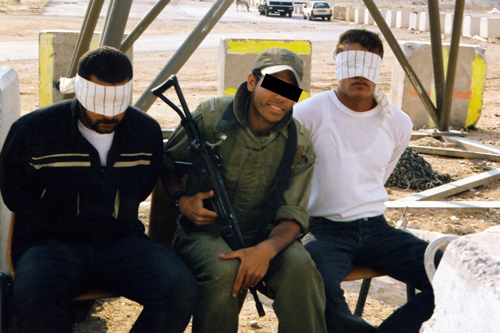
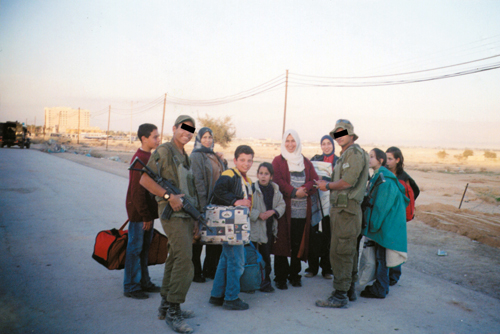
The soldier in the two photographs here collected dozens of photographs of himself with Palestinians he detained at checkpoints. (He contributed the photographs to a 2004 Breaking the Silence exhibit on the realities of Israel’s military rule.) In most of the images, the detainees are blindfolded. It seems clear that, in the first scene, the soldier was not hoping to gain the detainees’ recognition of his superiority. Rather, he was hoping to gain the recognition of his intended audience of fellow soldiers. Furthermore, the question of these men’s innocence did not cross his mind. He was morally indifferent to his picks.
The second photograph, in which the same soldier appears, might raise some doubts about my analysis of the checkpoint: Why can’t the checkpoint be lovely once in a while? There seems to be no cruelty in this picture. Everyone is smiling. This photograph suggests that even at the checkpoint, Israeli soldiers and Palestinian families can transcend their differences and communicate their common humanity.
But this is not friendliness in the picture: the stares are opaque and the smiles are vacuous. The soldiers, desperately acting out, wanting to be seen, doing whatever they can to find content in themselves, decide to take a picture with a Palestinian family that happens to be at the checkpoint. The members of the family are anxious to pass through the checkpoint safely and quickly. To do that, they are willing to obey the soldiers’ whims. They are certainly willing to pose for the camera.
So the family smiles obediently, their smiles of fear and distress; the soldiers smile mindlessly, their smiles of those who have given up on what they once knew to be themselves.