The Fall of Roe: The Rise of a New America
Elizabeth Dias and Lisa Lerer
Flatiron Books, $32.99 (cloth)
Undue Burden: Life and Death Decisions in Post-Roe America
Shefali Luthra
Doubleday, $29 (cloth)
Abortion Beyond the Law: Building a Global Feminist Movement for Self-Managed Abortion
Naomi Braine
Verso, $24.95 (paper)
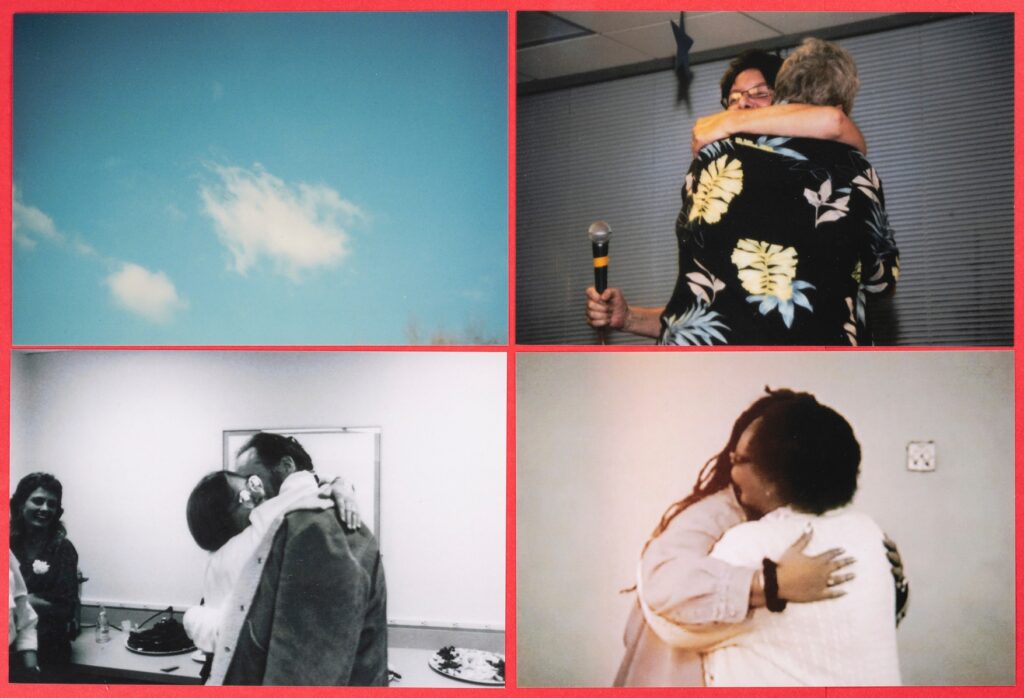
Like many women at the Whitney Museum of American Art’s 2024 Biennial, I lingered for a long time before “The Last Safe Abortion,” Carmen Winant’s assemblage of more than 2,500 photographs of abortion care workers, taken over the half-century during which Roe v. Wade protected the right to terminate a pregnancy.
I stood back to absorb it whole, corner to corner, floor to ceiling. I examined the pictures one by one—four-by-six-inch lab prints, the kind you get developed at drugstore kiosks, most of them archival, some taken by the artist. In them, women answer phones and hang signs, hands take blood, hold other hands. There are waiting room chairs, examination tables, one with soft blue booties over the stirrups, and pictures of the sky. Exhibited on the two-year anniversary of Dobbs v. Jackson Women’s Health Organization, the Supreme Court ruling that overturned Roe, “The Last Safe Abortion” is a plainspoken yet monumental eulogy. I was not the only viewer in tears.
“I loved it for all of its mundanity,” said the artist of abortion care. And abortion is indeed mundane, in the sense of its ordinariness. Legally or not, people have always terminated unwanted pregnancies and will continue to do so; one in four American women will have an abortion in her lifetime. Yet, like other mundane activities—housework, child care, the labor of deliveristas and hospital orderlies—legal abortion has been as invisible as it is essential. Ignored politically during its lifetime by all but its fiercest champions and detractors, it is finally, posthumously, receiving its due acclaim.
How can we win abortion back—and what, exactly, do we want to win? Three books published since Roe’s fall suggest that the answers depend on how we think about the workings of politics, the practices and meanings of reproductive care, and the relationships among them.
Read together, two of the books—The Fall of Roe: The Rise of a New America and Undue Burden: Life and Death Decisions in Post-Roe America—tell one grim story. Both are masterfully researched and lucidly written by veteran journalists—the former by Elizabeth Dias and Lisa Lerer of the New York Times, the latter by Shefali Luthra of 19th News. Each makes a necessary contribution at an urgent moment. Yet each also gets something fundamentally wrong about the subject it treats, narrowing the imagination of what comes next.
The Fall begins in 2012—during the Obama administration—and recounts the fifty-year campaign of the “passionate” religious minority that finally brought down the constitutional right to abortion; it also follows the liberal feminist movement that tried, inadequately, to defend that right. Undue Burden picks up the narrative just after the 2021 enactment of SB 8, Texas’s ban on abortions after a “fetal heartbeat” can be detected (around six weeks into pregnancy—when there is no functional heart). When the courts let SB 8 stand, the outcome of Dobbs, announced on June 24, 2022, was ordained. Luthra surveys the devastation that ruling has wrought on abortion-seekers and reproductive health care, not just in red states but across the nation.
In addition to this chronological division, The Fall tells the political part of the story, Undue Burden the corporeal part. Yet the books share a framework, treating abortion as primarily a medical procedure, undertaken after a decision “between a woman and her doctor.” The authors view the denial of bodily autonomy as a matter of individual harm, to be redressed through civil lawsuits and Constitutional challenges and better patient care. We are, in short, inside the frame of Roe v. Wade. What follows logically is a need to restore Roe or something like it.
Only the third book, Abortion Beyond the Law, offers a vision that looks forward. Sociologist Naomi Braine surveys territories barricaded by criminalization but also expanded by new technologies: secure digital communication and safe, effective medications for terminating pregnancies at home. “Abortion’s past . . . is not abortion’s future,” law professors David S. Cohen, Greer Donley, and Rachel Rebouché wrote in the Stanford Law Review earlier this year. Braine explores a global underground network working in that future today, enabling self-managed abortion in some of the world’s most restrictive environments and, in doing so, creating a radical feminist alternative in reproductive care.
In 2012, as The Fall of Roe describes it, “the abortion-rights movement was dominated by four big organizations”: Planned Parenthood Federation of America (PPFA) was the health care arm; the Center for Reproductive Rights, the “law firm of the movement”; NARAL Pro-Choice, “the political operation”; and EMILY’s List, the PAC that funds pro-choice Democratic candidates. A similar small group of major organizations define the antiabortion movement: the Susan B. Anthony List (SBA), the conservative counterpart of EMILY’s List; the National Right to Life Committee; Concerned Women for America; and Students for Life.
Against this backdrop, two Great Women battle. Cecile Richards, the head of PPFA from 2006 to 2018, is “the most powerful symbol of abortion rights in the country, a Goliath commanding a force nearly unmatched in American politics.” Her equally vaunted opponent is Marjorie Jones Dannenfelser, who entered politics as one of a select cadre of protégés of the ultraconservative Heritage Foundation and rose to become the founder and first director of SBA, establishing herself among Washington’s right-wing elite. Chapter openings toggle from one Great Woman to the other, creating the drama of the book.
Richards and Dannenfelser might agree with the authors’ portrayal of their outsized importance. Shortly after Trump took office in 2017, Dannefelser declared: “Cecile Richards was in the White House all the time during the Obama administration. It’s our turn.” Or her turn. Yet in keeping with the Great Person Theory of History, the book introduces someone who had an even bigger role than Dannenfelser in bringing down legal abortion: Leonard Leo, a nonpracticing attorney, head of the Federalist Society, prodigious fundraiser, and manager, through myriad interlocking funds, of one of the largest pots of dark money in the country. The donation of $1.6 billion from an obscure businessman “transformed Leo into a power broker who could steer the conservative movement and, perhaps, the future of the country.”
Indeed, Leo has been widely credited as one of the most influential and effective conservative operators in U.S. history and the architect of the judiciary that produced Dobbs. He was instrumental in the nomination and confirmation of John Roberts, Samuel Alito, and his good friend Clarence Thomas. With the Federalist Society, Leo funneled a generation of young ultraconservatives and Constitutional originalists to the federal bench. Among them are U.S. District Court Judge Matthew Kacsmaryk, who ruled in favor of a group of antiabortion doctors challenging the FDA’s approval of the abortion drug mifepristone, and Neil Gorsuch, Brett Kavanaugh, and Amy Coney Barrett, who were on the list of preferred Supreme Court nominees that the Federalists supplied the Trump administration. Leo told Dias and Lerer that Chief Justice Roberts might have been thinking of him when the Court handed down its ruling in Dobbs.
But is the political history of abortion just a duel between two influential women, with the man destined to steer the future of the country as a second? Almost entirely missing from this picture are the grassroots. Where are the second-wavers who crashed legislative committee meetings, wrote manifestos, and performed safe abortions before Roe? The scholars and activists of color who drew a now-indelible connection between gender oppression and racism? The bloggers who took organizing online, fluidly moving between screen and street? Did Dannenfelser organize the church ladies who trained the citizen lobbyists and chartered the buses to the state capitals and the annual March for Life in Washington? Did she rouse the protesters from bed before dawn to stand outside the clinic doors and wave photographs of dead fetuses in the patients’ faces?
The book’s map of the pro-abortion movement resembles Saul Steinberg’s “View of the World from Ninth Avenue”—New York City teeming with details in the foreground, then a flat, virtually empty space representing the world west of the Hudson River. The authors reference “a constellation of far smaller, largely Black and Hispanic abortion-rights organizations, part of the reproductive justice movement that orbited Planned Parenthood”—PPFA and its three sisters the big green planets, the rest indistinct moons, out there.
In Fall’s discussion of the campaign to ensure the Affordable Care Act would guarantee birth control coverage, smaller reproductive justice groups appear only to be dismissed. To get this part of the ACA through, the coalition—meaning, for Dias and Lerer, mainly PPFA and its allies in the Democratic Party—agreed to reaffirm the Hyde Amendment, which prohibits federal funding for abortion. The law places abortion out of reach for anyone dependent on Medicaid—a population disproportionately of color, as is the population that has abortions. Antiracist feminists have been trying to get Hyde repealed since it was enacted in 1977. To them, say Dias and Lerer, the negotiators’ compromise was “a sign that the biggest organization in their world”—led by white women at the time—“was willing to trade off their rights.” Richards herself confirms their suspicions. “You always wish you could have done more,” she says, as if the problem were merely tactical, not existential.
Dias and Lerer don’t define the grassroots demand for reproductive justice, which SisterSong describes as “the human right to maintain personal bodily autonomy, have children, not have children, and parent the children we have in safe and sustainable communities.” The collective was founded in 1997 by a cluster of feminists of color frustrated with white liberal feminists’ unmoving focus on abortion and failure to address Black and brown women’s oppression as patients and parents. Dias and Lerer rehearse some of this. But they call SisterSong “a collective of abortion-rights organizations run by women of color,” erasing the critical distinction between abortion rights and reproductive justice.
Two scenes that bookend the story crystalize the book’s lopsided view of politics. The first takes place at the Texas State Capitol in June 2013, where Democratic Senator Wendy Davis is filibustering to block a vote on a twenty-week abortion ban. After eleven hours of talking—peeing into a catheter and neither eating, pausing, nor sitting—she is halted by the Republican leadership on a technicality. Davis’s supporters, packing the spectators’ gallery, erupt in cheers and stomping, creating such a din that they drown out the proceedings, running out the clock to end the special session, killing the bill. A similar bill will pass later, but that day they win. A GOP lawmaker calls them an “unruly mob,” and he’s not far off.
The way Dias and Lerer tell it, Richards “directed the crowd from her makeshift command station at the center of the rotunda,” having flown in from New York to strategize with Davis and mobilize the troops. With the roar from the chamber filling the rotunda, they write, “Richards threw her arms in the air, signaling to raise the volume even more.” But that’s not how Aman Batheja reported it (with help from Luthra) in the Texas Tribune. According to Batheja, the outburst “had not been planned by the established groups like Planned Parenthood, NARAL, Pro-Choice Texas and the Texas Democratic Party.” On the contrary, they had counseled decorum, lest they be kicked out; during the proceedings Richards “could be seen gesturing to the crowd to quiet down.” It was members of a grassroots coalition, including Occupy and the International Socialist Organization, who seized the moment to “goad” the crowd to deafening civil disobedience. Only then did Richards and her liberal allies join in.
As The Fall of Roe nears its end, Dias and Lerer go beyond ignoring grassroots activism practically to denigrating it. The Dobbs ruling is announced, the nation is in shock, and we peek in at the heads of the organizations, one by one. Dannenfelser’s phone lights up with texts. From her eighty-nine-year-old father: “You won!” From Mike Pompeo, Trump’s erstwhile secretary of state: “God is good.” Meanwhile, Richards is in her Upper West Side apartment, envisioning the world to come. She finds the ruling “devastating,” of course, but also—astonishingly—“unimaginable.” Finally, we get a glimpse of activists spilling out from the Supreme Court steps, gathering to rage and mourn. Through a bullhorn, Representative Alexandria Ocasio-Cortez exhorts them to organize. A woman calls out: “What can you do in Congress?” Replies AOC: “Right now, elections are not enough. We have to fill the streets.”
The book’s next sentence: “But filling the streets could accomplish very little.”
Really? Have Dias and Lerer forgotten that filling the streets—shorthand for activism—was what won Roe in the first place, and that grassroots groups and activists—most of them unheralded and unpaid—have enabled pregnant people to get abortions even as restrictions mounted and access waned?
If anyone on the pro-abortion side can be blamed for the loss of legal abortion, in fact, it is the professional, corporatized liberal feminists who are the heroines of The Fall and the organizations that prioritized risk management over all else, downplayed abortion in their rhetoric (the procedure comprised “only 3 percent” of services, Planned Parenthood stressed), shut clinics or discontinued abortion care when the political heat rose, and hewed so closely to Roe that they lost the profound meaning of abortion—and with it, the necessity of protecting it as a guarantor of bodily autonomy, the most basic human right. If the highest-profile provider had zealously defended abortion rather than shrinking from the fight, abortion might not have been so easily sidelined by elected officials and other social justice movements.
Setting The Fall of Roe in the C-suites of national organizations not only gives too much credit to executive directors, big-shot attorneys, and politicos. It distorts the process by which social change happens. Grassroots movements are the prow of the icebreaker. They make impossible demands until those demands sound reasonable and, eventually, are codified in mainstream political platforms and bills. The ideas that end up as policy do not originate with the final brokers of the deals. Few “leaders” lead; most follow. Without the grassroots there would be no Richards, no Dannenfelser.
If The Fall of Roe identifies the movers and shakers, Undue Burden introduces us to the people who’ve been moved aside and shaken—financially, emotionally, and physically—by the seizure of their rights. With in-depth profiles of desperate abortion-seekers in red states, interspersed with interviews with providers and advocates nationwide, Luthra documents the extraordinary pain and chaos caused by post-Dobbs abortion bans. But she also does in journalism what Carmen Winant does in art: pays tribute to the ordinariness of terminating a pregnancy. “People of all circumstances get abortions for all sorts of reasons,” Luthra writes. “They relate to those experiences differently, and those different stories are all equally valid and deserving of our attention.” The stories she tells reflect both these truths.
Undue Burden takes its title from the language of Planned Parenthood v. Casey (1992), which upheld Roe yet, many believe, weakened the standard by which its protections were maintained. If a restriction did not impose an “undue burden” on patients, the courts had to find it constitutional. Of course, Casey did not initiate abortion restrictions. The Hyde Amendment was imposed just four years after Roe, and before that, minors lost their self-determination when states began requiring parental consent to end a pregnancy.
But after Casey, virtually no burden seemed unduly burdensome by the lights of some court—not 24-, 48-, or 72-hour waiting periods between first appointment and procedure, not gratuitous intravaginal ultrasound exams, not “informational” lectures full of scary anti-abortion misinformation, and eventually, not six-week bans.
Luthra’s subjects must overcome these obstacles, and many more, to end unwanted pregnancies—and some don’t manage to. There’s Tiffany, from Houston, Texas, pregnant at sixteen and certain she wants an abortion yet abandoned by the baby’s father and waylaid by chronic depression, poverty, and abortion-averse parents. Tiff sleepwalks through the months, alternately trying abortifacient homebrews and denying reality. “The pregnancy felt like a nightmare, like something that couldn’t really be happening to her,” writes Luthra. The deadline passes even for a late-term abortion. Tiffany suffers pregnancy complications and gives birth prematurely to a healthy baby.
Another Texan, twenty-one-year-old Angela, is better situated, with secure if crummy housing, steady but poorly paid work, a young son, and a loving live-in partner. But she’s not ready for another kid: she’s carrying a ton of medical debt from the first birth and wants to go to nursing or accounting school and get a bigger apartment. Stymied by Texas law, she ends up fleeing to New Mexico, where she gets abortion pills from a clinic and performs a self-managed abortion there, unsure (like many others) whether the pills are legal in her state. “I can’t just be okay in my home,” she says, near tears. “I’m staying at someone else’s Airbnb, in pain, feeling guilty that I had to lie to my family, and feeling stressed about the financial hit that I took from this.” When Angela’s guilt subsides, rage takes its place.
Darlene, a forty-two-year-old married mother, also in Texas, must decide alone whether to continue a desired pregnancy despite a health-threatening condition because her doctors fear that standard-of-care information about her options—including aborting the fetus—might run afoul of the law. Jasper, a trans man, is just getting his life together in Florida at nineteen when he experiences symptoms of pregnancy. Although this is not impossible for a transgender man taking testosterone, neither he nor any health care provider thinks to give him a pregnancy test until an ultrasound reveals his twelve-week-old fetus. Jasper is unsure about abortion—he thinks he’d be a good dad, someday—but must rush to make up his mind and grab the only available appointment before hitting the state’s fifteen-week deadline. (Florida has since adopted a six-week limit—which would have been tough luck for Jasper.)
Most of Luthra’s subjects are young. Like the majority of abortion-seekers, many have kids. Few can afford to leave the state and pay for housing, childcare, and a procedure whose cost and complexity mount with time. “Abortion access is a story of racial and economic inequality,” Luthra writes, and on every page, that abstract statement is brought to agonizing life. One detail: an undocumented person traveling near the Southern border to obtain a legal abortion risks hitting immigration checkpoints—and possible deportation.
The parallel story to these personal trials and tragedies is the battering Dobbs has administered to reproductive healthcare throughout the United States. As clinics close in over twenty states and ob-gyns relocate to where they can practice, the crisis has been immediate and severe. TRAP laws—“targeted restrictions on abortion providers,” that is, arbitrary and costly regulations designed to put them out of business—had already thinned reproductive services in red states and rural counties. Then, overnight, there were none. In addition to abortions, many of these clinics provided contraception, prenatal and maternal care, and cancer screenings. In fact, the abortions often financed the rest—so the other services also died when the facilities shut down.
Blue states have been thrown into crisis too as patient demand has skyrocketed. California projected a 3,000 percent increase even before it declared itself a sanctuary in 2022. In-state patients can’t get appointments; a Kansas clinic received 16,000 phone calls in one day, with a single caller dialing more than 200 times to get through. Pregnancies advance, and termination—a safe, simple procedure when performed early—grows more physically taxing and expensive. Providers are frustrated, sad, and exhausted. One doctor, forced by a new ban to close her doors, opened two out-of-state clinics and commutes from home to both workplaces. “In between,” Luthra writes, “she’d make sure to be home for her kids’ honor society ceremonies and karate demonstrations. Somehow, she’d make it all work.”
The reporting in Undue Burden is wide and deep. Yet if The Fall misrepresents the political struggle over abortion by skipping over the grassroots, Undue Burden only partially reflects the experience of abortion-seekers and those who care for them. In fact, in 2024, Luthra’s focus on abortion as performed or overseen by medical professionals in a clinic or hospital no longer matches the reality for most people. As Cohen, Donley, and Rebouché discuss, the availability of abortion pills and proliferation of self-managed abortion (SMA) have changed that reality entirely.
“Abortion is now illegal in roughly a third of the country, but abortion pills are more widely available than ever before,” they write. “Clinics, websites, and informal networks facilitate the distribution of abortion pills, legally and illegally, across the United States.” They add that while “antiabortion advocates and legislators are adopting all manner of strategies to attack pills,” the pill bans are already proving unenforceable. The authors conjecture that the excessive, intrusive means legislators will find necessary to keep pills out of their states may prove intolerable even to people who don’t care about abortion.
SMA transforms not only the practicalities of abortion but its popular perception too. Abortion pills blur the distinction between induced abortion and miscarriage—the body responds the same way regardless of what triggers it—which helps to destigmatize abortion. In this “new era,” geography matters less; in all but the most urgent cases, it does not matter at all. “With pills, state governments and the medical establishment will lose even more control over abortion,” write the law professors. “Rather, informal and underground networks will meet much of the demand for abortion pills, cutting out gatekeepers.” This makes the authors (and me) optimistic about the future of abortion access. But it makes Luthra nervous.
Undue Burden is clear that SMA using mifepristone and misoprostol is safe and effective, that complications are exceedingly rare, and that self-management—the method of choice in much of the world—is becoming more popular in the United States. Yet Luthra both understates the ease of access to SMA here and overstates its risk.
Of course, the worst can happen—and has. This month ProPublica released an investigation of one of two preventable ban-induced deaths in Georgia: Amber Nicole Thurman, a healthy twenty-eight-year-old medical assistant and mother of a young son, died of sepsis when doctors kept delaying the evacuation of fetal tissue left in her uterus after an incomplete nine-week self-managed pill abortion. Still, of nearly 6 million women who took mifepristone in the United States from 2000 through 2022, thirty-two deaths were reported to the FDA (approximately one in 200,000). Thurman’s death is extremely rare.
But for Luthra, the only safe abortion is a medicalized abortion, overseen (even if done at home) by professional providers, who are represented as the only people with sufficient knowledge and expertise to be involved. She suggests that the rise of SMA will likely exacerbate an emotional and practical isolation that she attributes even to people who are not isolated. “It was perhaps the loneliest decision she’d ever made,” Luthra says of Angela, whose boyfriend, Nigel, is at her side from start to finish. Her subjects seem sequestered within their families and romantic relationships. Few of them have close friends to talk to. Feminism is something they’ve heard of, maybe even endorse, but it is of no practical use to them. Self-management “required knowing someone who could help, who knew where to look,” she writes. Her assessment is dour: “Whisper networks and borrowing people’s leftover medicine, counting on someone to know a little more than you did, and hoping for good luck.”
It is true that state legislatures—and Project 2025—are proposing to escalate digital surveillance to intercept or prosecute illegal abortions; police and citizen enforcers are already combing through Facebook and text messages to track down friends helping friends get pills. Still, you don’t need to know somebody who knows somebody. Long before Dobbs, anyone with a mobile phone or access to the internet could get a load of accurate information and guidance online about abortion pills. The Miscarriage and Abortion Hotline offers similar information, as well as direct confidential medical and emotional support through text or phone seventeen hours a day. Plan C, founded in 2015 to promote SMA both on- and offline, has an easy-to-use abortion pill finder for accessing medication by mail in any state red or blue, at prices down to zero.
Most of these sites counsel users to switch to encrypted apps when researching their options and offer instructions in erasing digital tracks, and many underground pill providers communicate only through surveillance-confounding platforms and systems. As Cohen and colleagues note, “when attempts to police out-of-state providers fail, anti-abortion legislators and activists will work to regulate, criminalize, and punish others in the information and distribution chains.” But as the state dreams up new ways to stop extralegal abortions, the underground “will respond with new ways to get pills into the hands of those seeking them.”
Luthra’s dire portrait invites resignation: if abortion is considered safe only within the always strained, now wrecked formal health care system, then the problem is intractable. “Treating the crisis as an actual emergency, and one that merited sweeping and immediate interventions—seemed impossible,” she writes. “Even the most aggressive state response would inevitably fall short.” Yet since the publication of Undue Burden in May, New Mexico has begun building a $10 million state-funded reproductive health care center serving both New Mexicans and patients from neighboring states where abortion is illegal. Other states are allocating funds in anticipation of increasing demand. New York will distribute $36 million to abortion providers; Maryland is appropriating $15.6 million for training and care.
Where The Fall of Roe neglects a grassroots feminist movement, Undue Burden ignores the possibility of widespread safe abortion outside the formal health care system. Yet right now feminist grassroots activists everywhere in the world are bypassing the medical establishment, enabling pregnant people to safely self-manage their abortions, and providing them with ample emotional and practical support. Abortion’s present is not abortion’s past. “We won’t go back,” as activists say, either to the coat hanger or even to Roe.
This is the world Braine describes in her rich, politically sophisticated, and inspiring book, which chronicles her encounters with the SMA movement, a network of local collectives, loosely linked regionally and globally, that staff hotlines, disseminate information, procure and deliver pills into pregnant people’s hands, and offer skilled and knowledgeable support before, during, and after the recipients perform their abortions at home. Latin American feminists call this last part acompañamiento—accompaniment—and the practice predates SMA. For decades, feminist networks have been “supporting individuals and families through the medical and legal aftermath of different forms of violence against women,” including rape, domestic violence, forced motherhood, and feminicidio, or femicide.
A veteran social justice activist who worked with street-level needle exchanges for IV drug users during the AIDS crisis, Braine writes that the movement for SMA “enables people with unwanted pregnancies to safely end those pregnancies regardless of the law.” Like needle exchange—built on a philosophy of harm reduction—the SMA movement “enables bodily autonomy and self-determination” regardless of the person’s circumstances or politics. An Argentine activist calls it “a feminism of direct action, body to body.”
The work is political—many of its participants are engaged in other progressive movements and resistance to oppressive regimes—but not entirely public, visible enough so people can easily find it, yet secret enough to safeguard both workers and pregnancy-terminators from prosecution and imprisonment. Braine calls SMA activism “civil disobedience without a press release.”
Traveling over several years to movement outposts in Latin America, Europe, and Africa, Braine interviews the activists at length, elaborating on their analyses of challenges and solutions, and skillfully integrating the local and the global. She notes, for instance, that while the digital technology that enables much of the work originates largely in the Global North, the deepest knowledge and longest experience travels in the other direction.
In fact, the Mexican collective Las Libres innovated the use of the ulcer drug misoprostol for intentional abortions—reversing the logic of the label’s warning that the medication may cause miscarriage. They helped thousands of people obtain and safely employ the drug in the decades when abortion was illegal in that country. On September 6, 2021, a week after SB8 went into effect in the United States, Mexico decriminalized abortion federally (though it’s still illegal in some states). Las Libres soon began smuggling pills into Texas and now serves as a major link in the growing U.S. abortion-access underground.
Braine understands that civil disobedience and direct action do not substitute for political and legislative activism. She does not write off paid advocates or medical and legal professionals. The SMA movement collaborates with NGOs, in some countries more than others. And volunteers whose work constantly exposes them to arrest and prosecution need a list of attorneys willing to defend them, pro bono. (U.S. lawyers: volunteer now.)
She allows that SMA cannot replace every medical intervention that may be necessary during miscarriage or late-term abortion. Still—and this is probably the most controversial part of the movement’s practice—the activists accompany people using pills for second-trimester abortions at home, including helping them deal with the emotionally difficult and legally risky process of disposing of what are called, in the medical literature, the “retained products of conception,” which at this stage include a baby-like fetus. In Ohio, before voters enshrined the right to abortion in the state constitution, a woman was arrested for abusing a corpse when she miscarried a nonviable fetus and tried to flush it down her toilet. The grand jury declined to prosecute, but the ordeal was harrowing all the same.
“Second-trimester abortions often involve complicated social situations and more marginalized people or pregnancies,” writes Braine. Extreme poverty, geographical remoteness, emotional instability, or abusive partners can interfere with a needed abortion as much as the law does—precisely why SMA activists feel compelled to answer the call of people in those situations. Braine also suggests that the controversy is somewhat overblown. “Second-trimester SMA has repeatedly proven to be safe and effective when supported by knowledgeable activists,” she insists, citing recent data indicating that “South American collectives may be more successful at completing second-trimester medication abortions than medical clinics.”
Since Roe, liberal proponents have called abortion a “decision between a woman and her doctor.” (The ruling itself is less generous to women. In the first trimester, it reads, the decision “must be left to the medical judgment of the pregnant woman’s attending physician.”) Doctors had been consolidating their control over reproduction since the mid-nineteenth century, and Roe consolidated it further. In fact, one study of patients who had abortions in the United States found that only about one in four discussed the decision with their primary care provider or gynecologist. According to another study, the patients who declined to talk with those providers either didn’t think it would be “beneficial”—the doc did not perform abortions or know much about them—or they feared the disclosure would disturb the doctor-patient relationship.
The SMA movement, a descendent of the feminist health movement of the 1970s, repudiates the medical establishment’s appropriation of reproductive care. Its practices of knowledge building reverberate beyond the facilitation of safe abortion under criminalization. Braine describes the goal as transformative: to “place the experiences and needs of pregnant people at the center, and build demedicalized, community-based approaches to abortion. This is not abortion as a medical process, no matter how feminist: it is abortion as radical bodily autonomy and as ordinary life, simultaneously, ‘at home, with friends,’ to paraphrase the name of a Chilean collective.”
The most radical political demand of pro-abortion feminists, from the pre-Roe era to this day, is consonant with the SMA movement’s practices and goals: not to legalize abortion but to repeal abortion laws. That is, to allow medical facilities to provide abortion care as they do just about any other kind of care, and to authorize the sale of abortion drugs over the counter without a prescription. In the United States abortion is the rare procedure bound by specific legislation—and legalization comes with regulation, which can re-open the door to TRAPs and tighten the space for abortion until a pregnant person can barely squeeze into it. Repeal makes abortion one of those things the law doesn’t need to touch.
Unlike the executive directors and elected officials that populate The Fall of Roe, the SMA activists do not regard themselves as advocates for others. Unlike the doctors and nurses in Undue Burden—hardworking and courageous as they are—they do not consider the people they help to be their patients or clients. Unlike liberal feminism—and diehard defenders of Roe—this global movement does not conceive of abortion as a private or individual matter. Instead, says Braine, they understand “the deeply collective nature of autonomy and self-determination.” The principles of acompañamiento—a practice of “solidarity rather than service, of mutuality rather than hierarchy”—infuse a politics that is charting paths beyond abortion, toward liberation and human rights for all.
Independent and nonprofit, Boston Review relies on reader funding. To support work like this, please donate here.