
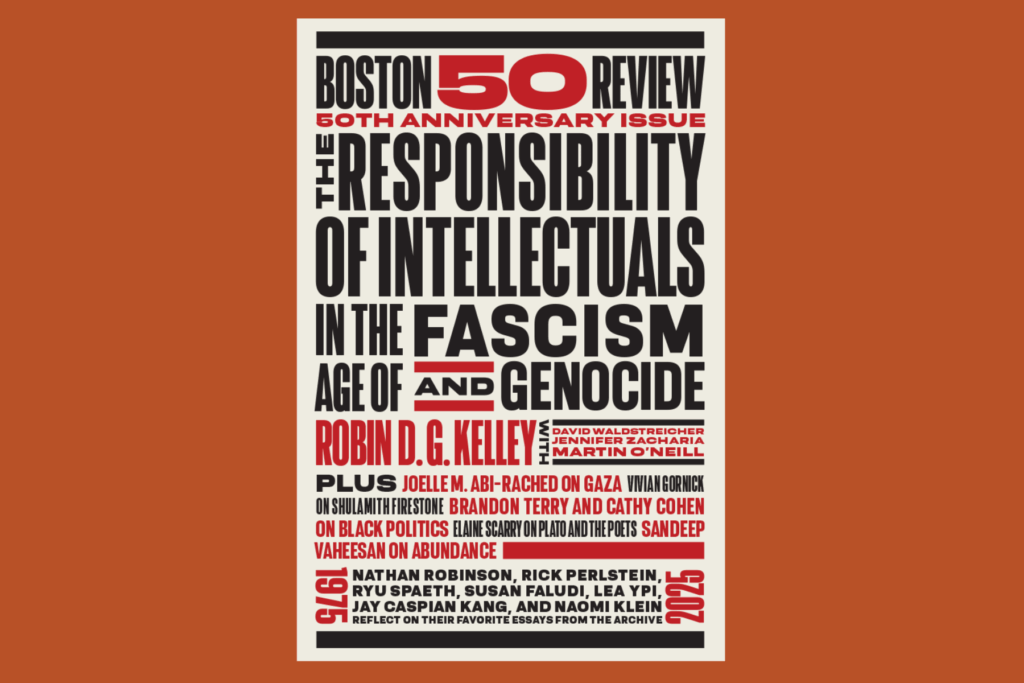
See the Table of Contents here.
This second issue of our fiftieth year features longtime contributors (including Robin D. G. Kelley, Vivian Gornick, and Elaine Scarry), newer voices in the magazine, and a celebration of classics from the archive. But more than simply a compilation of writing by authors we are privileged to work with, the issue reflects a conviction that has animated our work for decades: the daunting challenges we face must be met by collective thought and action.
As a starting point, Kelley revisits Noam Chomsky’s landmark essay, “The Responsibility of Intellectuals.” Published in 1967 as the Vietnam War was rapidly escalating, Chomsky’s injunction—“to speak the truth and to expose lies”—remains a powerful call to conscience, Kelley argues. But in the Vietnam era, the intellectuals supporting the war all believed that they were acting responsibly. Moreover, the privileges that Chomsky associated with intellectual life are in increasingly short supply. A campaign of McCarthyist repression has overtaken universities. Lies circulate unchecked, no matter how forcefully exposed.
In these conditions, Kelley takes inspiration from the antifascist and anticolonial struggles of the 1930s and ’40s—particularly from the Black radicals who refused and resisted complicity in their own age of fascism and genocide. Like them, he concludes, “we need to stand in solidarity and fight for others as if our lives depended on it.” Historian David Waldstreicher, Palestinian human rights lawyer Jennifer Zacharia, and political philosopher Martin O’Neill expand on what this moment requires—not just of intellectuals, but of journalists and of us all.
Movements will be part of any effort. Brandon Terry interviews political scientist Cathy Cohen, who has been involved in some of the most consequential social movements of our time, about what we’re up against and how activists can do better. On electoral politics and policy, David Austin Walsh explains what Zohran Mamdani’s triumph in the New York City mayoral primary means for the future of the Democratic Party, and Sandeep Vaheesan assesses the “abundance” agenda and how best to build where need is greatest. Two review essays explore personal accounts of ruptured social connections: Samuel Hayim Brody on memoirs of the Arab Jewish world destroyed by colonialism, and Vivian Gornick on the reissue of Shulamith Firestone’s Airless Spaces, a work about mental illness—but in the end about the essential loneliness of the human condition.
We’re grateful to our readers for the ongoing support, and to Naomi Klein, Susan Faludi, Jay Caspian Kang, Rick Perlstein, Ryu Spaeth, Lea Ypi, and Nathan Robinson for writing about their favorite Boston Review essays—from Chomsky’s 2011 “Responsibility of Intellectuals, Redux,” to Gornick’s appeal to “honor the existence of the one not like ourselves,” to Scarry’s 2002 “Citizenship in Emergency,” which transforms the actions of passengers on 9/11’s Flight 93 into an urgent call for democratic accountability. “Why,” she asks, “are we sitting quietly in our seats?”
Scarry has a new essay in this issue as well, challenging the conventional wisdom that Plato wanted to rid the just city of poets. She tries to get the story right; if we don’t, we risk “cutting off philosophers from poetry’s expressive resources”—in other words, severing politics from imagination.
Her essay echoes the words of Colombian President Gustavo Petro in Joelle Abi-Rached’s trenchant essay on Gaza and the hypocrisy of the liberal international order. In a speech in July before leaders from the Global South, convened to hold Israel accountable for war crimes, Petro stressed the need to keep alive “the possibility of another kind of humanity, one that can love and think collectively.” We’re working to do our part.