
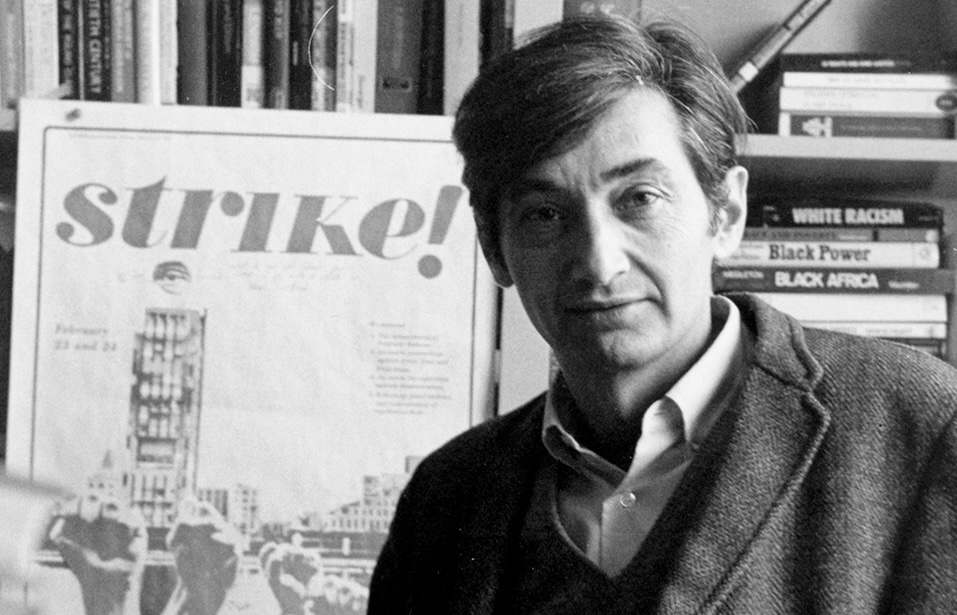
Has any single book drawn more Americans leftward over the last half century than A People’s History of the United States? Howard Zinn was not the first to write about Bartolomé de las Casas, the Flour Riot of 1837, the Teller Amendment, or MKULTRA, but no historian before him had been so audacious as to compile these and other subjects into a sweeping page-turner on national rapacity and popular resistance.
Conservatives are still saying that what A People’s History did to this country will take decades to remediate. The federal government has set itself to the task, and one imagines that in the drafty shell of Linda McMahon’s Department of Education, amid the fire sales of office furniture and summary sackings, a Two Minutes Hate is observed each morning before a massive projection of Zinn’s twinkly visage.
As if to rebuke the “America250” festivities this July, a new biography by Dave Zirin reveals the true character of our Emmanuel Goldstein. The People’s Historian: The Outsized Life of Howard Zinn, published by Dutton in August, is in the first place a reminder of how much Zinn accomplished as a participant in history and not just a chronicler of it. Among other things, he built ships in the Brooklyn Navy Yard; dropped napalm on France during the war, which prompted his turn to pacifism; organized sit-ins with his young, gifted, and Black female students at Spelman College (among them Alice Walker and Marian Wright Edelman); served as a key advisor to the Student Nonviolent Coordinating Committee; helped recover American POWs from North Vietnam; became a minor pop culture phenomenon thanks to Good Will Hunting; and held the attention of young people through his last years—last days, even—as one of his generation’s most outspoken opponents of the wars in Afghanistan and Iraq. He died in 2010 at the age of eighty-seven.
Zinn has a bulldog in Zirin, the longtime sports editor of The Nation. They became close in the last years of Zinn’s life, when the elder Z encouraged the younger to write a book that ended up being called A People’s History of Sports in the United States. Some of Zinn’s last public appearances before his death in 2009 were onstage with Zirin. So The People’s Historian is a personal book—“biased,” certainly, as Zinn’s opponents like to say—but it’s a reminder for Americans in the twenty-first century what moral and intellectual courage looked like in the twentieth.
I called Zirin last week to discuss the book. The day we spoke, Zirin had just arrived back home by train after covering the Knicks’ remarkable comeback victory in Game 4 of the NBA Finals. “I haven’t slept,” he said, but he had plenty of energy to discuss his old friend. This transcript of our conversation has been lightly edited for clarity.
—Andrew Holter
Andrew Holter:Let me ask you first about your own relationship with Zinn. How old were you when you first encountered A People’s History, and what impression did it make on you?
Dave Zirin:I was eighteen, basically a teenage knucklehead, and I had no interest in the history that I was being taught in school. My sister gave me a book called The Twentieth Century: A People’s History—the truncated version of the book. That was really smart of her, because in my knuckleheadedness I really didn’t care about the fifteenth, sixteenth, seventeenth, eighteenth, or nineteenth centuries. You could have told me about 1870 and I would have thought you were talking about 1270—it meant nothing to me. The only history I was interested in was the history of my grandparents. I would sit down with my grandpa, who was born in 1906, and hear stories from him about the twenties, thirties, forties, and that was my love of history.
The Twentieth Century felt like revealed knowledge. I would read five or six pages and have to put the book down and walk around the room, because there were implications with every page. And reading this and taking it in, I thought, well, there might be an obligation for me not only to spread the word but to do something about the world in which I live. Which at eighteen was a scary prospect.
Holter:You met Zinn in the nineties, but in the mid-2000s he took you on as a kind of protégé—is that fair to say? I was watching footage of one of your appearances with him and it’s clear how much he enjoyed your conversations. Why do you think he took such a shine to you?
Zirin:I didn’t really get to know him that well until I started sportswriting with my own radical, political-historical bent. You have no idea how flattering it was to me, and mind-blowing, when I first learned that he read my stuff. At the time—this is 2005—he was part of something called the People’s History series with The New Press and he asked if I would do A People’s History of Sports in the United States. I’ll never forget thinking: I am way too inexperienced, way too callow, way too intellectually bereft to actually write this book. But I don’t want anybody else writing it! Thank God, The New Press had an incredible editor named Andy Hsiao.
“Zinn says, what actually is special and precious about this country is its history of struggle and the ways that people, ordinary people, have been able to do extraordinary things.”
That led to me doing this unforgettable event with Howard and a friend of mine, the late pitcher Jim Bouton. I was talking to Jim and he mentioned that People’s History changed his life. I told Howard that, and Howard said that Jim’s book, Ball Four, was one of his favorite memoirs, so to get them together for an event in Boston was incredible.
In the last couple of years of his life, Howard was sharp as a tack, but he was also eighty-six, eighty-seven years old, and he asked if, instead of lecturing, I would travel with him and interview him on stage, so he could sit and speak. He was the easiest interview ever. I could just say “civil rights movement—talk about that,” and he would go for half an hour.
I would never say in a million years that I was somehow a protégé of his—he had too many actual protégés. I think that he got a kick out of the fact that we were a couple of Jewish guys with radical politics and Brooklyn roots who took great joy in history.
Holter:You really go to the mat with Zinn’s critics in this book in a way that not every biographer would—or has, to be more accurate. The right-wing critics are pretty easily dispensed with, and you don’t waste much time on them, but you make a point to challenge the critiques of people like Eric Foner and Martin Duberman who basically sympathized with Zinn’s politics but took issue with aspects of his scholarship. Am I right that a big part of your interest in writing this book was the chance to mount an all-around defense of Zinn, as not just an activist but a serious scholar and intellectual?
Zirin:Everybody is fair game. Foner’s critique I wanted to challenge on political substance. His conclusion upon his first read of People’s History was that it was depressing, because of the litany of defeats that Zinn recounts. We have to see that critique in light of the fact that this book has inspired people for decades, not depressed them. Since that’s the case, what did Foner get wrong?
Join our newsletter
New pieces, archive selections, and more straight to your inbox
Duberman, whose book on Paul Robeson is one of the greatest biographies ever written, I think misses that Howard was a public-facing, activist-intellectual and that there are so many lessons to learn from his life. I felt like he didn’t engage with the substance of Howard’s life and what it offers us today. I read his biography, Howard Zinn: A Life on the Left (2012), once before writing one word of my own, but I didn’t want the tone, the politics, or his own conclusions to in any way affect my own approach. I wanted to write a book about Howard worthy of the sort of grand narratives that defined his life.
The 2010s saw more protests than any decade globally in the history of time, and yet here we are with global right-wing authoritarianism. People who knew about my relationship with him have asked me all these questions: What would Howard say about the fact that you had all these people trying to make a people’s history and we’ve ended up here, in this horrible place? Would that have impacted his optimism? Was he simply wrong that change comes through mass struggle and mass activity? What was he pulling from historically that allowed him to be an activist for over seventy years? What sustained him? That’s what I wanted to capture.
Holter:The idea that Zinn was secretly a member of the Communist Party has had a long tail. Hoover’s FBI certainly thought he was, and you cite Ronald Radosh as the leading spokesman for that allegation in this century. The evidence just isn’t there, but I wonder how you see the stakes of the question. Why did it matter, or why does it matter, whether he was actually a member of the Party?
Zirin:It’s certainly not true that it would be somehow shameful if he had been a member. There are so many giants who were either connected to the Communist Party or were formal members—people like Richard Wright, Howard Fast, the list is really long. But it matters because history matters and facts matter, and his critics were and are going to brand him. He always denied it, so their argument became that he was a deeply secret member operating in some kind of sleeper cell in college.
“Howard fought tooth and nail against public ostracization because he thought it would divide and destroy the left, and he was absolutely right.”
The argument that he was in the CP serves to make us more ignorant, not just about his own history, but about the history of the left in general. No actual member of the Communist Party would have thrown themselves into the civil rights movement the way he did. There were a lot of conflicting views in the Party about whether the movement was bourgeois, dominated by the NAACP, and so on. Howard was open about his objections to Stalinism. He became a pacifist coming out of World War II when the CP was justifying its role in the war.
The reason they try to brand him a Communist, I think, is that he never cooperated with the Red Scare. Still, to this day, that’s proof that you’re some kind of political apostate, the fact that you wouldn’t cooperate with the FBI. To me, it just makes him all the more heroic that he wasn’t a member and still refused to cooperate.
Howard believed in his heart of hearts that we needed a united left, and he saw people in the Communist Party as part of that left. He believed in public disagreements, too—which, by the way, is another thing that differentiated him from the CP. He fought tooth and nail against public ostracization because he thought it would divide and destroy the left, and he was absolutely right. In the movements he was involved in in the late ’40s, like the American Veterans Committee, that actually proved itself out. [A.H. note: Formed in 1943 as a liberal alternative to the American Legion, the American Veterans Committee purged the Communists in its ranks in 1948 and remained a minor organization until disbanding in 2008.]
Holter:Zinn wasn’t a patriot in an obvious sense, but he gave the United States a lot more credit than conservatives admit. He believed in America, or at least Americans, didn’t he?
Zirin:In a way that makes the right very uncomfortable. His America is not their America, and their America is not his. They would say that American progress is a result of the genius of the Founding Fathers, the Constitution, Declaration of Independence—this very Biblical view, almost like Moses coming down from the mountaintop.
Zinn says, what actually is special and precious about this country is its history of struggle and the ways that people, ordinary people, have been able to do extraordinary things, inspiring people not only here but around the world. He also always stands with and celebrates history’s survivors and mourns history’s dead. He’s going to talk about the fact that slavery was a product of capitalism and the logic of the United States. He’s going to talk about who the Founding Fathers actually were. He’s going to talk about the exploitation of immigrant labor. He’s going to do this in an unapologetic way, and in a way that has a level of historical rigor.
Holter:On that note about rigor, let me ask you about a line from one of Zinn’s critics, the Harvard historian Arthur Schlesinger Jr., who served as an advisor to John F. Kennedy and went on to write many books flattering the Cold War liberal consensus. Schlesinger said somewhere that Zinn was “a polemicist, not a historian.” The same might be said of Schlesinger, you note, but I wonder if Schlesinger wasn’t paying Zinn an unwitting compliment there. There’s a lot of honor in the polemical tradition, and when I think of great polemicists working today, I think of Dave Zirin. Is being a polemicist so bad?
Zirin:Howard could polemicize with the best of them, and he wore that label proudly. As he said, “You can’t be neutral on a moving train.” (That is the title of Howard’s memoir.) Or as Bouton told me, “If you try to stand on the fence too long, you’re gonna slip, and then it’s bye-bye privates.” But he didn’t say “privates.”
Holter:I bet he didn’t.
Zirin:When people like Schlesinger brand him a polemicist, I bristle, because it’s done as a way to denigrate his academic contributions. “Polemicist” becomes the antithesis of “serious academic,” when Howard showed that you can be a serious academic and a polemicist.
Holter:Your chapter on Zinn’s time as a professor at Spelman is fascinating. He immediately gets involved in the civil rights movement, which leads him eventually to a role in the creation of SNCC. But he’s also—and this is really interesting—in the middle of a generational conflict unfolding at historically Black colleges across the country, which at Spelman had a lot to do with the school’s expectations of young women. It’s Zinn’s place in that controversy that forces him to leave Georgia, not that he’s run out by the Klan or the local sheriff. What happened?
Zirin:It was very important to him, seeing Spelman go from this patriarchal, very strict environment in the ’50s to, as he put it, a “school for pickets.” That social process never left him, and it was foundational to his radical optimism.
In that chapter, I center a lot of the stories of the incredibly heroic Black women much more than Howard and his wife Roz, whose contribution at Spelman was really to provide space and structure for the people who wanted to lead. They never tried to assume leadership. That space-making was ahead of its time. Today there’s so much discourse about white people in antiracist struggles not taking up too much space, letting the people who are the ones with the heel on their necks be the ones who lead the way forward. That was the way Howard operated.
“You can’t have pie-in-the-sky optimism, but an optimism rooted in fact and history and the politics of change is something all of us, particularly young people, desperately need.”
He was eventually forced out because he was a thorn in the administration’s side, and they were done with him. The school’s president, Albert Manley, was very patriarchal in his outlook, but he was also the first Black president of Spelman. He had pressures on him, not to mention his great fear that if his students involved themselves in the civil rights movement, they would be subject to all kinds of violence. He felt a need to protect them. Meanwhile Howard is like, if y’all want to fight back, that’s how change happens. It’s the difference between somebody opening a door and somebody slamming a door. Howard was eventually forced out in part because of unfounded rumors and innuendo about his relationship with a student.
The most gracious act I can think of was when, after decades, he was invited back to speak at Spelman commencement. Instead of using that address to settle old scores or speak out against the administration, he used it as a time to speak about hope and history to the students. It was perfect. Here Howard is back at Spelman decades later, and he’s still not making it about him.
Holter:A People’s History was a big success after its publication in 1980. It was mostly well-received by critics, nominated for a National Book Award, and its sales increased year after year for decades. But Zinn’s next book didn’t appear until the early nineties. I’m curious what the success of People’s History meant to him. Did it change his sense of purpose?
Zirin:I think the book insulated him from getting forced out of Boston University, where he taught from 1964 to 1988. To BU president John Silber—one of my book’s great villains—Howard became too big to fail. He had tenure, but much was done to try to make the situation intolerable for him. He couldn’t be pushed around the same way with such a successful book out and such a national following.
This situation also gave him the opportunity to do two things that he loved. One was to go around and speak about history to audiences that weren’t just college kids; Howard would go to red states, blue states, wherever, to speak about this history and use his humor as a way to connect with audiences. Another was to do a ton of different kinds of writing—columns, polemics—to actually try to provide history and ideological leadership to movements that developed in the ’80s, ’90s, and ’00s.
Holter:He was writing plays around this time, too, wasn’t he?
Zirin:That started before People’s History, but the theater was always a great passion of his and a great love. He wrote several plays that all did quite well—one was reviewed in the New York Times. He wrote three plays: Daughter of Venus, Emma, and Marx in Soho. And then of course The People Speak, the stage production of People’s History, which he was very hands-on with as well, deep into his eighties.
Holter:How much of that interest in drama was connected to his wife, Roslyn?
Zirin:Roslyn was connected with everything. They met when they were barely out of their teens. They both had a great love of politics, and her love of literature surpassed his. Like so many women of her generation who were with these kinds of male intellectuals, she was a reader and editor of his work. She also built her own life, which was not easy with the shadow of a person like Howard. They were married for, I believe, sixty-three years.
The theater was more of a common interest between them. They were both children, teenagers, during the Depression, which might have been the last time that the stage was seen as popular culture, in a mass way. Theater wasn’t something just for the elites or for high school plays. Theater was what you went to for entertainment and for intellectual rigor and learning. That’s what they came up on in Brooklyn, and I love the fact that that never left him.
Holter:Zinn wrote and spoke as a Jewish anti-Zionist when that was a much lonelier position than it is today. This is something you have in common with him: you’ve been adamant about the need for solidarity with Palestine for a long time. I’m not thinking strictly about Israel here, but do you see Zinn’s life and work as having a special importance for American Jews?
Zirin:I want to take it to Israel, because it’s such a good question and an important question, because it’s the question in Jewish life right now. It’s the generational question in Jewish life. As Rabbi Brant Rosen said: Can Judaism survive Zionism, given the central place of morality in Judaism and the absence of morality, I would argue, in genocide and land appropriation and ethnic cleansing? Zionists—Zionist Jews, I should say, because let’s always remember that there are actually more Christian Zionists in the United States than there are Jews, period—are pushing to bind the religion with the politics of Zionism. You have synagogues doing land sales of occupied lands. That does a disservice to all of us Jews. To me, that’s the real antisemitism—this idea that if you’re Jewish, you therefore support this project of ethnonationalism and ethnic cleansing.
What makes Howard so important as a Jewish figure is that he’s born in 1922, so he’s part of a generation that didn’t grow up with the logic of Israel being central to Jewish life. His ideas are a living reminder that Zionism was, until World War II and the Holocaust, very much a minority politics in the Jewish community. Instead, we believed in the idea of collective liberation, that we would fight antisemitism by linking arms with others who wanted to fight oppression. We would fight for them and they would fight for us—the politics of solidarity. The politics of Zionism really are anti-solidarity, and that’s exactly why I think it was always so repellent to Howard, this idea that the way forward for the Jewish community would be, first of all, harming others in Palestine, and second of all, walling ourselves off from people who are fighting oppression.
Now, you don’t see Howard really engaging with Israel until the 1967 war, even though Israel was founded, of course, in 1948. I think that speaks more to the perspective of the left in the United States. After ’67 and the deeper anticolonial solidarity that grew out of people opposing the war in Vietnam, that’s when you really start to see the interest in Palestine in the U.S. left.
Holter:Besides People’s History, which book of Zinn’s would you especially recommend? You point out that SNCC: The New Abolitionists (1964) was a great journalistic achievement—
Zirin:I think that book should garner a massive revival. It’s an incredible work of reportage as much as a history. It was never thought of as the New Journalism of people like Gay Talese, but it’s so connected to it, because all of that stuff—Plimpton, Talese, Mailer—they’re all arising out of that same context in the sixties, where people are really trying to think about different ways to report. It all grows out of the same soil.
Holter:Why is Zinn’s life important today?
Zirin:I have two young kids, and they know the world is messed up. They know that the world needs to be better and they’re willing to put themselves on the line to make that happen, but what they lack is the optimism that they could actually win. You can only go so far without that optimism. You can’t have pie-in-the-sky optimism, but an optimism rooted in fact and history and the politics of change is something all of us, particularly young people, desperately need. I think Howard’s life story gives a road map for how we can get there.
Independent and nonprofit, Boston Review relies on reader funding. To support work like this, please donate here.