reviewed:
The Jewelers of the Ummah: A Potential History of the Jewish Muslim World
Ariella Aïsha Azoulay
Verso, $44.95
Three Worlds: Memoirs of an Arab-Jew
Avi Shlaim
Oneworld Publications, $29.95
When We Were Arabs: A Jewish Family’s Forgotten History
Massoud Hayoun
The New Press, $27.99
I. The Hand and the Eye
Around my neck I wear a golden chain. From this chain, two pendants hang. One takes the form of the Hebrew letters chet and yod, which spell the word chai, “life,” from which my middle name also derives. My mother gave me this chai for my bar mitzvah, and I still wear it nearly thirty years later.
The other pendant is more mysterious. No one in my family can recall who gave it to me, and I don’t remember buying it. It takes the form of a stylized hand, and on it are inscribed three Hebrew words invoking divine protection. This object is known in the Jewish world as a hamsa, from the Arabic word for “five.” Muslims call it the Hand of Fatima, and it is most associated today with the countries of North Africa. But the image of the open hand, as a symbol of protection and care, probably precedes both Judaism and Islam; it has been found in ruins and imagery from Babylonia to Greece. And what does the hand protect against? Whatever the provenance, the answer is always the same: the eye. Specifically, the evil eye. Against the hatred, envy, and resentment of good luck and blessings observed in the eye, cultures across the Mediterranean agree: it is the hand that shields and defends.
Ariella Aïsha Azoulay’s recent book, The Jewelers of the Ummah: A Potential History of the Jewish Muslim World (2024), uses the hamsa as a section marker within chapters. But more than that, this massive text is itself a hamsa—a paean to the craftwork of her Algerian-Jewish and Palestinian-Jewish ancestors’ hands and a rejection of an evil way of seeing. A curator, filmmaker, and scholar of visual culture, Azoulay has long been concerned with documenting, as she puts it here, “the longue durée of the Euro-American investment in the destruction of the Jewish Muslim world, of which Palestine is now the ultimate site of its genocidal violence.” With this book she means to evoke, in the most intimate detail to date, the totality of that destruction, “in order to remember, imagine, and speculate on what a different form of sharing the world might have been and still might become today.” Precisely for this investment in conjuring the past, however, and again like the hamsa, it is likely to be experienced by readers with a progressive, rationalistic, and materialist outlook as superstitious, romantic, perhaps even conservative. Azoulay knows this; these are the readers she most wants to challenge.
The book is structured as a series of addresses to living and dead family members, poets, and thinkers who have inspired or provoked her. (An early version of one of these letters, to the French historian Benjamin Stora, first appeared in these pages.) The epistolary form distinguishes Azoulay’s work from other recent memoirs by authors whom others may identify as “Mizrahi” but who describe themselves as “Arab Jews,” among them the Moroccan-Egyptian-Tunisian-American journalist and artist Massoud Hayoun, in When We Were Arabs: A Jewish Family’s Forgotten History (2019), and the Iraqi-Israeli-British historian Avi Shlaim, in Three Worlds: Memoirs of an Arab-Jew (2023). Memoirs may seem uniquely suited to cut through this bewildering thicket of categories, each with its own affordances and constraints. They direct our focus to the experiences of individuals, families, and communities, regardless of theory or the abstract narratives of history; they say, here’s who I am, here’s who we were. Even so, Azoulay makes grand, controversial claims that deserve both appreciation and scrutiny.
Mizrahi, a Hebrew word meaning “Eastern,” is used in the State of Israel to refer to Jews from Muslim-majority countries. Confusingly, it has widely come to replace the older term Sephardi, even though the latter traditionally means “Spanish” and has been used since medieval times to describe the Jews of the Iberian Peninsula, many of whom fled to the lands of the Ottoman Empire after their expulsion in 1492. It has never made much sense to describe the Jews of Iraq, for example—millennia-old communities with no connection to Spain or Portugal—as Sephardi. Nor does it make sense to describe Morocco as “east” of Germany. Instead, Mizrahi is an artifact of Israeli history, yoking together Jews with divergent histories in Tunisia, Yemen, and Iraq as they underwent similar experiences of immigration. But precisely because those experiences were so humiliating, the term has its opponents. In The Arab Jews: A Postcolonial Reading of Nationalism, Religion, and Ethnicity (2006), Yehouda Shenhav translates Mizrahi as “Oriental,” succinctly capturing the affects and attitudes that he and other opponents hear in it.
Memoirs direct our focus to the experiences of individuals, families, and communities, cutting through inherited and abstract categories; they say, here’s who I am, here’s who we were.
As an alternative, “Arab Jews” has a subversive quality. Although the term was used throughout the twentieth century by thinkers and politicians ranging from the Tunisian-Jewish writer Albert Memmi to Israeli prime minister Golda Meir, it was pioneered in its current sense by the Iraqi-Jewish intellectual Ella Shohat. The category should not be thought of as attempting to perform the same work as “Mizrahi,” however. Most obviously, it does not purport to include Jews who identify as Kurdish, Turkish, Persian, Afghan, or Berber. Quite the contrary, its advocates appreciate it for its non-comprehensiveness, its power to particularize. Hayoun puts it this way: “Like my ancestors for as long as my family can remember, I am Arab. Of Jewish faith. I am not Sephardi or Mizrahi. . . . My family is not from east of somewhere. To us, where we are from in North Africa is not in an imagined East of an imagined West; it is the center of our world.”
The subversive power of “Arab Jew” may not be obvious to readers in the United States, where any religious designation seems free to modify any ethnic term. There are Arab Christians and Arab Muslims, so why not Arab Jews—people whose ancestors belonged to Arab lands, spoke Arabic, listened to Arabic music, ate Arab food, shared Arab customs and attitudes, all while believing in the God of the Torah and keeping the Jewish commandments? A significant part of Azoulay’s implicit argument is that history has repressed this possibility, especially through a narrative of ancient enmity between “Jews and Arabs.” (Shenhav deems this “methodological Zionism,” founded on “an epistemology where all social processes are reduced to national Zionist categories.”) This conjunction—this and—does violence to complex realities and hybrid identities wherever it goes. Think of how many books and articles continue to be published about “Blacks and Jews,” as if no one were both Black and Jewish.
“European Jews,” by contrast, are never wrenched apart in this way—and this, of course, is often precisely what is meant by Ashkenazi, the complement, or foil, to Sephardi and Mizrahi. If the conjunction is motivated by a history of enmity, this exception for Europe is strange, to say the least. Was Europe not, for centuries, a land of hellish persecution for Jews, who were estranged as the ultimate Others? Is this not what we recall when we inventory the sins of antisemitism—the blood libel and the expulsions, the ghettoes and the disputations, the pogroms and the Holocaust? Why, then, does it sound so stilted and unnatural to say “Europeans and Jews”?
Shenhav’s idea of “methodological Zionism” provides one possible answer. Pioneered by Jews who hailed from Central and Eastern Europe, Zionism has historically posited both that Jews are a Middle Eastern nation unto themselves and that the Jewish state is culturally and politically “Western,” which in this framework is essentially to say, civilized. The tension can be smoothed over if one effectively defines Jewish history as European Jewish history, marginalizing the histories of Jews outside of Europe. Shenhav proposes that this is one reason why Arab Jews are so often portrayed as traditionally pious. European Jews can be secular because their identity is always already affirmed by Zionism; Arab Jews, by contrast, must be Jewish “religiously.” The philosopher Lewis R. Gordon has written about feeling pressure, as a Black Jew, to wear a kippah to signify Jewishness, as if he did not have the same right as a white Jew to be secular.
Join our newsletter
New pieces, archive selections, and more straight to your inbox
Azoulay has a different proposal, which extends Shenhav’s idea in a more radical direction. She uses the term “Muslim Jews,” incorporating Islamic categories into the discussion of her Algerian ancestors. The ummah of her title, a term that roughly means “global Islamic community,” is meant to capture the preeminence of Jews in jewelry-making and metalwork throughout the precolonial Islamic world.
This provocative term also suggests the possibility of a parallel category of “Christian Jews,” something many readers would surely reject. Two considerations might lessen the appearance of contradiction. The first may be illustrated by an anecdote told by Jacques Derrida—like Azoulay, an Algerian Jew. In his 1995 funeral oration for his colleague, the Lithuanian-French philosopher Emmanuel Levinas, Derrida relates that they once attended a lecture by André Neher at the Congress of Jewish Intellectuals. At some point during the talk, Levinas turned to Derrida and said: “You see, he’s the Jewish Protestant, and I’m the Catholic.” The joke works by metonymy: “Protestantism” as biblical primacy versus “Catholicism” as the importance of mediating tradition. (Derrida, for his part, called himself a “Marrano of French Catholic culture,” alluding to Spanish Jews who were forcibly converted to Christianity in the fourteenth and fifteenth centuries but secretly maintained Jewish practices.)
Second, there is the category “Judeo-Christian.” The term continues to be used uncritically across the political spectrum: on the right it names a heritage that supposedly undergirds Western civilization, while on the left it denotes the force that dispossesses the indigenous, represses the feminine, and despoils the earth. It has become commonplace in Jewish communities and academia to deny that “Judeo-Christian” has any real referent—it is argued that “Judeo-Christian” simply and always reduces to “Christian.” Azoulay proposes that one of the most central projects of modern Western colonialism is precisely to create the “Judeo-Christian,” not least through the violent redistribution of ancient Jewish communities to nearly two countries alone (the United States and the State of Israel, followed distantly by France, Canada, and the United Kingdom). Because the “Judeo-Christian” cannot exist without negating the Islamic, and because it seeks to claim Jews for the Christian side of the divide it both imagines and enforces, “Muslim Jews” becomes an act of reclamation and resistance against colonial domination.
The structure of Azoulay’s book suggests this radical conclusion is meant to emerge more or less naturally from reflection on the family histories overwritten by Zionism. Whether others would be led to a similar conclusion through their own such exercises is less clear. Mizrahim in Israel are disproportionately right-wing. Shlaim and Hayoun follow Azoulay in repudiating “Mizrahi,” but their stories share important similarities with those told by counterparts on the center and right, such as the Iraqi-Jewish journalist Lyn Julius in Uprooted: How 3000 Years of Jewish Civilisation in the Arab World Vanished Overnight (2018). Following these divergences is essential to understanding the complex position of these Jews vis-à-vis the State of Israel, Palestinians, and the “West.”
II. The Left Hand and the Right
Best known today as one of the Israeli “New Historians” (alongside others such as Ilan Pappé and Benny Morris), Shlaim was born in Baghdad in 1945, a period when Iraq had achieved formal sovereignty as the “Hashemite Kingdom of Iraq” but remained subordinate to the British Empire under the terms of the Anglo-Iraqi Treaty of 1930. Briefly overthrown by pro-Nazi Iraqi military officers in April 1941, the British defeated the coup by May and re-asserted their authority.
Perhaps because the short-lived independent regime was so virulently antisemitic, many Iraqis saw the return of British imperialism as a conspiracy of Jewish interests, and the worst incident of anti-Jewish mob violence in Iraqi history took place in June. In a two-day pogrom known as the Farhud, more than one hundred Jews were killed and hundreds more were injured; more than a thousand homes and businesses were damaged, with looting amounting to millions of pounds. This event is often linked in popular histories with the eventual mass emigration of Iraqi Jewry to Israel ten years later, though Zionist emissaries who visited the country in the mid-1940s complained that it seemed to have already passed from consciousness, and Shlaim’s childhood memories as related in Three Worlds seem scarcely colored by it at all.
The three worlds of his title are those of his youth: Iraq, Israel, and England. The first occupies half of the book, though Shlaim left Baghdad when he was five years old. This is partly because Shlaim cannot resist the historian’s instincts to contextualize his family’s experience within the imperial and colonial history of Iraq, and partly because of the emotional tenor of the book. After emigrating to Israel, Shlaim writes, his grandmothers continued to view Iraq “as the beloved homeland while the Land of Israel was a place of exile. Their true feeling could have been expressed by a reversal of Psalm 137: ‘By the waters of Zion, there we sat down, and there we wept, when we remembered Babylon.’” Of course, as he also tells us, his family had been very wealthy in Iraq, with a palatial home and servants, while in Israel they struggled to remain in the lower middle class. His parents, Yusef Shlaim and Saida Obadiah, were also Baghdad-born; they had “extended families, many friends, a support network, and a high social status. Before the birth of Israel and the first Arab-Israeli war, the thought of leaving the country for good would have been inconceivable.”
Because the “Judeo-Christian” negates the Islamic, and because it claims Jews for the Christian side of the divide it both imagines and enforces, “Muslim Jews” becomes for Azoulay an act of resistance.
The Iraqi-Jewish community was the wealthiest among Middle Eastern Jewry, though most Iraqi Jews were not as well-off as Shlaim’s family, and a variety of political orientations flourished. As in interwar Eastern Europe, Communists, socialists, and Zionists all vied with patriotic Iraqi liberals and nationalists for the hearts and minds of the Jewish community. Nevertheless, Shlaim relates that when he later asked his parents whether they had any Zionist friends, Obadiah invoked ethnicity rather than class: “No! Zionism is an Ashkenazi thing. It had nothing to do with us!”
Despite these attitudes, the defeat of the Arab armies by the State of Israel in 1948, followed by a series of bombings of Baghdad Jewish institutions between April 1950 and June 1951, marked a turning point for Iraqi Jews, culminating in their departure en masse for Israel. Something like the American hostility toward Muslims after 9/11, or toward the Japanese during World War II, took hold: every Jew was assumed to be a Zionist and possibly a spy for Israel, regardless of how loudly they proclaimed their liberalism, communism, or Iraqi nationalism. Even non-Zionist or anti-Zionist Jews could be alarmed by the “blood-curdling rhetoric about throwing the Jews into the sea,” Shlaim writes, or could take satisfaction in the defeat of the overconfident armies of the Arab states, especially if the Palestinian experience of the war—the destruction and expulsion of the Nakba—was left out of consideration.
The bombings, which killed three or four Jews and injured others, helped convert these feelings into the more radical choice to leave the country of one’s ancestors forever. In this regard, Shlaim’s book contains a piece of sensationalist interest: he claims to settle seventy-five years of controversy over the alleged perpetrators. From the moment Iraqi Jews arrived in Israel, some claimed that Zionists had been responsible, all too eager to provoke immigration to Israel. In March 1950, when the Iraqi government first enacted a denaturalization law offering Jews the chance to leave for Israel by renouncing their Iraqi citizenship, very few took up the offer. The bombings, which began a month later, greatly exacerbated the sense that Iraq was no longer a safe home for Jews, and over the ensuing months emigration accelerated a thousandfold. Israeli authorities long denied any involvement, blaming the Iraqi right-wing nationalist party al-Istiqlal; after all, the reasoning went, the Iraqi government would also benefit from Jewish emigration as long as migrants were forced to forfeit their property at the border. Shlaim splits the difference, claiming that “three of the five bombs were the work of the Zionist underground in Baghdad.”
His argument rests on the work of Yaacov Karkoukli, an Israeli born in Baghdad in 1928, who claimed in interviews with Shlaim to have been part of a Zionist activist circle that included members who carried out the attacks. Karkoukli justifies the terror as a means of accelerating Jewish emigration but stresses that the attacks were not directed by the Israeli state and that meticulous preparation was made to minimize loss of life. Shlaim treats Karkoukli’s claims as mostly but not wholly reliable given their consistency with the Lavon Affair of 1954, which led to the resignation of Israeli defense minister Pinhas Lavon following public confessions by Egyptian Jews whom Israeli intelligence had recruited to plant bombs in U.S. Information Services offices in Cairo and Alexandria as part of a false flag operation meant to sow division between Egypt and the West. (Lavon always denied having given the order, and it was not until 2005 that the State of Israel acknowledged the operation when it honored nine Egyptian Jews who had been involved.) What clinches the case for Shlaim is an extract from a Baghdad police report in Karkoukli’s possession—“undeniable proof,” he writes, “of Zionist involvement in the terrorist attacks that helped to terminate two and a half millennia of Jewish presence in Babylon.”
I am not the scholar to confirm or refute Shlaim’s claims. In 1942 David Ben-Gurion had said that “if there are diasporas that it is our obligation to eliminate with the greatest possible urgency by bringing those Jews to the homeland, it is the Arab diasporas. . . . If we do not eliminate the Iraq exile by Zionist means, there is a danger that it will be eliminated by Hitlerite means.” This much is clear: with the mass exodus of 120,000 Iraqi Jews by the end of 1951, many of whom were airlifted directly by Israel, both Ben-Gurion and al-Istiqlal got their wish.
What happened upon arrival in Israel forms the basis of the “Mizrahi” narrative largely shared by left and right. In Shlaim’s accounting, Iraqi Jews were soon joined by 45,000 Jews from Yemen, 31,000 from Turkey, 21,000 from Iran, 16,000 from Egypt, 30,000 from Morocco, 13,000 from Tunisia, 31,000 from Libya, and 1,500 from Algeria. (The low number from Algeria is significant; Algerian Jews mostly remained there until independence in 1962, and then emigrated to France rather than Israel.) All these refugees, whom Israeli officials called olim (“immigrants”), were met with second-class citizenship and experiences of degradation that continue to shape Israeli politics and culture. Some were sprayed with the pesticide DDT upon their arrival at the airport, as if their countries of origin were inherently dirty. (This story has been immortalized by the Iraqi-Jewish author Sami Michael in his 1974 novel, All Men Are Equal—But Some Are More.) They were then sent to the ma’abarot, transit camps where they lived in tents or corrugated iron shacks, with limited water and almost no employment opportunities. Some of these camps were surrounded by barbed wire and guarded by police, viewed as potential breeding grounds for crime.
Education, which could have served as a route out of this situation, largely failed to fulfill this promise for Mizrahi children. Instead it ham-handedly tried to shoehorn them into the Zionist narrative of European-as-Jewish history, informed by foreign minister Abba Eban’s worry that “the goal must be to instill in them a Western spirit, and not let them drag us into an unnatural orient.” (It is not hard to multiply such quotations. The Polish-born Yitzhak Gruenbaum, first interior minister of Israel, said in 1943 that “We, the Jews, are twentieth-century people of Europe, whereas the Arab population is still at the developmental level of the fifteenth and sixteenth centuries. . . . the Mandate government must conduct its affairs based on the point of view that Palestine is a European country like England or its dominions.” Records of Zionist emissaries to Arab Jewish communities prior to the establishment of the state are full of disparaging comments on the quality of the “human material.”) Shlaim testifies to this condescending posture: one German-Jewish teacher of his “made some disparaging remarks about Orientals and their decadent habit of wearing jewelry. Then she turned to me and ordered me to remove my necklace and ring.” In the face of this contempt, it was his parents’ decision to send him to England for school that made it possible for Shlaim to become the scholar and public intellectual now known around the globe for his critical analysis of Zionism and his eloquent criticism of the Israeli government. (Pappé and Morris, like the other Israeli New Historians, are of European descent.)
Two decades of humiliations of this nature culminated with the Mizrahim taking revenge on the Ashkenazi elite by voting in Menachem Begin and the Likud in 1977, ending the thirty-year reign of the Labor Party. It was perhaps not inevitable that this revolt should have taken a “right-wing” form. The Israeli Black Panthers, founded in 1971, sought to combine demands for ethnic/racial justice with a broader left-wing program, similar to its American namesake. But Begin—himself Ashkenazi, like most subsequent Likud leadership, including Benjamin Netanyahu—wound up reaping the benefits of increased Mizrahi political consciousness through canny appeals to this slighted and snubbed community. In Shlaim’s words, “he related to them at the emotional level as proud, patriotic, equal fellow citizens. . . . Begin gave all of us a voice, and united all of us against the Ashkenazi-Mapai establishment, regardless of our country of origin in the Muslim world.”
The left and right have competing explanations for Likud’s reliable base of Mizrahi support. The right contends that the Mizrahim “know the Arabs,” carrying from their homelands a long legacy of oppression and mistrust that naturally inclines them toward more hawkish policies. The left asserts that “hatred of the Arabs was deliberately cultivated in Israel by unprincipled politicians in order to gain power and prolong their hold on it,” as Shlaim puts it. On this account, the psychological wages of anti-Arab and anti-Palestinian sentiment are clear: the more the Ashkenazi establishment likens you to Arabs and portrays you as a threat, the more you respond by out-flanking them in your patriotism, nationalism, and anti-Arabism.
Shlaim does not narrate his way out of his own youthful attraction to this type of politics. Instead, Three Worlds ends with his IDF service in the mid-’60s, when he still “veered to the right of the political spectrum and shared the militant nationalism that was its hallmark,” with his eventual move to the left only coming “many years later.” The essence of that turn was his coming to believe that “the Zionist movement and the State of Israel have actively worked to erase our common past, our intertwined histories and our centuries-old heritage of pluralism, religious tolerance, cosmopolitanism and co-existence.” The solution he envisions here is “remembering the past,” which teaches that “there is nothing inevitable or pre-ordained about Jewish-Arab antagonism.” His latest book, Genocide in Gaza (2025), takes a stand against the most recent and most monstrous outcome of that narrative.
As an elder, Shlaim is able to draw on his own hazy memories of childhood in Baghdad. But his attitude is mirrored by Hayoun, a millennial born in Los Angeles, when he writes in When We Were Arabs of the need to “paint for you a lost world to prove that we existed.” The title has the quality of paradox: Is it really possible that the grandparents who raised him, Daida (Tunisian) and Oscar (Moroccan-Egyptian), “were” Jewish Arabs, while he “is” not? Hayoun moves one step past remembering, rejecting the notion that to be an Egyptian or Tunisian Jew is to be “forever part of a bygone era of romance and poetry.” To do this, Hayoun intends his book “to breathe life into my grandparents and to avenge their lives, which multiple incarnations of imperialist white supremacy truncated and warped to political ends.” He laments the degree to which Oscar and Daida succumbed to generations of French, British, and Israeli pressure “to view themselves as something—anything—other than Arab.”
As an American and a millennial, Hayoun is self-conscious about this identity: he understands it as something that he is claiming, not a biological or ontological truth but a move in a political war of position. His grandparents found the prospect provocative—asked once “if we were Arabs,” Daida reacted as if the word were a slur: “You sound like the Askenaz.” Prodded to clarify, she responded that she was Tunisian. Oscar joined in, asking bemusedly: “Yes, what else are we [if not Arabs]?” Hayoun sees not only Jews but also Muslims and Christians as having “drunk the colonial Kool-Aid” with respect to contempt for Arab identity. Like many marginalized writers seeking to reclaim and valorize what has been disparaged, Hayoun walks a tightrope between wanting to “recall the beauty of a degraded people” and “promoting something akin to a Make America Great Again mentality.” How, he asks, “does one champion an ethnic identity without falling into the pit of tribal nationalism?”
We usually understand “divide and rule” as a tactic for dividing populations. But it also divides people from their own pasts.
Hayoun travels to his grandparents’ homelands but finds no easy answer. A visit to Egypt reveals little that resembles the bygone world depicted in the Golden Age cinema of his grandparents’ generation: the dapper, cosmopolitan men and women combining the best of the European and Middle Eastern worlds. Hayoun feels the truth of Thomas Wolfe’s observation that “you can’t go home again.” Yet on a visit to Casablanca, he reports that “the very cells in my body seemed to recognize the air there.” On a trip to Tunisia for the first time with his mother Nadia, in the months after Daida’s death, the cab driver taking them to Daida’s old street, upon learning that his passengers were Jewish Tunisians, offered a welcome home and “a stick of adamhot, Tunisian fish eggs in a waxy cylinder, a traditional treat thought to originate in the Jewish community.”
Going home again, literally and metaphorically, is central to all these narratives. So it is, of course, to narratives of the Nakba and of Palestinian refugees, with which stories of the Jews of Arab countries have increasingly been linked over the past several decades. The comparison goes straight to the heart of Azoulay’s book. Her account is worth quoting at length:
For a long time, I refrained from comparing the expulsion of the Jews from Algeria and the expulsion of Palestinians from Palestine. The Zionist instrumentalization of such symmetry as the basis for rejecting Palestinians’ demands makes it very difficult to find a way to articulate this. To a certain extent, however, such a comparison can be generative, for it forces one to ask how the expulsion of the Jews, facilitated by their conversion into Europeans and Euro-Zionists, became the exchange rate of decolonization. That is: How did it become acceptable for Jewish bodies to be trafficked between (French) Christians and (Algerian) Muslims? And how did this traffic imposed through international agreements of decolonization contribute to the possible (non-) solutions offered to Palestinians—especially in a world where assimilation aligned all Jews with the Euro-American Christian world?
III. The Hand of Napoleon and the Hand of God
The question of returning home, of “bygone” eras and “vanished” worlds, is the thread running through all the letters in The Jewelers of the Ummah. A half-century ago, Memmi already wrote in Juifs et Arabes (1974) that “it is far too late to become Jewish Arabs again.” Azoulay, born in what she makes a point of calling the “Zionist colony in Palestine” in the year of Algerian independence as a Muslim nation-state, reminds us that this very sense of belatedness is among the sensibilities that colonialism strives to produce.
We usually understand “divide and rule” as a tactic for dividing populations, preventing them from unifying to overthrow the colonial power. But “divide and rule” also divides people from their own pasts. Not only is the period before the arrival of the colonizer portrayed as primitive, but the colonizing power positions itself as arbiter of what is great in the cultural heritage of the colonized, declaring the living cultures to be “degenerate” versions of some preferred past. Thus history itself, like the land, becomes the property of the colonizer, and the colonized come to understand themselves as belated, living in the wake of some long-ago Golden Age.
Much of Azoulay’s book concerns the way the French made this move in Algeria, with particular reference to architecture and craft. From the moment they arrived in 1830, the French made catalogues of Algerian art. They took photos, made drawings, and seized individual pieces to display in French museums. They bulldozed entire neighborhoods full of craft shops, drove craftspeople out of business, and recruited young Algerian girls to schools where they taught them how to weave their own styles in a “modern” way.
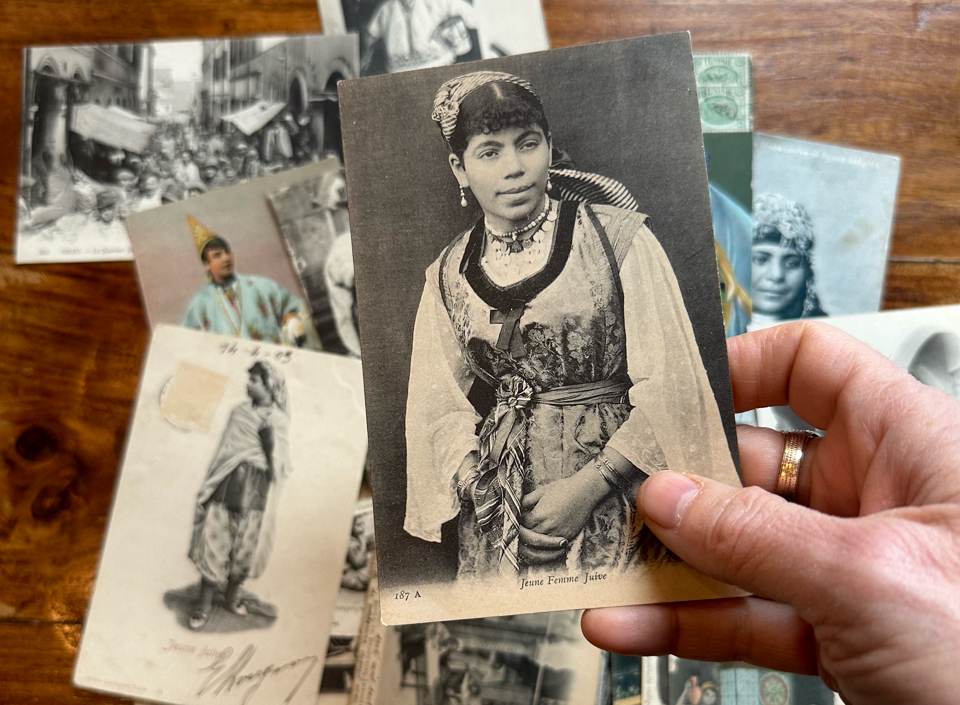
The effect, Azoulay perceptively demonstrates, was quite literally to disembody. In her own photos of Algerian-Jewish jewelry, bracelets and necklaces are always hanging on human beings, on their arms and necks and torsos; in the French catalogues they hover in the air against a white background, numbered for ease of reference. These colonial inventories “sought to make sure that both unruly people and unruly objects were under control,” Azoulay writes. The scholars who compiled them imagined that they could isolate the “pure” form of each piece, capturing what was essential so that French jewelers could replicate the art, ideally using machinery for mass production. But this colonial dream was always impossible. By wrenching these objects from the hands of their creators and their social world, colonialism sought to transform those objects and that world into something else entirely.
In Discourse on Colonialism (1950), Aimé Césaire developed the notion of the imperial boomerang: the repression that colonial powers perpetrate abroad ultimately gets unleashed at home. Jewelers of the Ummah identifies something like the reverse phenomenon within European history: the creation of internal colonies at home preparing the dominating power to erect external colonies abroad. Before the French did this to the Algerians, that is, they did it to themselves—to French Jews, and even to French Christians. Just four decades before the colonization of Algeria, in a frenzy of anti-religious sentiment, French revolutionaries of the First Republic suppressed the Catholic Church, nationalized its property, and abolished the Gregorian calendar (instituted by Pope Gregory XIII in 1582), purging its names and holidays of old gods and reorienting time itself—away from the Christian liturgy, toward the atheism of the Cult of Reason and the rationalist deism of the Cult of the Supreme Being.
Emperor Napoleon Bonaparte in turn abolished the Republican calendar in 1805, even though it was “too late” for him to ever be King of France. “It was by making myself a Catholic that I won the war in the Vendée,” he had said, “by making myself a Moslem that I established myself in Egypt, by making myself an ultramontane that I turned men’s hearts toward me in Italy. If I were to govern a nation of Jews I would rebuild the Temple of Solomon.” It is a striking token of imperial prerogative that Napoleon, a born and baptized Catholic, could speak of “making himself a Catholic” (and even an ultramontane, a papist par excellence), notwithstanding his excommunication in retaliation for his annexation of the Papal States.
Whatever this man was, he subjugated Catholics, Protestants, Muslims, and Jews. Like conquerors throughout history, he called this subjugation “emancipation,” and everywhere there were those who were drawn to this promise and those who saw through it. Azoulay mentions the Egyptian campaign, famously documented by the historian and scholar Abd al-Rahman al-Jabarti. Faced with a conqueror who proclaimed allegiance to liberté, egalité, and fraternité, al-Jabarti responded by rejecting those things. Nor was he swayed by Napoleon’s boast that he had defeated Islam’s old enemy, the Pope. As al-Jabarti saw it, that only meant that Napoleon was not a Christian at all but some new thing—a traitor to all religions, including Christendom.
Al-Jabarti’s suspicions were mirrored in European regions that Napoleon conquered, within their own local contexts. Thanks to Napoleon’s export of the principles of the Revolution, religious minorities in the conquered territories—Protestants in Catholic-majority areas, Catholics in Protestant ones, as well as Jews everywhere—were “emancipated” in the sense that they could pursue higher education and enter professions previously closed to them. But after Napoleon’s defeat in 1815, these changes were rolled back and permanently identified with the hated French. Religious qualifications were reintroduced, and reaction was the order of the day. The counterrevolutionaries of Prussia, Bavaria, and the Papal States would have understood al-Jabarti perfectly.
This was never a simple story of checkered progress, of two steps forward and one step back. The “emancipators,” including such luminaries as the Abbé Grégoire in France and Christian Wilhelm von Dohm in Prussia, understood individual Jewish rights as contingent upon collective Jewish disappearance. Emancipation was tied to “regeneration” and “civic improvement,” upon the Jews’ becoming useful, loyal lovers of the state, as indistinguishable from Christians as possible in their appearance, speech, demeanor, and customs. These were the explicit terms of the deal, and it did not take twentieth-century postcolonial theory to see it. Supposedly isolated, “uneducated” Jewish communities in the Russian empire grasped the stakes perfectly well. Hasidic masters lined up on both sides of the question, some seeing Napoleon as a potential liberator from tsarist oppression and agent of messianic return to the land of Israel, while others—most notably the Alter Rebbe, founder of Chabad Hasidism—saw him as a rebel against God.
Ultimately, the French made this same offer to Algerian Jews, though only after subjecting them to the same colonial violence and dispossession as Algerian Muslims. Azoulay is emphatic on this last point, intensely preoccupied with debunking the myth that Algerian Jews jumped at the opportunity to ally themselves with the colonizers. Drawing on work by scholars like Joshua Schreier and Sarah Abrevaya Stein, as well as her own research, she describes four decades of failed struggle on the part of the French to win voluntary allegiance, culminating with the imposition of citizenship by force with the Crémieux Decree of 1870, which granted citizenship to most Algerian Jews (excluding southern, Saharan Jews) during the Franco-Prussian War. Jews from France who had already taken Napoleon’s deal played a key role in this struggle, founding the Alliance Israélite Universelle (AIU) in 1860. Their aim, as an AIU circular from 1896 put it, was to “send a ray of light from Western culture to the communities that have become ossified in the course of hundreds of years of repression and backwardness.” The AIU pursued this mission civilisatrice through education, promoting French language and culture primarily to Algerian Jewish children. Azoulay calls these AIU teachers, along with the rabbis sent from the Central Consistory of France to supplant the local religious authorities, “converts to a new form of being-a-Jew.”
Another of her central arguments is that the Algeria created by anticolonial struggle converted its people to a parallel new form of being-a-Muslim, a nation-state form dispossessed of its Jewish past. In other words, the new Algerian government collaborated with the French in defining Algeria as Muslim and Jews as European; indeed it achieved independence in part by sacrificing its Jews. Suspicion had intensified during the revolution, Jews being perceived as aligned with the French given the grant of citizenship; by 1957 the FLN had shifted away from its earlier position that Jews were integral to Algeria and began attacking Jewish institutions. In this way, Azoulay suggests, all the Arab governments that cast suspicion on their Jewish populations in the wake of the birth of the State of Israel were and remain complicit with Zionism and the longer-term colonial project of Europe. The point has occasionally been recognized in the halls of Arab power, and not just by the PLO; in 1975 the government of Iraq invited all Iraqi Jews to return, promising full citizenship rights. But to repeat Memmi’s words from that same year, it was by then perceived as “too late.”
Azoulay seizes on moments from her family history that highlight resistance to colonial domination. Her grandfather Joseph deserted the French army during World War I; her great-grandmother Marianne decided in 1895 to name her daughter Aïcha (as if to say, in one of Azoulay’s many memorable chapter titles, “Fuck you, France, my daughter is Islam”), even if that daughter grew up to name her own son—Azoulay’s father—Roger Lucien. Jewelers thus weaves together broad colonial dynamics with intimate, familiar ones, both brutal and delicate.
Nationalization, like racialization, is always ongoing. It is never only, or merely, a fait accompli. And it is because it is continually taking place that it can be resisted.
Craft is the knot that ties these threads together. For Azoulay, craft represents embeddedness, the complete life that colonizers cut apart by separating “religion” from “ethnicity” from “citizenship” from “economic activity” from “language” from “culture” and on and on. Her picture is of a prelapsarian harmony undone by decade after decade of domination. As “the jewelers of the ummah,” Algerian Jews were at one with their life-world, in the manner of all indigènes. Colonial divide-and-rule worked relentlessly over 130 years to shatter it—not only to erase it but to erase the erasure, destroying the very memory of Jews as African, Algerian, and indigenous. The products of this process were either individuals of “Jewish” faith, fit to be citizens of Western liberal countries, or “Jews,” members of a national entity fit to colonize Palestine. Azoulay’s central purpose is to reject this dichotomy.
This brings us full circle, back to the challenge she poses to the “progressive” left. Craft has often been portrayed as the very paradigm of romantic nostalgia—the first victim of technological supersessionism—while Luddism is widely seen as the epitome of the lost cause. On this, liberal capitalist progressivism and “orthodox” Marxism have always agreed. Next to their scientific and technological realism, the idealism of the great champion of craft, the English socialist William Morris, has always been derided as fuzzy. “People interested . . . in the details of the arts of life feel a desire to revert to methods of handicraft for production in general,” Morris wrote in 1888. “It may therefore be worth considering how far this is a mere reactionary sentiment incapable of realization, and how far it may foreshadow a real coming change in our habits of life.” This is Azoulay’s problem as well: the possibility of reviving and restoring a murdered culture.
For her, resistance to something as massive and insidious as the “too late” of colonial temporality, the imposed running-forward of historical time, begins with personal practice. She stops thinking of herself as Israeli, as Mizrahi, and instead thinks of herself as a Palestinian and Algerian Jew. She teaches her hands to make the motions her ancestors made, to create jewelry. And of course, she speaks and writes to the dead, hoping through conversation with Marianne, Roger, and her mother Zahava as well as with Hannah Arendt, Frantz Fanon, and Ghassan Kanafani to come to an understanding with the past. All this is based on the premise that since the colonial project continues in the present, it continues precisely in us. Nationalization, like racialization, is always ongoing. It is never only, or merely, a fait accompli. And it is because it is continually taking place that it can be resisted, in ways that may not require imagining a utopian turning back of the clock or undoing of what has been done. Azoulay knows the possibility will strike many as even more remote, even more belated, amid the destruction of Gaza; she completed the manuscript before the violence had erupted. Still she believes that “Palestine can still be the site of the ultimate collapse of this crusade.”
In the swamp of social media, the word “RETVRN,” with its substitution of an ancient Roman “V” for “U,” is now used to mock—viciously or playfully, depending on context—a certain type of reactionary obsessed with classical aesthetics and eager to roll back modernity. For readers whose primary understanding of the left is “progressive,” Azoulay’s approach to decolonization may seem uncomfortably close to this sensibility. “We must return to what colonialism has deprived us of,” she writes. At the end of the book, she imagines the granddaughter of a character in Kanafani’s 1969 novella Returning to Haifa resisting what domination has wrought by reclaiming the name of her Arab ancestors:
The return has already started. Here I am . . . breaking the Zionist spell over my body, over the land, over our prophetic powers. These are powers that can assist us in healing, in immersing ourselves in the seven years of repair the Torah calls for, renewing our gratitude to our life among others, respecting the balance and secrets of the world and living under their mantle.
I would invite readers inclined to dismiss all this as flagrant or feeble romanticism to consider that the distance between Morris and Marx has been overstated. Marx, after all, wrote in Capital that in “manufacture and handicrafts, the workman makes use of a tool, in the factory, the machine makes use of him.” His grandfather was a rabbi; his father, who began practicing law after being “emancipated” by Napoleon, had to enter the Christian Evangelical church of Prussia to maintain his career after Napoleon’s defeat. Little wonder he was able to perceive liberalism as an ambiguous form of “progress,” and after all the set of people moved by the Communist Manifesto’s critique of capitalism for destroying what we cherish—“all that is solid melts into air, all that is holy is profaned”—has long included conservatives.
For myself, I do not need Marx’s authority to license Azoulay’s potential history of the Jewish Muslim world, or Shlaim and Hayoun’s rejection of Memmi’s claim that it is “too late to be Arab Jews.” I think instead of the way the rabbinic sages of Palestine and Babylonia grappled with the question of resurrection in the wake of their own destruction and loss, not just of the Temple but the entire way of life associated with ancient Judaism. They began with the simple acknowledgment of the Jewish daily liturgy that resurrection is God’s business: Blessed are You, YHVH our God, who makes the dead live. In their clever and wise way, however, they went on to identify other times in life when this phrase should be recited. Upon waking up in the morning, they said, one should thank God for resurrection. A day of rain, when the land is nourished, is akin to resurrection. Seeing a friend one has not seen for a year, one thanks God for resurrection.
In sanctifying these mundanities with the dignity of the most extreme miracle, the rabbis tell us that we should not be so haughty with our assumptions about what is possible, or where the line lies between human power and the divine. In the everyday, practical work of our hands, the world where the highest value is to “see the light” may vanish.
Independent and nonprofit, Boston Review relies on reader funding. To support work like this, please donate here.