
Reviewed:
Wages for Housework: The Feminist Fight Against Unpaid Labor
Emily Callaci
Seal Press, $30
The Next Shift: The Fall of Industry and the Rise of Health Care in Rust Belt America
Gabriel Winant
Harvard University Press, $19.95 (paper)
Care: The Highest Stage of Capitalism
Premilla Nadasen
Haymarket, $49.50
Every morning in 1968, Mariarosa Dalla Costa woke at four to take the early train from her home in Padua to Porto Marghera, an industrial city facing Venice across the lagoon. In dawn air thick with toxic smoke, she would stand outside the petrochemical factories, distributing material for the Marxist group Potere Operaio (“Workers’ Power”). The leaflets were copied by the women, who worked late into the night cranking the handle of the mimeograph machine, but they were written by, for, and about working men. Factory workers, they urged, should throw down their tools and overthrow capitalism. All well and good. But something made Dalla Costa uneasy: her Marxist boyfriends thought the liberation of women could wait until after the liberation of the proletariat. “These men,” she later confided to her friend Selma James, “continue to prevent me to understand deeply and deeply and deeply.”
James, thirteen years older, certainly would have empathized. The child of Brooklyn union stalwarts, she married a factory worker and had her first child at eighteen, caring for him around her shifts, in factories where she packed marshmallows and soldered radios alongside women who sang the jingles of rival brands as they worked. In 1955 she left her husband to move to London with Trinidadian activist and historian C. L. R. James, thirty years her senior. After the early, adventuring years of their relationship, they became mostly housebound; James longed to go out dancing but stayed home, debating the cause and tending to her husband’s fragile health. They separated, ultimately divorcing, and she formed a Marxist women’s reading group. The story of exploitation in Capital focused on industrialization: men leaving their homes for the factory, forced to work for someone else’s gain. Yet James had seen for herself that women fared worse under capitalism than men, whether in the factories of Los Angeles, the council houses of London, or the slums of Trinidad. Why were they missing in Marx?
The state knew that if push came to shove, mothers—unlike, say, striking coal miners—would have to retreat from the picket line to take care of their loved ones.
Dalla Costa met James on a trip to London in 1970; as the two began reading, writing, and corresponding, they began to develop a theory of capitalism from the other side. Where did women—always feeding, washing, rocking children to sleep—fit into the great drama of human history? As factories opened, women were pushed into feminized ghettos, financially dependent on men even as they did the labor at home that made breadwinning possible. So when production moved beyond the home, women were alienated from it, too. Out of this understanding, the two women—along with collaborators such as Sylvia Federici and Wilmette Brown—forged the rudiments of a Marxist feminism focused, as James put it, on “housework, the work that produced workers—the basic ingredient of all industry, and of all profit.”
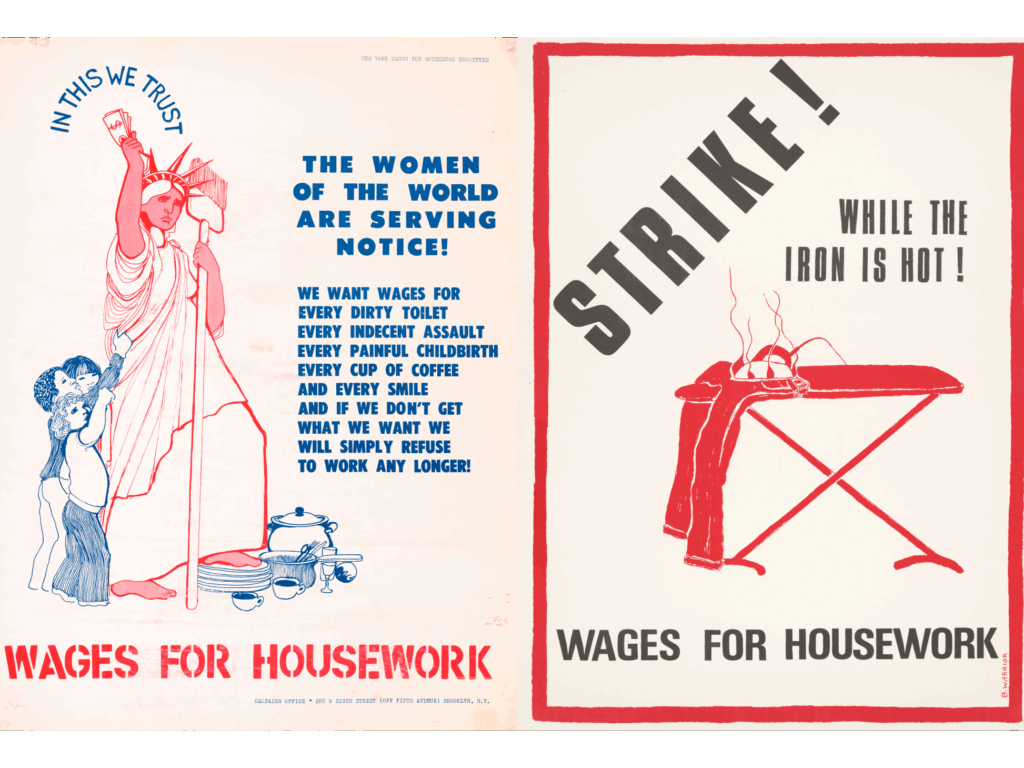
Thus “Wages for Housework” was born—the phrase would serve as the movement’s name, theoretical North Star, and rallying cry. Paying women for domestic labor, they argued, would break the cycle of exploitation for everyone. If profit was shared between waged workers and the people whose work produced them, women could be free. They might leave their husbands, share child care, and dissolve the traditional family. If they did, men would no longer be trapped by the obligation to provide for women and children, and could strike without fear. Wages for housework was a means, and its end was the destruction of capitalism.
That hasn’t happened, of course. On the contrary, over the half century since the movement reached its zenith, care work has become less the unseen precondition of capitalist labor than the embodiment of it. Factories have closed. Stay-at-home housewives have become much more the exception than the rule. And paid care work, from laundering to nursing to nannying, food preparation to janitoring, by some estimates now accounts for some 25 percent of GDP in the United States. The wish that women’s care work be waged seems to have come true, albeit in funhouse-mirror form: legions of women now work in low-paid roles caring for other peoples’ families, while the vast majority still take care of their own families for free.
How did we get here? Has Wages for Housework been proven wrong, and could things have turned out otherwise? The three books discussed here provide essential windows into the changing relationship between capitalism and care, offering important lessons for the future of left feminism.
Emily Callaci’s Wages for Housework offers the most comprehensive history to date of the slogan that became a movement, chronicling these feminist utopias, the thinkers that dreamed them, and the obstacles to their achievement. By 1971 Dalla Costa had given up waiting outside factories, opting instead to seek out the wives of workers in their homes, while chores were done and babies were bounced on hips.
While men at least had the camaraderie of the union hall and the factory canteen, women’s lives were atomized: each cooked her own family’s meals and washed her own doorstep. “We demand communal canteens,” Dalla Costa wrote, “and the canteen should serve our needs, not just become like the lunchrooms of factories, which shuttle workers through only to make them more productive.” A designer as well as a dreamer, she imagined neighborhoods organized around shared childrearing, elder care facilities woven into community life, communal laundries alongside the canteens. Life would no longer serve profit but life itself. Work that sustained life and work that created goods would be less rigidly divided, and a twenty-hour working week would allow everyone to participate in care and still have time for other endeavors.
But where would the wages come from, and how could women demand them? In Belfast in 1974, Rose Craig, one of dozens of working-class women interviewed by the movement, had an idea. If factory workers could strike against their bosses by downing tools, then women should strike against the state by abandoning their dependents. A mother of three, Craig calculated that the government budgeted £8.15 per child per week in foster care. If every poor mother surrendered her children to the state, she asked, “How much is it going to cost the government after four or five weeks? . . . They’ll have to give in to you.” The next year, in Iceland, women tested the principle in a one-day strike. Ninety percent refused all labor, paid and domestic. Beds went unmade. Schools stayed shut, and factories became chaotic crèches. Shops sold out of sausages, which even the most incompetent father could cook and even the fussiest child would eat. In the strike’s wake, child care provision expanded, the wage gap decreased, and Iceland soon became the first country in the world to elect a woman president.
Other women’s strike movements thrived—and faltered. Just as many men hesitated to strike on the grounds that their dependents relied on their wages, the bargaining of housewives was limited by love. Instead of striking, many women practiced micro-abandonments of duty. Near Milan in 1974, Milli Gandini let dust gather on the countertops and refused to cook for her children. She took her saucepans, painted them bright colors, drilled holes in the lids, and bound them shut with barbed wire. She made a friend who cooked perfect risotto. The women merged their households and, sharing dinner and saving time, they made art. It was, on the smallest scale, the kind of canteen and crèche utopia that Dalla Costa had envisaged. Care shared was care halved, and the time taken back could be used for the creative and transcendent.
Less privileged women, Callaci shows, tried to build infrastructure. Looking to the fuller child care and maternal benefits of social democratic Europe, a splinter group in the United States, Black Women for Wages for Housework, focused on the state. Since 1935, New Deal–era America had offered Aid to Families with Dependent Children (AFDC), but until the 1960s Black families were largely excluded from the cash handouts because the scheme did not include agricultural or domestic laborers. Many Southern states also made receipt of AFDC dependent on maternal “morality,” barring women who they claimed were having sex outside of marriage. Applied selectively, in Louisiana these morality clauses excluded some 95 percent of Black families in poverty. In the 1960s, as a response to the civil rights movement, some aspects of AFDC were federalized, meaning states could no longer invent and enforce their own policies. The response was backlash. All of a sudden, the “welfare mother”—always portrayed as Black—became a shorthand for promiscuity, dependency, and a threat to the family. Single women raising children alone were decried as drains on the state.
For Margaret Prescod, a founding member of Black Women for Wages for Housework, the precariousness of welfare exposed all heterosexual partnership for what it was: coercion. By campaigning for full, universal benefits—a wage conditioned on nothing but the provision of care—the group struck at the conceit that some women were more deserving than others. Single mothers had always troubled patriarchal capitalism, which channeled unemployment benefits and medical care through a male breadwinner. Using a Wages for Housework framework, Prescod and her fellow activists argued that the single mother is not a burden but a producer; state support a payment owed, not charity.
But in addition to virulent racism, the group faced another structural obstacle. When the state refused to support working-class mothers, they got second and third jobs and continued to survive in the margins. Withholding their labor was not an option: they continued caring for their children, whether the state supported them or not. This was the double-bind of care under capitalism. For a single day of jubilant protest, Icelandic women could feel comfortable handing their families one sausage-based supper, but marginalized mothers like Craig and Prescod weren’t going to abandon their children more permanently. Potent though they were, the Wages for Housework movement’s threats always remained just that. The state knew that if push came to shove, mothers—unlike, say, striking coal miners—would have to retreat from the picket line to take care of their loved ones.
The motto of the New York–based Domestic Workers Union, founded by a coalition of Black and immigrant women in 1989, was, and remains, “Tell Dem Slavery Done.”
The same was not necessarily true of their husbands. Not all husbands were loved ones, and many women had to care for them out of sheer economic need. Understanding that bind, Black Women for Wages for Housework built radical coalitions with women for whom the purely economic necessity of care was most explicit: lesbian feminists and sex workers. Lesbians, who faced custody battles if they left their marriages, were forced into compulsory heterosexuality, their love for the children keeping them bound to male partners they did not want. Sex workers, meanwhile, made the labor of heteropatriarchal capitalism explicit, by demanding a wage. “All work is prostitution,” Prescod and her collaborators wrote. “We are forced to sell our bodies—for room and board or for cash in marriage, on the street, in typing pools or in factories.”
The first campaigns of Black Women for Wages for Housework focused on the plight of single student mothers on welfare. In New York, state-funded child care for low-income women was halted if they began college. This, Prescod believed, ran contrary to the principle that raising children was work in itself. It also effectively barred poor, usually Black, mothers from education, trapping them in the very poverty portrayed as a drain on the state. Prescod, who had built solidarity between the queer community, Black women, and sex workers, reached out to the suburban housewife. They, too, should support the principle of welfare as wage, she argued: to reject it would be to deny the worth of their own work, too. “Although the government tries to isolate our struggles,” declared the women of Wages for Housework, “we refuse to be divided.”
But just as this fledgling coalition began to grow, the state itself was changing. “Wages for Housework was perhaps never more alien from the zeitgeist than in the 1980s,” Callaci writes. By then, the economic shocks of the 1970s had reshaped production, eroding the factory-worker core that had been so central to Marxist theory. This strain of feminism had been forged in an era of social democracy, taking for granted both a specific mode of production and a particular kind of state—one that mediated between unions and employers, supported the unemployed, and enabled many white working-class families to live on a single wage. In Britain and in the United States, that kind of state did not last. Callaci’s endpoint is the fragmented attempts of the Wages for Housework movements to fight spending cuts that further impoverished women. In The Next Shift, Gabriel Winant carries an analysis of care, work, and worth across the radical break represented by the 1980s, from postwar to the present. In his story, there is continuity. Social democratic welfare states, he argues, midwifed their own demise.
In postwar Pittsburgh, the rhythm of housework was tied to the rhythms of industrial labor. White, working-class housewives ran to collect laundry from the line when the steel plant whistles sounded, announcing that jet-black smoke from the chimneys was about to fill the sky. They handwashed industrial grease out of overalls since it was too thick to pass through washing machines. They stayed up late, or got up early, to cook for husbands, fathers, and brothers returning from the shifts at 2 a.m. When the men were out at work, or slept at home with the curtains drawn, front steps, laundromats, and small sitting rooms became women’s spaces. They built faith communities and close-knit friendships and shared the care of children and elders. But family came first, and the shape of the family depended on the factory.
Before the postwar steel boom, men earned less, more women had gone out to work, and families had lived in intergenerational configurations. As men came to earn more, families fragmented into individual, picket-fenced houses, and women were drawn back into the home. Winant features the voices of the children who grew up in this era. They remember speaking in whispers, tiptoeing around resting fathers, keeping arguments out of sight of watchful grandparents. The muted world of women and children grew louder when the slow rumble and warning whistles of the factory stopped. When a major strike stopped production and pay for months in 1959, older pre-war patterns of community and economy briefly returned. Women took in mending and shared canned foods saved from times of plenty. Their thrift and solidarity enabled men to fight for better pay and, vitally, better benefits. Factory workers won wages paid by steel, but benefits were paid in part by a state keen to keep the chimneys smoking.
In other words, the Fordist family wasn’t just created by factories and the family wage but by the social security that workers were afforded by the state in times of hardship. A level of protection against illness and unemployment, at least in the short term, drew women into the home. They didn’t need to work when times were good and had a buffer against the bad. But at home, they were not idle; in postwar white, working-class families, women took on an ever-greater share of caring labor, with standards of housework rising alongside the arrival of washing machines and vacuum cleaners. Gender roles became even more rigid. Meanwhile, families became less porous, turning first to the state in times of hardship rather than to kin.
Winant reveals a double irony. Thanks to the social norms it promoted—and the self-sacrificing, caring women it relied on—this kind of ruggedly individualist family was poised to endure the eventual rollback of the state that had enabled its creation. When the state stepped back, women were primed to step in. In other words, the degree of social democracy achieved in the postwar era, especially for white families, effectively greased the wheels for the state’s later retrenchment and turn to austerity. In principle, the collective action of unionized workers—made possible by the unpaid solidarity of women—might have won lasting improvements to pay and welfare entitlements. Instead, these things deepened the dependence of families on themselves and women on their husbands, leaving them more isolated and less collectively organized.
And then the factories began to close. The economic shocks of the 1970s demanded radical solutions, and neoliberal economists, who had been waiting in the wings with their big idea since the 1940s, were invited to experiment. Unions came under attack. State services—the kind that Wages for Housework imagined might be expanded toward a feminist utopia—were cut back. Reagan cut welfare budgets by around $20 billion in 1981–82, including reducing the value of food stamps, cutting free school meals for over a million children, reducing the value of AFDC and allowing states to tie its benefits to “workfare” schemes. These changes were formalized under Clinton, who in 1996 changed AFDC to Temporary Assistance to Needy Families (TANF), writing in the requirement to seek work or work, and the time limited nature of the assistance.
But throughout this age of neoliberal retrenchment, Medicaid remained—and its benefits, won in part through union-negotiated contracts, now support an aging working class. As workers’ bodies deteriorated, and younger generations moved away chasing new jobs, the care that former factory workers’ failing hearts and hardened arteries needed went beyond what wives and daughters could provide at home—and in any case, these women were themselves out working, following the collapse of the breadwinner wage.
The result is that health and social care is now the largest employment sector in the United States, accounting for one in seven jobs nationwide. In former industrial cities—Detroit, Cleveland, Milwaukee, Baltimore, Philadelphia—the rate in 2017 was one in five. Nationally, women comprise about 80 percent of workers in this sector. And though the care is waged, the wages are poor. Super-hospitals keep costs low by hiring via agencies and paying by output rather than hours. In 2013, the University of Pittsburgh Medical Center claimed to have no employees. Five years later, secretarial staff began being paid for words typed rather than time spent. Other workers heave bodies on and off beds, launder sheets, wipe away blood and tears.
These employees are the former housewives and daughters of Rust Belt America. The ethos of love’s labor was exported straight from the home to the care home. Wives of Pittsburgh factory workers in the 1980s recalled that hospital work came naturally: they had been taught to work (“we scrubbed clothes by hand”) and to love (“I like helping people”) by their mothers. In Halifax, England, in 1985, a hospital laundry worker chose to imagine that the shirt collars she starched and the sheets she bleached belonged to her husband. How else to make sense of the intimacy and the filth of such poorly paid work? Prescod argued that married women were coerced into loving their husbands; in similar fashion, low-waged workers are coerced into caring.
Caring for former workers once the factories had closed left women yet again cleaning up after industrial capitalism: not washing grease out of overalls but wiping sputum from the faces of former steel workers with pneumoconiosis, a lung condition created by metallic dust. And as they did so, care itself became monetized. Medicaid provided long, comfortable hospital stays and round-the-clock nursing for blue-collar workers. In 1983 Medicaid was reformed, ostensibly to cut federal spending. In fact, the reform provided a fresh impetus for intervention: instead of treatment and care being reimbursed at cost (plus a percentage as profit), diagnoses were given fixed price tags, incentivizing dramatic intervention and rapid discharge.
Just as the state was being rolled back, large surgical hospitals emerged as its main beneficiaries, serving an aging but well-insured former industrial population. New Deal welfarism proposed that the state would foot the bill for care. The Wages for Housework movement argued that these payments should go to women. Neoliberalism ensured that private corporations—not female workers—would collect them.
Of course, care was a source of profit long before private health care and mega-hospitals. In her provocative and illuminating new book, Care: The Highest Stage of Capitalism, Premilla Nadasen traces the origins of care work to plantation slavery. In this system, profit did not just arise from the sale of cotton harvested by the enslaved: bearing babies and patching up the labor-worn also played a central role. It’s here where Nadasen rejects the Marxist framework of feminists like James and Dalla Costa. Care was never solely about providing for workers; it was its own factory.
Workers who pack their children’s lunches for free and then go out to tend to the frail bodies of elders for pay can demand fairer pay for their waged labor.
Nadasen draws a general lesson: the labor of care, she argues, has always been both the provisioning of capital and the creation of capital itself. For her, the concept of “social reproduction”—the idea that care is a precondition of profit—thus does less than “racial capitalism” in explaining the contemporary economics of care. During American slavery, in empires, and in the era of segregation and social democracy, the populations on whom profit relied—Black and brown people—never had reliable health care, eldercare, or child care. Indeed, the insecurity of care made them exploitable, left them to the mercy of the market, made them accept work that barely allowed them to feed their children. These conditions, of course, also applied to the poorest white members of U.S. society, particularly women. Nadasen doesn’t deny this but argues that the treatment of enslaved people, migrant laborers, and minorities reveal something about capitalism and care writ large: that care is a commodity extracted for profit from society’s most precarious people.
The precarity of the caring class was orchestrated by design, in Nadasen’s view. For care to be profitable, its cost must be below the cost of its provision. Under slavery, in empires, this was achieved by force; after empires fell, it was extracted in the form of what sociologist Arlie Hochschild calls “global care chains,” in which immigrant women, driven by vast and deeply entrenched global economic inequalities, leave their children in the care of relatives to care for the families of others in the Global North. Care profit in the United States left a care deficit elsewhere in the world. The abundance of care for the wealthy left the poor without. Today, Nadasen argues, domestic workers experience conditions not unlike the slavery of their ancestors. The motto of the New York–based Domestic Workers Union, founded by a coalition of Black and immigrant women in 1989, was, and remains, “Tell Dem Slavery Done.”
The family economies of care this creates in the Global North are disorganized and patchy. Domestic workers are employed by families as well as by the giants of the neoliberal care industry; profit is distributed. Nadasen argues that every cent between what a nanny, a cleaner, a fast-food restaurant worker, an eldercare assistant is paid, and what their employer is paid during the time they would have spent on the outsourced familial task, is unfairly extracted. Slavery, colonialism, and our contemporary care economy rely on the same thing: a group of people from whom care can be taken, with little or nothing given in exchange. This continues to work in the United States due to migrant laborers and an uninsured underclass, a precariat, who tend to patients in hospitals they could never access, or care for children in daycare centers that their own children could not attend.
But something has changed. Our contemporary care economy may be the latest expression of racial capitalism, but it does not directly extend the practices of slavery. Though it made profit from human bodies, slavery geared social reproduction toward the creation of them: healthy babies made strong workers. In the liberal feminist understanding, care’s value lies in the labor it frees other women up to perform. The oft-repeated formulation of campaigns for state-funded child care is that more child care means more women working means more dollars in the economy means more GDP: a win-win-win-win. Both Nadasen and Winant point to a much more fundamental shift across the last fifty years. It is not the productivity of bodies but their decay and decline—the aging population of the last generation of industrial workers—that has become a new source for profit. Since 1965, for-profit hospitals have benefitted from the state, being paid an additional percentage for each patient they care form each patient they treat, as profit. Though the math and mechanisms of payment changed in 1983, profit from state-funded care has continued to grow. In the 1980s, as the gates of steel works began to close, Winant writes, Pittsburgh’s flagship Presbyterian University Hospital opened a new, multi-million-dollar wing, as it generated wealth from the vast need of aging, unemployed steel workers.
This phenomenon— privately owned caring businesses profiting from federally funded welfare—goes well beyond Medicaid. Foster care in the United States has not just one price but several. Orphaned children with veteran parents, with special educational needs, or with ongoing health conditions, have state funding. Once the child is taken into foster care (foster carers, like all care workers, are paid a pittance), money flows into the coffers of outsourced child protective services, paid for by states. Profit—the difference between what the federal government has budgeted for the care of the child compared to the cost of that care for the outsourced provider—is extracted at every level. This creates perverse incentives: the neediest children are not supported to stay with their families but extracted by a system that understands care as a site of profit generation. Black children are twice as likely as white children to end up in foster care; it has always been clear which families can be broken in the service of capital. Little matter that fostered children are less likely to graduate high school, and more likely to be imprisoned, unemployed, or economically precarious as adults. The future citizenship of these children is sacrificed on the altar of immediate profit.
This is what Nadasen calls the “highest state of capitalism”: by commodifying care, we have worked out how to extract wealth even from those who are not creating it. But the state will not always pay. The well-insured, exhausted bodies of former factory workers won’t be with us forever. So then, there is another neat trick: debt. Some 40 percent of Americans carry medical debt; it is the number one source of debt collections. The finance industry buys this debt—from both institutions and individuals—and charges interest against it. Health care costs the poor more—as of 2022, Medicare households devote an average of 13.6 percent of annual spending on health-related expenses, while families using other forms of insurance devote an average of 6.5 percent. But if you can’t keep up payments, and debt accumulates, you will pay far more. Arrest warrants for failing to show up in court for minor medical debts are on the rise; debt for care—much like the ongoing need to care for loved ones—forces people into poorly paid work. Winant writes that “unemployment, indebtedness, and precarity . . . have become the fundamental human experience of capitalism over the past several decades.” It’s the looming threat of zero hours’ work for a cost of living you can never pay.
The Wages for Housework movement began to fragment in 1978, when James and Dalla Costa parted ways. James wanted a united front, disciplined and coherent; Dalla Costa wanted other radical movements to take what they needed from it, using its message to fuel their own struggles. James found Dalla Costa undisciplined, while Dalla Costa found James overbearing. The thirteen-year age gap between them seemed to widen with time.
What neither friend anticipated was how capitalism and the state might adapt to changing conditions without giving way to revolution or social democracy. And yet, rather than Wages for Housework’s theory having fallen out of favor, its core assumption—that the absence of care will topple capitalism—has seeped into how liberal feminists speak about the “care crisis” in the aftermath of COVID-19. If enough daycare centers and community hospitals close, if workers cannot access the care that allows them to show up and generate profit for others, if the most fundamental mechanisms of social reproduction collapse, then surely the state, or corporations, will step in to keep the economy running?
In the age of allegedly labor-saving AI, when workers appear to bosses and investors as more and more dispensable, the prospect looks remoter than ever. As for the state, the vision of one that works for the people can be especially hard to imagine. The Trump administration has hollowed out the vestiges of a more comprehensive care infrastructure, which Biden briefly boosted during the pandemic. Headline programs like Medicaid and Head Start as well as piecemeal forms of assistance that make life livable for the poorest Americans (supplemental nutrition payments, support for foster carers and their charges) have been stripped back in under a year. And now another possibility looms: the poor, the uncared-for, will continue to find ways to survive, while the profit extracted from them—not only from the care they provide but from their very need for it—grows and grows.
Where can we find hope? Callaci, Winant, and Nadasen all agree on one point: care workers must withdraw their labor where they can, to make claims for their own dignity as workers. The explosion of the care economy strengthens their hand: care is now not only quietly essential to capitalism—shirts ironed, lunches packed, new workers birthed and reared—but a site of profit in and of itself. And more, while today’s waged care worker might be doubly burdened—caring within the home and beyond it—this means that unlike her housewife foremother she is not isolated. Within a workplace, there is the possibility of organizing and collective bargaining.
And so, the next shift could well be followed by the next walkout. Workers who pack their children’s lunches for free and then go out to tend to the frail bodies of elders for pay can demand fairer pay for the part of their labor that is already waged. This kind of collective care strike—rather than those envisaged by Wages for Housework—would be a collective crisis. Instead of the private shame of unwashed clothes, the private grief of children taken into care, a care strike of the already waged would force a change at the level of institutions, the state, the economy.
Wages for Housework was right to see a pathway to liberation through the valuating of care. But, by beginning that struggle outside the home—fair pay for care work rather than wages for housework—we might begin to raise the value of care across the board. When outsourced care becomes more costly, in-home care might finally be seen as the essential labor that it is and be more fairly shared. To arrive at the communal crèche and canteen, we must begin at the picket line.
Independent and nonprofit, Boston Review relies on reader funding. To support work like this, please donate here.