
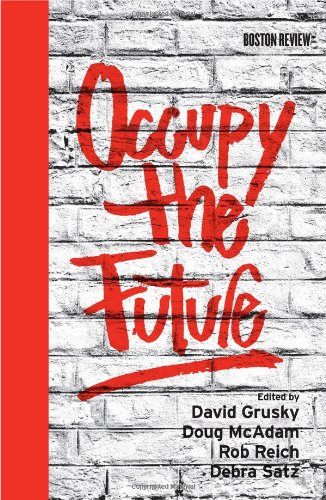
The Occupy Wall Street movement has ignited new questions about the relationship between democracy and equality in the United States. Are we also entering a moment in history in which the disjuncture between our principles and our institutions is cast into especially sharp relief? Do new developments—most notably the rise of extreme inequality—offer new threats to the realization of our most cherished principles? Can we build an open, democratic, and successful movement to realize our ideals?
Occupy the Future offers informed and opinionated essays that address these questions. The writers—including Nobel Laureate in Economics Kenneth Arrow and bestselling authors Paul and Anne Ehrlich—lay out what our country’s principles are, whether we’re living up to them, and what can be done to bring our institutions into better alignment with them.
Contributers: David Grusky, Doug McAdam, Rob Reich, Erin Cumberworth, Debra Satz, Kenneth J. Arrow, Kim A. Weeden, Sean F. Reardon, Prudence L. Carter, Shelley J. Correll, Gary Segura, David D. Laitin, Cristobal Young, Charles Varner, Doug McAdam, Paul R. Ehrlich, Anne H. Ehrlich, Paul R. Ehrlich and Anne H. Ehrlich, Donald A. Barr, Michele Elam, Jennifer DeVere Brody, H. Samy Alim and David Palumbo-Liu.